
Choosing a replacement watch strap can be confusing because band width, strap length, wrist circumference, and watch case size all describe different measurements. Watch band sizes help you find a strap that attaches securely to your watch and fits comfortably around your wrist. Most traditional straps use millimeters to identify their width, while their length determines how comfortably they fasten.
Apple Watch bands follow a separate sizing system based on case compatibility and wrist circumference. Understanding these measurements makes it easier to replace an old strap, choose a suitable bracelet, or find the correct Apple Watch band without guessing.
Watch Band Sizes at a Glance
- Definition: Watch band sizing describes the width, length, and fit measurements needed to match a strap to a watch and wrist.
- Main measurements: Lug width, strap length, wrist circumference, and buckle width.
- Most important distinction: Band width determines whether the strap fits the watch; band length determines whether it fits the wrist.
- Common misconception: A 20mm watch case does not automatically require a 20mm strap. The relevant measurement is the lug width.
What Watch Strap Measurements Actually Mean
A watch strap has several dimensions, and each serves a different purpose. The first is lug width, which measures the space between the inside edges of the watch case lugs. This determines the width of the replacement strap where it attaches to the watch.
The second is strap length. On a traditional two-piece leather or rubber strap, manufacturers often list two measurements, such as 120/75mm. The first number represents the longer section, while the second represents the shorter section. These measurements generally exclude the buckle.
Wrist circumference is the measurement around your wrist where you normally wear your watch. It helps determine the appropriate strap length.
Finally, buckle width describes the narrow end of the strap where it connects to the buckle. A strap may taper from 20mm at the watch to 18mm at the buckle.
These measurements are not interchangeable. A strap can have the correct attachment width but still be too short or too long for your wrist.
[readmore url=”https://wristaurahub.com/vortic-watches/”]
Standard Watch Strap Widths and Their Measurements
Traditional watch straps are generally measured in millimetres. Common attachment widths include 16mm, 18mm, 20mm, 22mm, and 24mm, although smaller, larger, and odd-numbered measurements are also available.
The following chart provides a practical reference for common strap widths.
| Strap width | Approximate inches | Typical application |
|---|---|---|
| 14mm | 0.55 in | Small watches |
| 16mm | 0.63 in | Compact dress watches |
| 18mm | 0.71 in | Smaller everyday watches |
| 19mm | 0.75 in | Selected vintage and modern watches |
| 20mm | 0.79 in | Common everyday watches |
| 21mm | 0.83 in | Selected sports and dress watches |
| 22mm | 0.87 in | Larger everyday and sports watches |
| 24mm | 0.94 in | Larger cases and rugged designs |
These are strap attachment widths, not wrist measurements or watch case diameters.
A 20mm strap is a common choice, but that does not make it a universal replacement. Always check the manufacturer’s specifications or measure the watch lugs before ordering.
How Strap Width Changes Across Watch Styles
Different watch designs use different attachment widths to maintain visual balance.
- Dress watches: Often use relatively narrow straps that complement slimmer cases.
- Field watches: Commonly use practical widths such as 18mm, 20mm, or 22mm.
- Dive watches: Often use wider rubber, silicone, or metal bracelets.
- Chronographs: May use wider straps to balance their larger cases.
- Vintage watches: Can have unusual or odd-numbered lug widths that need precise measurement.
The case design matters, but the actual lug measurement should always determine your replacement strap width.
How to Measure Watch Band Sizes Correctly
You do not need professional equipment to measure a traditional watch strap. A metric ruler, flexible measuring tape, or digital caliper is usually enough.
1. Measure the Lug Width
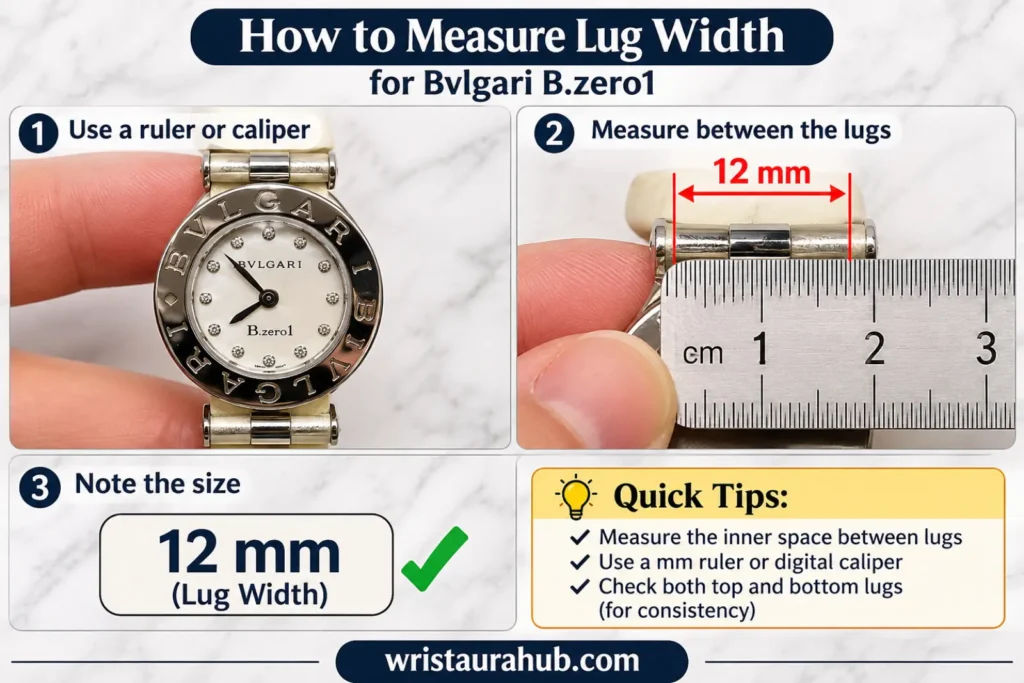
Remove the existing strap if possible. Look at the two metal lugs where the strap connects to the watch case.
Measure the distance between their inside edges using a ruler or caliper. Record the measurement in millimetres.
For example:
- 18mm lug width requires an 18mm strap.
- 20mm lug width requires a 20mm strap.
- 22mm lug width requires a 22mm strap.
Avoid measuring the outside edges of the lugs. Doing so produces an incorrect measurement and may lead to a strap that does not fit.
2. Measure Your Wrist Circumference
Wrap a flexible measuring tape around your wrist at the point where you normally wear your watch.
Keep the tape comfortably snug rather than pulling it tightly against your skin. Record the measurement in centimetres or inches.
If you do not have a measuring tape, use a piece of string or paper. Mark where the ends meet, then measure the marked length against a ruler.
3. Check Your Existing Strap Length
If your current strap fits comfortably, remove it and lay both sections flat.
Measure the longer and shorter sections separately, excluding the buckle. Compare these measurements with the replacement strap’s listed dimensions.
This method is particularly useful when replacing a leather strap with another leather strap of similar construction.
4. Check the Buckle Width
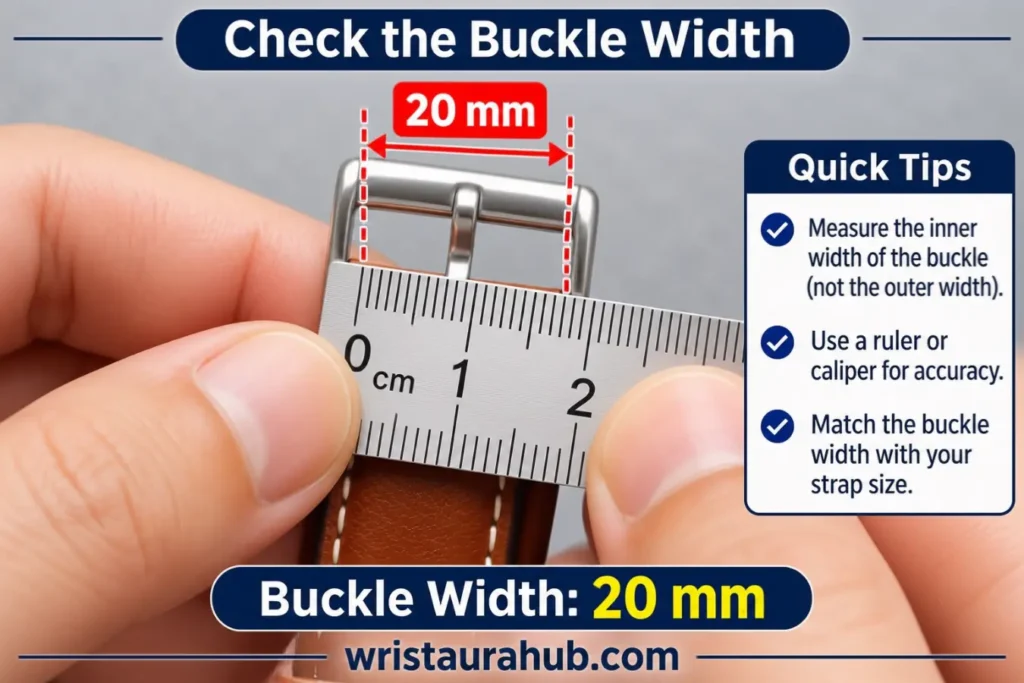
Some straps become narrower toward the buckle. A strap listed as 20/18mm has a 20mm attachment width and an 18mm buckle-end width.
If you intend to reuse your existing buckle, check that its internal width matches the new strap.
Watch Band Sizes Chart: Wrist Circumference in Inches and Millimetres
Wrist circumference is useful when selecting a strap length. The following reference groups common wrist measurements into practical fitting categories.
| Wrist circumference (inches) | Wrist circumference (mm) | General fit category |
|---|---|---|
| 5.5–6.0 | 140–152 | Very small |
| 6.0–6.5 | 152–165 | Small |
| 6.5–7.0 | 165–178 | Medium |
| 7.0–7.5 | 178–191 | Medium to large |
| 7.5–8.0 | 191–203 | Large |
| 8.0–8.5 | 203–216 | Extra large |
These categories are general fitting references, not universal manufacturer sizes. Actual strap length depends on the watch case, strap construction, buckle position, and available adjustment holes.
For example, two people with a 7-inch wrist may need different strap lengths if one wears a large watch case and the other wears a smaller one.
[readmore url=”https://wristaurahub.com/fossil-watches-for-men/”]
Understanding Strap Length Labels
Traditional two-piece straps often use measurements such as:
| Strap length | Longer section | Shorter section |
|---|---|---|
| Short | 105mm | 65mm |
| Regular | 115mm | 75mm |
| Long | 125mm | 85mm |
| Extra long | 130mm | 90mm |
These are illustrative length combinations, not standardized wrist-size guarantees. Manufacturers may use different measurements and sizing labels.
If your wrist falls between two options, compare the actual strap dimensions and the manufacturer’s stated wrist range rather than relying on S, M, or L alone.
Apple Watch Band Sizes and Compatibility Chart
Apple Watch uses a different system from traditional watch straps. Instead of measuring only the lug width, buyers must consider two things: the watch case size and the wrist circumference supported by the particular band.
Apple also groups compatible bands across certain case sizes. According to its official compatibility guidance, the general groups include:
| Apple Watch case size | Compatible band case-size group |
|---|---|
| 38mm, 40mm, 41mm | Compatible with one another |
| 42mm, 44mm, 45mm | Compatible with one another |
| 46mm | Compatible with 44mm, 45mm, and 46mm |
| 49mm | Compatible with 44mm, 45mm, and 46mm |
These compatibility groups are based on Apple’s published guidance. Check the exact band listing before purchasing, especially for newer case generations and specialist bands. Apple Support (IN)+1
Understanding Apple Watch Band Lengths
Apple Watch bands come in several styles, and their sizing labels vary.
Sport Band: Uses adjustable fastening holes and commonly comes in S/M and M/L options. Some current configurations also offer XL sizing.
Sport Loop: Uses a hook-and-loop fastening system, allowing more flexibility in adjustment.
Solo Loop: Uses a continuous stretchable design. It requires a specific numerical size rather than a conventional buckle adjustment.
Braided Solo Loop: Also uses numerical sizing, but its woven construction can feel different from a traditional adjustable strap.
Alpine Loop and Trail Loop: Use their own size labels and wrist measurement ranges, particularly on Ultra models.
Ocean Band: Uses an adjustable tubular design intended for Apple Watch Ultra models.
Do not assume that every Apple Watch band uses the same wrist-size chart. The fit depends on the band style and its specific product listing.
Apple Watch Band Sizes in Inches
Apple generally publishes wrist measurements in millimetres. You can convert those measurements into inches by dividing the millimetre value by 25.4.
Here are some useful conversions:
| Wrist measurement (mm) | Approximate wrist size (inches) |
|---|---|
| 130mm | 5.12 in |
| 140mm | 5.51 in |
| 150mm | 5.91 in |
| 160mm | 6.30 in |
| 170mm | 6.69 in |
| 180mm | 7.09 in |
| 190mm | 7.48 in |
| 200mm | 7.87 in |
| 210mm | 8.27 in |
| 220mm | 8.66 in |
For example, Apple’s current 46mm Sport Band listing gives the S/M option a wrist range of 140–190mm and the M/L option a range of 160–210mm. That is approximately 5.5–7.5 inches and 6.3–8.3 inches, respectively. Check the exact style and listing because these ranges are not universal across all Apple Watch bands. S/M+1
How Apple Watch Band Sizing Works
The easiest way to understand Apple Watch sizing is to separate case compatibility from wrist fit.
First, identify the case size printed in your watch specifications. Then find a band designed for a compatible case-size group.
Next, measure your wrist and compare it with the band’s stated minimum and maximum circumference. If you are choosing a Solo Loop or Braided Solo Loop, follow Apple’s numerical sizing instructions instead of guessing based on S/M or M/L.
Apple provides a printable sizing tool that helps users determine their Solo Loop size. Print it at 100% scale, wrap it around your wrist, and follow the measurement instructions. Printing it with page scaling enabled can produce an inaccurate result. Apple
How to Choose the Right Band for Your Wrist
The best strap should fit securely without pinching your skin or moving excessively.
Consider these factors before selecting a replacement:
- Small wrists: Look for shorter strap lengths and adjustable fastening systems. Avoid oversized strap tails that extend too far beyond the keepers.
- Medium wrists: Standard strap lengths often provide enough adjustment, but check the listed circumference range.
- Large wrists: Consider long or extra-long straps and verify the maximum wrist measurement before purchasing.
- Active use: Rubber, silicone, and fabric straps can offer practical comfort and easy adjustment.
- Formal wear: Leather straps and slim metal bracelets often create a cleaner appearance.
A watch should sit securely without restricting circulation. For Apple Watch, the fit also needs to maintain consistent contact between the back of the case and your skin for wrist detection and sensor functions.
[readmore url=”https://wristaurahub.com/best-watches-under-300/”]
Common Mistakes When Choosing a Replacement Strap
Confusing Case Diameter With Lug Width
A 40mm watch case does not automatically require a 40mm strap. Case diameter and lug width describe different dimensions.
Assuming All Apple Watch Bands Are Universal
Apple Watch bands have compatibility requirements. A band that fits one case-size group may not fit another.
Ignoring Strap Length
Getting the correct width is only half the job. A strap can fit the watch perfectly but remain uncomfortable because its length is unsuitable.
Treating S, M, and L as Standard Measurements
Different manufacturers use different sizing systems. Always check the actual measurements instead of assuming every medium strap has the same length.
Measuring With a Loose Tape
A loose measuring tape can produce a larger wrist measurement than your actual circumference. Keep it comfortably snug and measure at the normal wearing position.
The Final Talk
Choosing a replacement strap becomes much easier once you understand the difference between lug width, strap length, and wrist circumference. Traditional watches require the correct attachment width and suitable strap length, while Apple Watch owners must also check case compatibility and the specific band’s wrist range.
The simplest rule is to measure first and purchase second. A few minutes spent checking the dimensions can prevent an incompatible strap, an uncomfortable fit, and an unnecessary replacement.
Frequently Asked Questions
Apple Watch bands come in different case-compatible groups and wrist-fit options. Depending on the style, sizing may include S/M, M/L, XL, or numerical sizes for Solo Loop and Braided Solo Loop bands.
Apple Watch bands are available for several case sizes, including 38mm, 40mm, 41mm, 42mm, 44mm, 45mm, 46mm, and 49mm. Compatibility depends on Apple’s specified case-size groups and the individual band design.
Measure the inside distance between the watch lugs to determine the attachment width. Then measure your wrist circumference with a flexible tape to estimate the strap length you need.
Yes. Apple’s compatibility guidance lists 44mm and 45mm bands within the same general compatibility group. However, always verify the specific band design before purchasing.
No. Traditional watch straps generally use millimeters for attachment width, but strap lengths and size labels vary between manufacturers. Some watches also have integrated or proprietary strap connections.
A watch band should feel secure without digging into your skin or restricting movement. You should be able to wear it comfortably throughout the day without excessive sliding or pressure.
Discover More to Learn
Swiss Pocket Watch: Types, Brands & Makers
Movado Watches for Men: Best Collections, Styles & Value
[authorbox]