
What if your next watch came with a piece of American history already inside it?Vortic watches are far more than timekeepers—they’re wearable pieces of American watchmaking history. By transforming antique American pocket-watch movements into modern wristwatches, Vortic creates designs that feel genuinely different from the typical Swiss or Japanese options.
Its American Artisan Series pairs carefully restored vintage movements and dials with modern cases handcrafted in Fort Collins, Colorado. But before buying one, it’s worth knowing which Vortic style suits you, whether its distinctive larger cases will fit your wrist, and whether the vintage character and craftsmanship make the price worthwhile.
What Are Vortic Watches Known For?
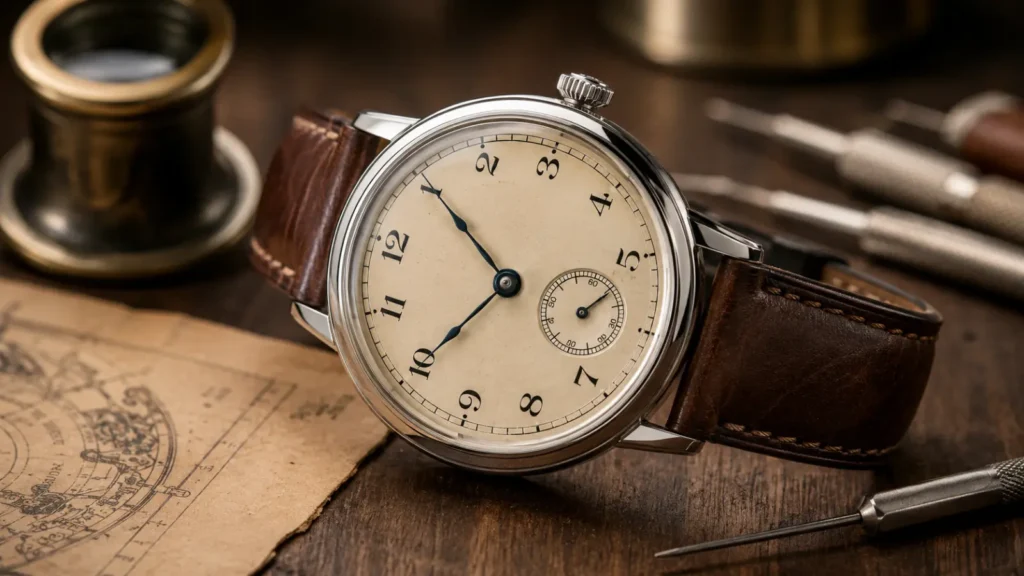
Vortic watches are best known for repurposing antique American pocket watches into one-of-a-kind wristwatches. Rather than simply copying vintage styling, Vortic uses original movements, dials, and hands from old American pocket watches and places them inside newly manufactured cases.
The concept gives the watches something most new mechanical watches cannot easily reproduce: genuine age. A dial may carry decades of patina, while the movement itself can date back to the early 20th century.
Vortic’s current workshop is in Fort Collins, Colorado, where the company builds its watches and continues developing its manufacturing capabilities. The company traces its beginnings to 2013, when founders R.T. Custer and Tyler Wolfe began developing the idea of combining antique American pocket-watch movements with modern manufacturing technology.
The result is closer to wearable Americana than a conventional dress or sports watch.
Why Are Vortic Watches Different?
The strongest argument for Vortic is not movement accuracy, finishing comparable to a Swiss luxury manufacture, or technical complications. It is provenance.
Each American Artisan Series watch can contain a vintage movement and dial rescued from an American pocket watch dating from roughly the 1880s through the 1950s. Vortic restores and tests these movements before fitting them into its modern cases.
That approach creates several characteristics worth understanding before buying:
- Antique mechanical movements: Most American Artisan pieces use restored, manually wound pocket-watch movements.
- One-of-a-kind construction: Individual watches can have different movements, dials, finishes, and historical details.
- Large cases: Many Vortic pieces are substantially larger than conventional everyday watches.
- American manufacturing: Vortic builds its wristwatches in Fort Collins, Colorado.
- Modern case technology: The brand has used titanium 3D printing, CNC machining, and other modern manufacturing methods alongside vintage movements.
- Historical dials and hands: The original dial and hands are retained when the watch is converted.
This is why comparing Vortic directly with a mainstream mechanical brand can be misleading. You’re buying an object with two timelines: an antique movement and a modern wristwatch case.
7 Best Vortic Watches to Consider
There isn’t a conventional seven-model lineup in the way you’ll find at brands such as Seiko, Hamilton, or Tissot. Vortic’s inventory consists heavily of individual numbered pieces, with different movements and dials giving each watch its own identity. Current and recent examples show prices ranging from roughly $2,600 to $6,000-plus, depending on the piece and construction.
Here are seven representative Vortic watches and series worth knowing.
1. Vortic Lancaster Series — Best Overall Choice
The Lancaster is arguably the easiest Vortic family to recommend because it captures the brand’s concept without necessarily going as large as the 51mm Railroad models.
Recent Lancaster examples include 45mm and 47mm cases, with vintage Hamilton movements appearing in several pieces. One Lancaster 097, for example, uses a 47mm sandblasted titanium case, sapphire crystal, leather strap, and a manually wound Hamilton movement from the vintage pocket-watch era.
Spec snapshot:
- Movement: Restored vintage American manual-wind movement
- Case: Stainless steel or titanium, depending on piece
- Size: Commonly around 45–47mm
- Crystal: Sapphire on the cited Lancaster 097
- Water resistance: Often limited; the Lancaster 097 is rated at 1 ATM
- Price: Recent examples roughly $2,600–$6,000+
Best for: Buyers who want the classic Vortic experience without automatically choosing the biggest case.
2. Lancaster 005 — Best for Vintage Character
The Lancaster 005 is a particularly interesting example because it began life as a 1924 Hamilton pocket watch before being converted into a wristwatch.
Its sandblasted stainless-steel case, polished bezel, coin-edge detailing, and vintage Hamilton movement create a convincing blend of old and new. Vortic lists the watch at $3,000, although individual availability changes as these pieces sell.
Spec snapshot:
- Movement: Antique Hamilton manual-wind movement
- Original source: 1924 pocket watch
- Case: Sandblasted stainless steel
- Size: 45mm
- Price shown by Vortic: $3,000
Best for: Someone who wants the strongest possible connection between the original pocket watch and the finished wristwatch.
3. Springfield Series — Best for American Watchmaking History
The Springfield watches take their name from Springfield, Illinois, and use movements sourced from historical American watch manufacturers. The Springfield Railroad 025, for example, uses an Illinois Watch Company movement dating to 1923.
The appeal here is the movement story. Instead of getting a newly manufactured caliber designed to look vintage, you’re getting an actual historical mechanism.
Spec snapshot:
- Movement: Restored antique American movement
- Examples: Illinois Watch Company and other historical manufacturers
- Case sizes: Commonly around 45mm, with larger Railroad variants
- Style: Vintage Americana
- Price: Recent Springfield pieces have appeared around $4,500 and higher
Best for: Collectors who care more about provenance than conventional modern specifications.
4. Boston Series — Best for Railroad Heritage
The Boston line is particularly compelling for fans of American railroad-watch history. Vortic has produced Boston pieces using vintage Waltham movements, including Railroad Edition examples.
The Boston Railroad 025, for instance, uses a Waltham movement, a 51mm machined-bronze case, sapphire crystal, and leather strap. Vortic lists it with 1 ATM water resistance.
Spec snapshot:
- Movement: Vintage Waltham manual wind
- Case: Bronze on the cited Railroad 025
- Size: 51mm
- Crystal: Sapphire
- Water resistance: 1 ATM on the cited example
- Price shown: $5,000
Best for: Railroad-watch enthusiasts and collectors who aren’t intimidated by oversized cases.
5. Chicago Series — Best for Elgin Collectors
The Chicago collection provides another route into historic American watchmaking. The Chicago Railroad 039, for example, contains an Elgin Watch Company movement, original dial, and original hands from a vintage pocket watch.
The cited example has a 51mm case, bronze crown and hardware, sapphire crystal, stainless-steel case back, and leather strap. Its manually wound Elgin movement is listed with approximately 36 hours of power reserve.
Spec snapshot:
- Movement: Vintage Elgin manual wind
- Size: 51mm on the cited Railroad example
- Crystal: Sapphire
- Water resistance: 1 ATM
- Price shown: $4,000
Best for: Buyers who specifically appreciate Elgin and early American watchmaking.
6. Lancaster Railroad — Best Oversized Vintage Pick
If the standard Lancaster is not dramatic enough, the Lancaster Railroad pushes the concept further.
The Lancaster Railroad 018 uses a Hamilton movement and dial from 1926 inside a DLC titanium case. Vortic describes it as a one-of-a-kind conversion and lists it at 51mm.
Spec snapshot:
- Movement: Vintage Hamilton manual wind
- Movement year: 1926 on the cited example
- Case: DLC titanium
- Size: 51mm
- Style: Railroad-inspired
- Price shown: $5,000
Best for: Large-wristed collectors who want maximum visual impact.
7. Cleveland Railroad — Best for Rare Movement Stories
The Cleveland Railroad series is another strong choice if the movement’s origin matters more than having a conventional modern caliber.
The Cleveland Railroad 011 contains a vintage Ball Watch Company movement, with Vortic using the city name because the historical manufacturer was located in Cleveland. The cited piece has a 51mm case and is listed at $5,000.
Best for: Serious Vortic collectors who enjoy researching the history behind the movement inside the case.
Vortic Watches Compared
| Vortic family | Typical character | Case size examples | Movement style | Best for |
|---|---|---|---|---|
| Lancaster | Classic, versatile Vortic | 45–47mm | Vintage American manual wind | First Vortic |
| Springfield | Illinois/American heritage | Around 45mm+ | Vintage American | History-focused collectors |
| Boston | Railroad heritage | 45–51mm | Often Waltham | Railroad enthusiasts |
| Chicago | Elgin/Chicago connection | Around 51mm in Railroad models | Vintage American | Elgin fans |
| Lancaster Railroad | Oversized, dramatic | 51mm | Vintage Hamilton examples | Large wrists |
| Cleveland Railroad | Rare historical character | 51mm | Vintage Ball examples | Collectors |
| Burlington | Less common historical route | Varies | Vintage American | Niche collectors |
The important point is that Vortic watches are not mass-produced references where every example has identical specifications. Size, movement, dial, case material, water resistance, and price can vary significantly from one numbered watch to another.

Are Vortic Watches Good Quality?
Yes, but their quality should be judged differently from a conventional Swiss or Japanese mechanical watch.
Vortic’s strongest quality advantage is the combination of restored historical movements and modern case manufacturing. The company says its American Artisan cases incorporate processes including titanium 3D printing and CNC machining, while the watches are assembled individually in Northern Colorado.
The weak point is the age of the movement. A restored antique pocket-watch caliber is inherently a different ownership proposition from a modern ETA, Sellita, Miyota, or Seiko movement. Service and parts availability can require more specialist knowledge, and performance should not be judged purely against a modern movement’s specifications.
The water resistance is another area where buyers need realistic expectations. Individual models can have low ratings; examples on Vortic’s site include 1 ATM. That makes many pieces better suited to dry everyday wear than swimming or serious outdoor use.
Pros
- Genuine antique American movements
- Often original vintage dials and hands
- One-of-a-kind character
- Modern American-made cases
- Strong historical story
- Interesting alternative to conventional luxury watches
- Highly collectible concept
Cons
- Very large cases on many models
- Antique movements aren’t as convenient as modern calibers
- Limited water resistance on many examples
- Prices can reach several thousand dollars
- Availability is unpredictable because many watches are unique
- Not the obvious choice for someone prioritizing technical specifications
Vortic Watches vs Hamilton: Which Is Better?
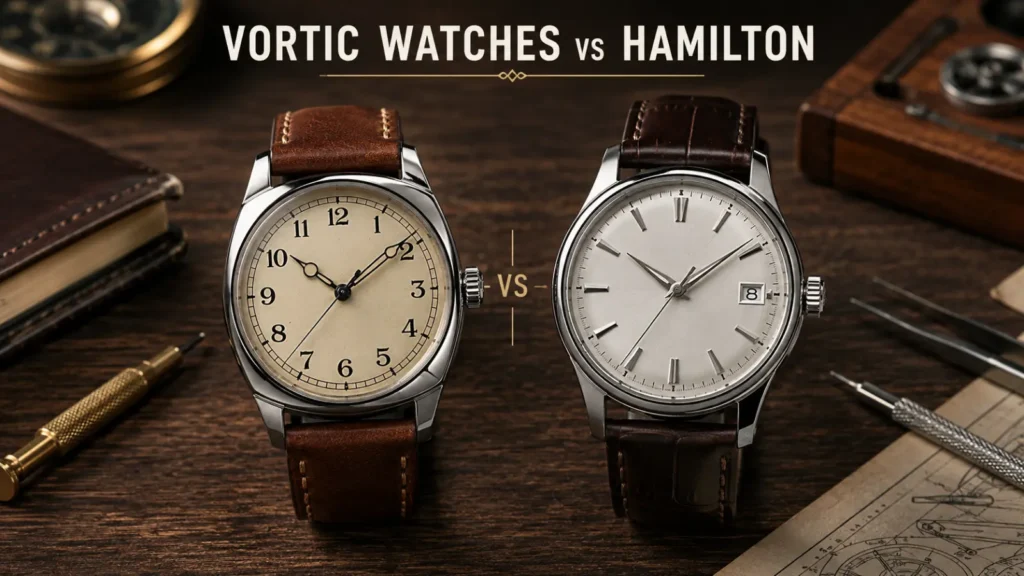
Hamilton is the better choice if you want a conventional everyday mechanical watch. Vortic is the more interesting choice if your priority is historical provenance and individuality.
Hamilton offers standardized collections, modern movements, familiar sizing, and much broader availability. Vortic instead takes antique American pocket-watch movements and preserves them in newly manufactured wristwatch cases. That makes the two brands almost opposites in terms of buying philosophy.
| Factor | Vortic | Hamilton |
| Core appeal | Historical one-off watches | Modern watches with strong heritage |
| Movements | Restored antique American pocket-watch movements | Modern mechanical/quartz movements depending on model |
| Availability | Limited and individual | Broad |
| Sizing | Often very large | Much wider range |
| Water resistance | Varies; often limited on vintage conversions | Generally more practical across modern collections |
| Collectibility | Strong individuality | Strong brand/model history |
| Best buyer | History-focused collector | Everyday mechanical-watch buyer |
If you want one watch to wear everywhere, Hamilton is usually the safer decision. If you want a conversation piece that preserves an actual piece of American watchmaking history, Vortic watches are far more distinctive.
Who Should Buy Vortic Watches?
Vortic watches make the most sense for buyers who see a mechanical watch as an object of history rather than simply a precision instrument.
They are particularly appealing if you enjoy vintage American watchmaking, pocket watches, unusual independent brands, or American manufacturing. The concept also works well for collectors who already own conventional Swiss and Japanese watches and want something completely different.
A Vortic is less convincing if you need a slim office watch, high water resistance, modern automatic convenience, or an easy-to-service movement available at almost any watchmaker.
Before buying, ask yourself:
- Can I comfortably wear a 45–51mm watch?
- Do I value the history of the movement more than modern movement technology?
- Will I actually use the watch in situations where its water resistance matters?
- Am I comfortable paying several thousand dollars for a one-of-a-kind piece?
- Do I prefer individuality over having an easily replaceable reference?
If most answers are yes, Vortic becomes a much easier recommendation.
Common Mistakes to Avoid When Buying Vortic Watches
The biggest mistake is treating every Vortic reference as if it has the same specifications. Because the brand works with individual antique movements and dials, you need to examine the exact watch you’re buying.
A few other mistakes can turn an otherwise excellent purchase into a frustrating one:
- Ignoring case diameter: A 51mm Vortic is a serious wrist presence. Check the actual dimensions rather than relying on product photographs.
- Assuming vintage means fragile or modern means waterproof: The exact case construction and water-resistance rating matter more than the age of the movement alone.
- Expecting modern automatic convenience: Many American Artisan watches are manually wound.
- Comparing only movement specifications: The historical movement, original dial, restoration, and one-off construction are central to the value proposition.
- Buying without researching the movement: Learn about the manufacturer and approximate era of the movement inside the exact piece.
For one-of-a-kind or resale-sensitive purchases, keep the original documentation and detailed product information. The provenance is part of what makes the watch interesting.
The Final Talk
A Vortic watch doesn’t just tell you the time—it gives you a piece of American watchmaking history to wear.
Vortic watches stand out because they turn genuine antique American pocket-watch components into modern wristwatches rather than simply copying vintage designs. The Lancaster is the most approachable starting point, while the Boston, Chicago, Springfield, and Railroad editions offer even more historical character for collectors.
Their large cases, manual-winding movements, and limited water resistance may not make them the most practical everyday watches, but that isn’t really the point. If your priority is originality, craftsmanship, and a timepiece with a story you can actually wear, Vortic watches offer something few modern brands can match.
Yes. Vortic says its American Artisan Series watches are built in Fort Collins, Colorado, using antique American pocket-watch movements and domestically produced case components and manufacturing processes.
Many Vortic American Artisan watches use restored antique American pocket-watch movements. Depending on the individual watch, the movement may come from historic manufacturers such as Hamilton, Waltham, Elgin, Illinois Watch Company, or Ball Watch Company.
Most American Artisan examples are manually wound rather than automatic. The exact winding and movement configuration should be checked on the individual product page before buying.
Not generally in the way a modern dive or sports watch is. Water resistance varies by model, and some examples are rated at only 1 ATM, so buyers should check the exact specification and avoid treating these pieces as swimming watches.
Vortic’s cases are designed around antique pocket-watch movements, which are considerably larger than many modern wristwatch movements. Some models are around 45–47mm, while Railroad editions can reach approximately 51mm.
Discover More,
anordain watches: 7 Beautiful Models Reviewed
Digital Watches for Men: 7 Best Picks for 2026
Nordstrom Watches: 7 Best Picks Worth Buying
[author]
Pingback: ATT Apple Watches: 3 Best Choices for Every Budget in 2026