
Why keep replacing watch batteries when sunlight can keep your watch running for years?A dead watch battery is a small frustration, but it can quickly become a bigger hassle when you have to reset the time, replace the battery, or worry about the watch stopping at the worst possible moment. Solar watches offer a smarter solution by converting light into energy, giving you the accuracy and low maintenance of quartz without the constant battery changes.
In 2026, solar technology is no longer limited to basic everyday watches. From affordable Casio sports models and versatile Citizen watches to rugged dive watches and remarkably thin luxury designs, there are more choices than ever. The challenge is finding the one that actually matches your lifestyle.
The right solar watch should balance movement technology, case size, crystal type, water resistance, comfort, and design. In this guide, we’ll break down the best options worth considering and the common buying mistakes to avoid before you choose your next solar-powered watch.
What Are Solar Watches?
Solar watches are quartz watches that use light to generate electricity, which is then stored in a rechargeable power cell. A solar panel is typically integrated beneath the dial, allowing the watch to recharge from sunlight as well as artificial light.
Unlike a conventional quartz watch that relies on a disposable battery, a solar model is designed to replenish its stored energy whenever it receives sufficient light. Citizen’s Eco-Drive technology, for example, can use natural or artificial light and can keep a fully charged watch running for months in darkness.
That makes solar quartz particularly attractive for people who want a watch they can pick up, wear, and forget about.
How Solar Watch Technology Works
The basic process is straightforward:
- Light passes through or reaches the solar cell beneath the dial.
- The cell converts light into electrical energy.
- The energy is stored in a rechargeable power cell.
- The quartz movement uses that stored energy to regulate the watch.
- When the watch is kept in darkness, it continues running from its reserve until the stored energy is depleted.
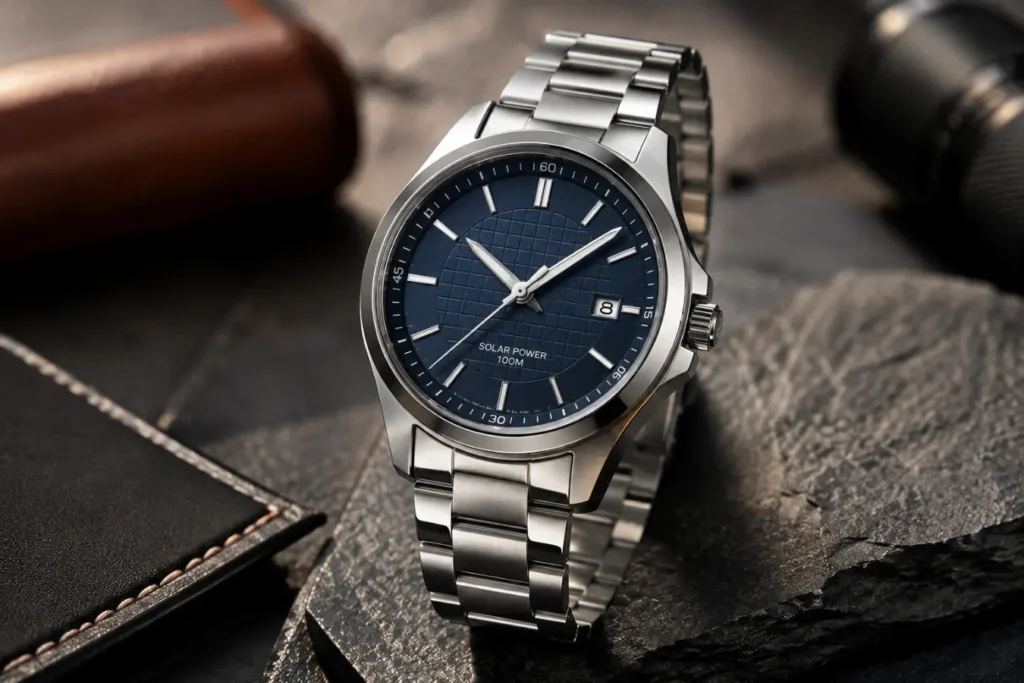
The technology has become sophisticated enough that the dial does not have to look like a visible solar panel. Modern solar watches can have conventional-looking sunburst, textured, black, blue, or even dress-watch dials.
Best Solar Watches for 2026
Not every light-powered watch is designed for the same job. Some prioritize toughness, others thinness, diving capability, travel functions, or everyday comfort.
| Solar watch | Movement | Water resistance | Case size | Best for |
|---|---|---|---|---|
| Citizen Promaster Dive BN0266-07E | Eco-Drive E118 | 200m | 40.6mm | Diving |
| Citizen Zenshin Three-Hand AW0130-85X | Eco-Drive J800 | 100m | 39mm | Everyday wear |
| Seiko SNE483 | Solar V157 | 100m | 43mm | Everyday/sport |
| Seiko SNE543 | Solar V157 | 200m | 46.7mm | Diving/sport |
| Casio AQ-S810W | Tough Solar | 100m | Varies by model | Budget/travel |
| Casio Pro Trek PRG-340 | Tough Solar | 100m | Outdoor-focused | Hiking/outdoors |
| Citizen Eco-Drive One AR5064-57L | Eco-Drive 8826 | 50m | 38.6mm | Luxury/dress |
Specifications and current pricing can vary by reference and market, so always check the manufacturer’s listing before purchasing.
1. Citizen Promaster Dive BN0266-07E
If you want one solar watch that can genuinely handle serious water use, the Citizen Promaster Dive is the obvious starting point. The BN0266-07E combines an Eco-Drive movement with a 40.6mm stainless-steel case, sapphire crystal, unidirectional dive bezel, and 200-meter water resistance. Citizen also identifies it as an ISO-certified dive watch.
Spec snapshot: Eco-Drive E118, 40.6mm case, 200m water resistance, sapphire crystal, polyurethane strap, approximately $450 at the time of research.
The important advantage is that you get genuine dive-watch functionality without accepting the maintenance routine of a traditional battery-powered quartz watch.
It is the pick for swimmers, divers, beach travelers, and anyone who wants a rugged daily watch that does not feel precious.
Best for: Diving, swimming, outdoor use, everyday wear.
Watch out for: The dive-watch styling is more casual than versatile dress watches, and buyers with very small wrists should try the 40.6mm case before purchasing.
2. Citizen Zenshin Three-Hand
The Zenshin Three-Hand is where solar technology becomes genuinely stylish. Its 39mm Super Titanium case and integrated bracelet give it a modern sports-watch profile without the bulk associated with many rugged solar models.
The AW0130-85X uses Citizen’s J800 Eco-Drive movement, offers 100-meter water resistance, a sapphire crystal, and a day-date display. Citizen lists Super Titanium as five times harder and 40% lighter than conventional stainless steel.
Spec snapshot: J800 Eco-Drive, 39mm Super Titanium case, 100m water resistance, sapphire crystal, integrated titanium bracelet, around $440 current U.S. price.
This is arguably the best balance in the group. It is light enough for everyday use, refined enough for an office, and capable enough for swimming.
Best for: Everyday wear, office use, travel, buyers who dislike heavy watches.
Watch out for: It lacks the mechanical movement character that collectors often seek from traditional watches.
3. Seiko SNE483
Seiko’s solar range deserves attention because it delivers the familiar Seiko design language with a movement that is easy to live with.
The SNE483 uses the V157 solar caliber, with approximately 10 months of operating time when fully charged. It has a 43mm stainless-steel case, Hardlex crystal, date display, and 10-bar water resistance.
Spec snapshot: V157 solar movement, 43mm case, 10-bar water resistance, Hardlex crystal, approximately 10-month power reserve when fully charged.
The V157 is especially appealing because it is a straightforward, practical solar movement rather than an overly complicated system.
For someone who wants a recognizable Japanese watch with traditional analog styling and low-maintenance ownership, the SNE483 makes plenty of sense.
Best for: Everyday wear, first solar watch, Seiko fans.
Watch out for: Hardlex is practical, but sapphire is preferable if scratch resistance is a major priority.
4. Seiko Prospex SNE543
The Seiko Prospex SNE543 takes the solar formula into proper dive-watch territory. Its V157 movement provides approximately 10 months of operating time when fully charged, while the watch offers 200-meter diver’s water resistance and a unidirectional rotating bezel.
Spec snapshot: V157 solar, 46.7mm case, 200m diver’s water resistance, Hardlex crystal, silicone strap, approximately $440 on Seiko’s Middle East listing at the time of research.
There is one major catch: 46.7mm is large. The lug-to-lug measurement is more manageable than the diameter alone suggests, but this is still a substantial watch.
If you have a larger wrist or specifically want the presence of a Prospex diver, it is a compelling solar option. Smaller-wristed buyers should consider the Citizen Promaster’s roughly 40.6mm format instead.
Best for: Diving, outdoor activities, larger wrists.
Watch out for: The case is simply too large for some wrists.
5. Casio AQ-S810W
Casio proves that solar technology does not have to be expensive. The AQ-S810W combines Tough Solar charging with a practical digital-analog display, world time, stopwatch, alarms, LED illumination, and 100-meter water resistance.
Spec snapshot: Tough Solar, 100m water resistance, world time, stopwatch, multiple alarms, LED illumination.
It is not trying to compete with an elegant mechanical watch. That is exactly why it works. This is a grab-and-go tool watch designed around convenience.
For travel, outdoor use, commuting, or a first solar watch, the AQ-S810W is difficult to criticize at its price level.
Best for: Budget buyers, travel, casual wear, students, outdoor use.
Watch out for: The resin-heavy construction and sporty styling will not suit buyers looking for a premium bracelet watch.
6. Casio Pro Trek PRG-340
If your idea of a perfect watch involves a trail map rather than a boardroom, the Pro Trek PRG-340 deserves a close look.
Its Tough Solar system converts light into energy while the watch adds a digital compass, barometer, altimeter, thermometer, world time, stopwatch, countdown timer, and illumination. It is rated to 10 bar and designed around outdoor use.
Spec snapshot: Tough Solar, 10-bar water resistance, digital compass, barometer, altimeter, thermometer, world time, stopwatch, alarms.
The real strength is not simply solar charging. It is the combination of solar power and low-maintenance outdoor instrumentation. Casio specifically designed the system to provide power for multiple functions rather than merely keeping the basic time display alive.
Best for: Hiking, trekking, camping, travel, outdoor enthusiasts.
Watch out for: It is a tool watch first. If you want a slim analog watch for formal occasions, choose something else.
7. Citizen Eco-Drive One – Best Ultra-Thin Solar Watch
The Eco-Drive One shows how far solar watches can move beyond rugged sports watches. The AR5064-57L combines Citizen’s Eco-Drive 8826 movement with a 38.6mm case measuring just 3.88mm thick, sapphire crystal, Super Titanium construction, and 50-meter water resistance. Citizen currently lists it at $4,995 in the U.S.
Spec snapshot: Eco-Drive 8826, 38.6mm case, 3.88mm thickness, 50m water resistance, sapphire crystal, approximately $4,995.
This is the choice for someone who wants solar technology without the visual cues of a typical quartz sports watch.
The downside is obvious: it is expensive. You can buy several excellent solar watches for the price of one Eco-Drive One. Its appeal comes from engineering, thinness, finishing, and the novelty of combining high-end watchmaking with light-powered quartz technology.
Best for: Dressier wear, collectors, thin-watch enthusiasts, luxury buyers.
Watch out for: The price and relatively modest water resistance make it a poor choice for someone who prioritizes ruggedness.
Are Solar Watches Better Than Regular Quartz Watches?
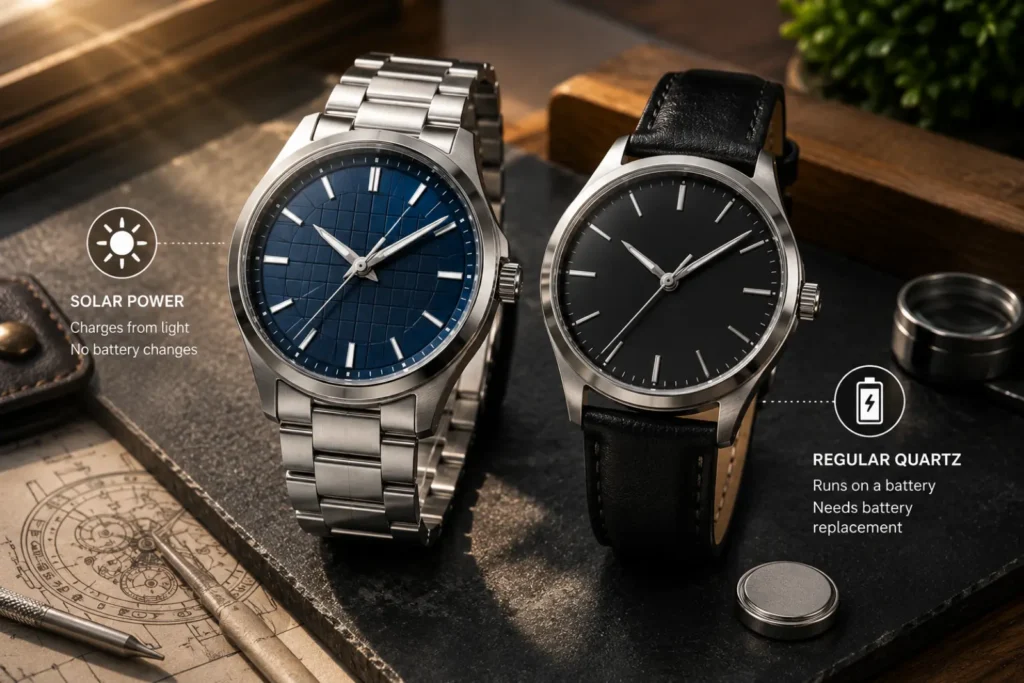
For most people, solar watches are more convenient than conventional quartz watches because they eliminate the normal cycle of disposable battery replacement.
That does not automatically make them better in every situation. A conventional quartz watch can be cheaper, thinner in some designs, and easier to maintain if the battery eventually needs replacement. Solar technology adds a rechargeable power cell and light-sensitive components to the construction.
The real advantage is ownership convenience.
A Citizen Eco-Drive, for example, is designed to run from both natural and artificial light and can operate for more than six months in darkness when fully charged.
Solar vs. Quartz
| Feature | Solar quartz | Conventional quartz |
| Power source | Light | Disposable battery |
| Accuracy | Generally excellent | Generally excellent |
| Battery changes | Normally avoided | Periodic replacement |
| Long-term convenience | Excellent | Good |
| Mechanical character | Low | Low |
| Maintenance | Low | Low |
| Ideal buyer | Set-and-forget owner | Simple, inexpensive ownership |
The choice is less about accuracy and more about convenience.
What Are the Advantages of Solar Watches?
The biggest advantage is simple: you stop thinking about battery changes.
A good solar watch can also be remarkably practical because the technology works with artificial light, not only direct sunlight. Casio’s Tough Solar system, for example, is designed to convert light from fluorescent sources as well as sunlight into stored energy.
Other advantages include:
- Low maintenance: No routine disposable-battery replacement.
- Excellent accuracy: Most are quartz-regulated.
- Long periods of autonomy: Many can keep running for months without fresh light.
- Wide price range: Options exist from inexpensive Casio models to luxury Citizen watches.
- Practical designs: Solar technology is available in dress, field, dive, travel, and outdoor watches.
- Convenience: Put the watch on and wear it without worrying about winding it.
What Are the Downsides of Solar Watches?
Solar watches are not maintenance-free forever. Their rechargeable power cells can eventually age, and the watch may eventually require professional servicing.
They also have a design limitation that mechanical-watch enthusiasts sometimes overlook: the movement is fundamentally about convenience rather than traditional horological theater.
Other drawbacks include:
- Rechargeable cells eventually age.
- A watch kept in darkness for too long can eventually stop.
- Some solar dials can limit design choices.
- Solar does not automatically mean waterproof or rugged.
- Premium solar watches can become surprisingly expensive.
- Collectors who value mechanical movements may find them less emotionally engaging.
The last point matters. A $4,000 solar watch is not automatically a better watch than a $500 solar watch. You are often paying for materials, thinness, finishing, engineering, and design rather than improved basic timekeeping.
How to Choose the Right Solar Watch
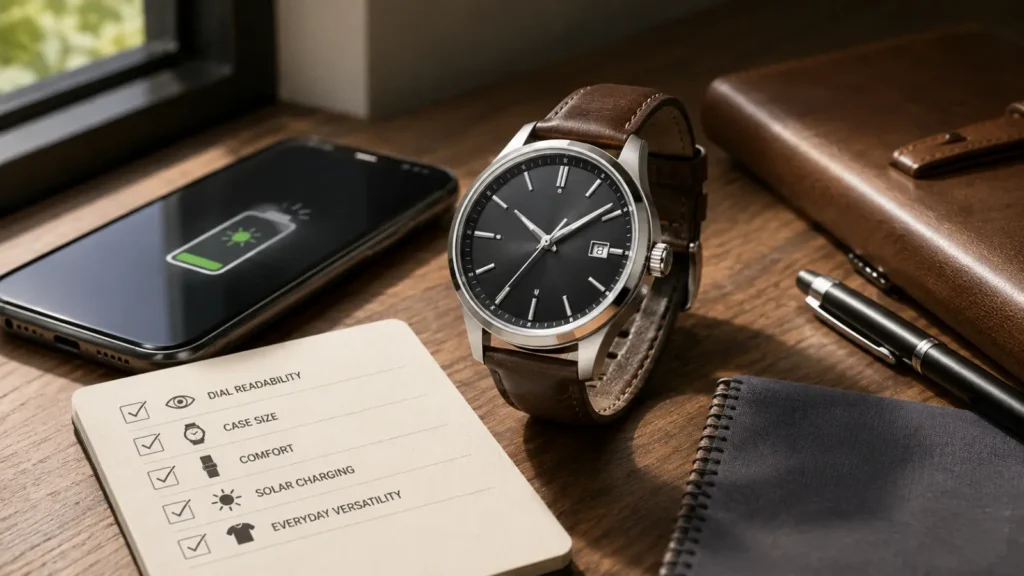
The best solar watches are not necessarily the most expensive ones. Start with how you actually intend to wear the watch.
1. Where Will You Wear It?
For office and everyday use, a 39–42mm analog model such as the Citizen Zenshin makes more sense than a large outdoor instrument.For hiking, choose something with sensors, illumination, and a rugged case.For diving, look for a genuine dive watch with appropriate water resistance and construction rather than assuming any solar watch is suitable underwater.
2. Do You Need Sapphire Crystal?
Sapphire is significantly more scratch-resistant than mineral or proprietary hardened crystals.
If you wear the watch every day and want it to look new for years, sapphire is a strong upgrade. If you are buying a budget sports watch and prioritize impact resistance and affordability, mineral crystal or Hardlex can still be perfectly reasonable.
3. How Large Is Your Wrist?
Do not judge fit from diameter alone.
Case thickness, lug-to-lug length, bezel shape, and bracelet articulation can change how a watch wears. A 46.7mm Seiko Prospex is a very different proposition from a 39mm Citizen Zenshin.
For smaller wrists, prioritize compact dimensions and short lug-to-lug measurements.
4. Do You Actually Need 200-Meter Water Resistance?
Probably not.
If you swim occasionally, 100-meter water resistance is already more useful than what most people need. If you scuba dive, however, choose a purpose-built dive watch such as the Citizen Promaster Dive rather than treating water resistance as a simple numbers game.
5. How Much Do You Want to Spend?
Solar watches cover an unusually broad price spectrum.
You can get practical Casio models for relatively little money, move into the roughly $200–$500 range for capable Seiko and Citizen watches, and spend considerably more on advanced titanium or ultra-thin models.
Do not spend more simply because a watch has solar technology. The technology itself is not rare enough to justify a huge premium.
Common Mistakes to Avoid When Buying Solar Watches
Buying a solar watch is relatively straightforward, but several mistakes can turn a convenient purchase into an unnecessary headache.
Assuming Solar Means No Maintenance
Solar avoids the normal disposable-battery replacement cycle, but the rechargeable power cell can eventually require service. Think low maintenance, not literally maintenance-free.
Assuming Sunlight Is Required
Many modern solar systems work with artificial light too. Citizen says Eco-Drive can use natural or artificial light, while Casio’s Tough Solar technology is also designed to harvest energy from indoor lighting.
Choosing Size From Diameter Alone
A large diameter does not tell you everything about fit. Check lug-to-lug dimensions and thickness before buying, especially with outdoor and dive watches.
Confusing Water Resistance With Dive Certification
A 100-meter rating does not automatically make a watch a professional dive watch. If actual diving is the goal, look for a watch specifically designed and certified for that purpose.
Ignoring the Crystal
A cheap watch with sapphire can sometimes make more practical sense than a more expensive watch with a scratch-prone crystal, particularly if you plan to wear it every day.
How Long Do Solar Watches Last?
A good solar watch can provide many years of service, but its rechargeable power cell is not immortal.
The exact lifespan depends on the movement, cell, usage, storage conditions, and servicing. Manufacturers design these systems to hold energy and repeatedly recharge rather than function like a disposable battery.
Citizen states that fully charged Eco-Drive watches can run for more than six months in complete darkness, while some models with power-saving functions can last much longer.
The practical lesson is simple: wear the watch or keep it exposed to suitable light periodically rather than storing it permanently in a dark drawer.
Are Solar Watches Worth Buying?
Yes. For most people, solar watches are among the easiest mechanical-free watches to own because they combine quartz accuracy with extremely low day-to-day maintenance.
The Citizen Promaster Dive is the strongest choice for serious water use, the Zenshin Three-Hand is the best everyday option, Seiko’s V157 models offer a strong traditional-watch alternative, and Casio dominates when practicality and outdoor functionality matter more than luxury finishing.
The only reason to skip solar is if you specifically want the craftsmanship, motion, and emotional appeal of a mechanical movement. If convenience comes first, solar is one of the smartest watch technologies available.
The Final Talk
The best solar watch is the one you forget needs charging at all.The best solar watches do more than turn light into power they make low-maintenance ownership feel effortless. Whether you want an everyday watch, a rugged companion for outdoor adventures, or a refined piece that disappears beneath a cuff, the right solar model can deliver years of reliable performance without the constant hassle of battery changes.
For most buyers, the sweet spot is a well-built solar watch in the $200–$500 range, where accuracy, durability, comfort, and value come together. If you need serious water resistance, a dedicated dive model makes more sense; if rugged practicality is your priority, a Tough Solar-style sports watch is hard to overlook. And if slimness and luxury matter most, modern ultra-thin solar technology proves that convenience doesn’t have to mean compromising on sophistication.
Ultimately, choosing the right solar watch comes down to how you actually wear it. Pick the case size, features, durability, and style that fit your routine, and the biggest benefit of solar technology becomes almost invisible: your watch simply keeps running.
FAQs
Yes, especially if you want quartz accuracy without regular disposable-battery changes. A quality solar watch can remain powered for months when fully charged and is generally very easy to live with.
No. Many solar watches can charge from artificial indoor light as well as sunlight. Citizen’s Eco-Drive and Casio’s Tough Solar systems are both designed to use multiple light sources.
It depends on the movement and model, but some can operate for several months from a full charge. Citizen states that many Eco-Drive watches can run for more than six months in complete darkness when fully powered.
They can eventually require service because rechargeable power cells and other components age. Solar technology greatly reduces routine battery maintenance, but it does not make a watch permanently maintenance-free.
Yes. Most solar watches use quartz regulation, so their accuracy is generally comparable to conventional quartz watches. The major difference is how the movement receives and stores its electrical power.
Discover More,
Digital Watches for Men: 7 Best Picks for 2026
anordain watches: 7 Beautiful Models Reviewed
Sternglas Watches: 7 Best Models You’ll Want in 2026
[author]