
A $50,000 watch isn’t automatically better than a $10,000 one—sometimes, it’s simply more expensive.The best high end watches justify their price with something you can actually appreciate: exceptional movements, hand-finishing, premium materials, distinctive design, proven heritage, rarity, or the kind of craftsmanship that makes a watch feel special every time you wear it. The wrong choice, however, can leave you paying thousands more for a name without getting meaningfully more watch.
In 2026, the luxury watch market offers more compelling choices than ever. You can go with the proven versatility of a Rolex Submariner or GMT-Master II, step into haute horlogerie from Patek Philippe, Audemars Piguet, Vacheron Constantin, or A. Lange & Söhne, or choose a less obvious piece that delivers remarkable finishing and mechanical sophistication for the money.
This guide cuts through the hype to highlight 7 high end watches worth considering in 2026—including what makes each one desirable, who it suits best, and whether its price is genuinely justified.
What Makes a Watch “High End”?
High end watches are not defined by one price threshold. In practice, the category begins where watchmaking quality, materials, finishing, exclusivity, and brand reputation become major parts of what you are paying for.
A $5,000 luxury watch and a $100,000 minute repeater obviously sit in different worlds. The important distinction is that high-end buying should be about more than the logo on the dial.
Look for:
- Mechanical quality: automatic or manually wound movements with serious engineering and finishing.
- Case materials: high-grade stainless steel, titanium, ceramic, precious metals, or platinum.
- Dial and movement finishing: hand-applied details, polished and brushed surfaces, decorative bridges, anglage, and other finishing techniques.
- Complications: GMT, chronograph, perpetual calendar, moon phase, tourbillon, and other advanced functions.
- Provenance: established watchmaking history can matter considerably at this level.
- Exclusivity: limited production and difficult-to-obtain references can increase collector appeal.
- Service support: an expensive mechanical watch deserves dependable long-term maintenance.
The biggest mistake is assuming that a higher price automatically means a better watch. It does not.
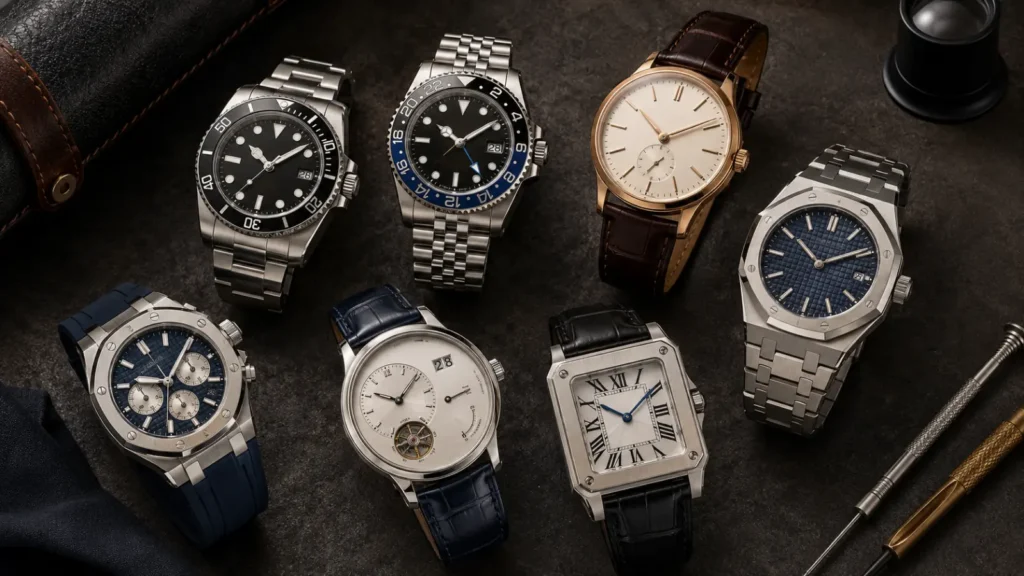
The 7 Best High End Watches to Consider in 2026
There is no single “best” luxury watch because collectors want different things. A Rolex may make more sense as an everyday watch, while an A. Lange & Söhne can be the better choice for someone focused on movement architecture and finishing.
Here are seven standout options across different types of luxury watchmaking.
| Watch | Type | Movement | Case | Approx. Price Tier | Best For |
|---|---|---|---|---|---|
| Rolex Submariner | Dive | Automatic | Oystersteel / precious metals | $11,000+ | Everyday luxury + diving |
| Rolex GMT-Master II | GMT | Automatic | Steel / gold / combinations | $11,000+ | Travelers |
| Patek Philippe Calatrava | Dress | Mechanical | Precious metal | $20,000+ | Traditional haute horlogerie |
| Audemars Piguet Royal Oak | Luxury sport | Automatic / mechanical | Steel / precious metals | $20,000+ | Iconic sports-luxury design |
| Vacheron Constantin Overseas | Luxury sport | Automatic | Steel / precious metals | $20,000+ | Versatile high horology |
| A. Lange & Söhne Lange 1 | Dress | Manual-wind | Precious metal / platinum | $30,000+ | Movement finishing |
| Cartier Santos | Dress/sport | Automatic | Steel / precious metals | $7,000+ | Design and versatility |
Price tiers are approximate and vary substantially by reference, material, market, availability, and whether the watch is new or pre-owned.
1. Rolex Submariner
The Rolex Submariner remains one of the safest choices if you want a genuinely luxurious watch that can also handle everyday life. Its combination of recognizable design, robust construction, strong resale demand, and diving heritage gives it an unusual amount of versatility.
Current Rolex listings place steel Submariner models around the low-$11,000 range in the U.S., while precious-metal versions climb considerably higher.
Spec snapshot:
- Movement: Automatic mechanical
- Case: Oystersteel or precious metals depending on reference
- Case size: 41 mm for current Submariner models
- Water resistance: Professional dive-watch rating
- Best for: Everyday luxury, diving, and collectors wanting strong brand recognition
- Price tier: Roughly $11,000+ new depending on configuration
The Submariner’s weakness is originality. You will see plenty of them. If you want something that feels personal or obscure, a smaller independent brand may be more interesting.
For a first serious luxury watch, however, the Submariner is exceptionally difficult to fault.
2. Rolex GMT-Master II
If you travel regularly, the GMT-Master II makes more sense than buying a complicated dress watch you rarely wear.
The current collection includes 40 mm models in Oystersteel, two-tone configurations, yellow gold, white gold, and Everose gold. U.S. retail pricing for current Oystersteel examples is roughly $11,800–$12,500, while precious-metal versions can exceed $50,000.
Spec snapshot:
- Movement: Automatic mechanical GMT
- Case: 40 mm
- Materials: Oystersteel, two-tone, or precious metals
- Function: Second time zone
- Best for: International travelers and collectors
- Price tier: Roughly $12,000+ new
The GMT-Master II also offers one of the strongest combinations of practical complication and luxury status.
The catch? Availability can be frustrating, and paying a large secondary-market premium can dramatically change its value proposition.
3. Patek Philippe Calatrava
If your definition of high end watches begins with understated craftsmanship rather than sports-watch hype, the Patek Philippe Calatrava deserves serious attention.
The Calatrava represents the traditional side of Patek Philippe: restrained proportions, precious-metal cases, elegant dials, and mechanical watchmaking without relying on a large collection of visible complications.
Spec snapshot:
- Movement: Mechanical, depending on reference
- Case: Precious metal
- Style: Traditional dress watch
- Best for: Formal wear and collectors who value understated haute horlogerie
- Price tier: Typically tens of thousands of dollars for modern examples
Patek Philippe’s position at the upper end of mechanical watchmaking is supported by decades of complicated-watch expertise. Its historical importance is especially apparent in complicated chronographs and perpetual calendars.
The Calatrava’s biggest drawback is also its biggest strength: it is deliberately quiet. If you want a watch that gets instant recognition across a room, a Rolex or Royal Oak is more effective.
If you want a watch that rewards close inspection, the Calatrava is a different proposition entirely.
4. Audemars Piguet Royal Oak
The Royal Oak changed the idea of what an expensive sports watch could look like. Its integrated-bracelet design, octagonal bezel, and highly recognizable dial architecture have made it one of the defining luxury watches of the modern era.
This is not the watch to buy if you want something anonymous.
Spec snapshot:
- Movement: Automatic or mechanical depending on reference
- Case: Stainless steel or precious metals depending on model
- Style: Integrated-bracelet luxury sports watch
- Best for: Collectors who prioritize design and wrist presence
- Price tier: Generally tens of thousands of dollars for current high-end examples
The Royal Oak is particularly compelling if design matters as much to you as movement technology. Its finishing and bracelet construction are central to the experience.
The downside is value. You are paying heavily for one of the most recognizable designs in luxury watchmaking, and that premium is not solely related to the cost of manufacturing the watch.
5. Vacheron Constantin Overseas
The Vacheron Constantin Overseas is one of the strongest choices for someone who wants genuine haute horlogerie without automatically reaching for a Rolex or Royal Oak.
The current steel Overseas Self-Winding is 41 mm, uses an automatic movement, carries the Geneva Seal, and offers interchangeable steel, leather, and rubber straps. Vacheron Constantin lists current versions at different regional prices, with one European listing showing €29,000.
Spec snapshot:
- Movement: Automatic
- Case: 41 mm steel for the referenced model
- Water resistance: 15 bar / 150 m
- Certification: Hallmark of Geneva
- Straps: Steel, leather, and rubber options
- Best for: High-end everyday wear
- Price tier: Around the high-$20,000-equivalent range and upward
That interchangeable-strap system makes the Overseas more versatile than its formal appearance suggests.
It is also a compelling choice for collectors who already own a Rolex and want to move into a different level of finishing and exclusivity.
6. A. Lange & Söhne Lange 1
The Lange 1 is arguably the most interesting choice on this list for someone who cares deeply about mechanical watchmaking.
Its asymmetric dial, oversized date, and power-reserve display make it immediately recognizable. More importantly, the watch combines that distinctive appearance with a manually wound movement and extensive traditional finishing.
The current Lange 1 in white gold measures 38.5 mm by 9.8 mm, uses the manually wound L121.1 movement, offers a 72-hour power reserve, and has 3-bar water resistance.
Spec snapshot:
- Movement: Manual-wind L121.1
- Case: 38.5 mm
- Thickness: 9.8 mm
- Power reserve: 72 hours
- Water resistance: 3 bar
- Functions: Time, outsized date, power-reserve indicator
- Best for: Collectors focused on movement design and finishing
- Price tier: Tens of thousands of dollars
This is also where you need to accept a major compromise: it is not a sports watch.
Three-bar water resistance and a precious-metal case mean you should treat it as a refined mechanical instrument rather than a watch for rough daily use.
For pure horological interest, though, the Lange 1 is one of the strongest choices here.
7. Cartier Santos
The Cartier Santos occupies an interesting position because its appeal begins with design rather than technical spectacle.
Its squared case, exposed screws, integrated-looking bracelet, and strong historical identity make it instantly recognizable. It also works with considerably more clothing than many oversized luxury sports watches.
Spec snapshot:
- Movement: Quartz or automatic depending on configuration
- Case: Stainless steel and precious-metal options
- Style: Dress/sport luxury
- Best for: Buyers prioritizing iconic design and versatility
- Price tier: Several thousand dollars and upward depending on model
The Santos is a particularly good choice if you want your expensive watch to look elegant without looking overly traditional.
It is not the pick for someone chasing the most technically elaborate movement. Its advantage is visual identity.
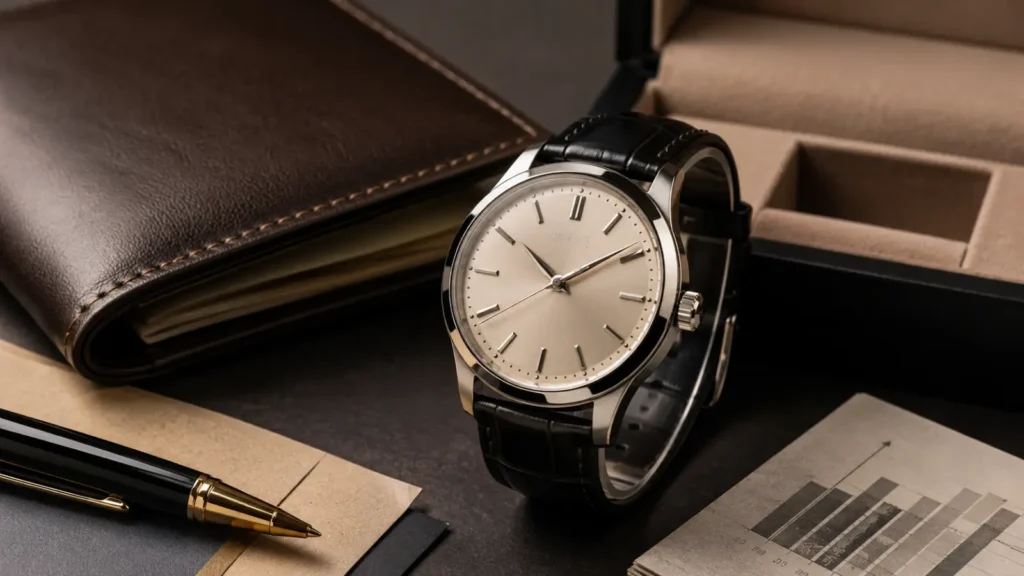
How Much Should You Spend on a High End Watch?
There is no universal price that makes a watch “high end.” A useful way to think about the market is by what changes as you move upward.
| Approx. Budget | What You Can Expect |
| $5,000–$10,000 | Entry-level luxury and strong Swiss/Japanese mechanical options |
| $10,000–$20,000 | Major luxury brands, iconic sports watches, precious-metal options |
| $20,000–$50,000 | Haute-horlogerie territory, stronger finishing and exclusivity |
| $50,000–$100,000+ | Precious metals, advanced complications, limited production |
| $100,000+ | Rare complications, exceptional finishing, major collector pieces |
These are broad market tiers rather than hard rules. The same brand can occupy several levels depending on movement, material, complication, and production volume.
For example, Rolex currently spans from steel models around several thousand dollars to precious-metal references well above $40,000. Its U.S. collection illustrates just how broad the luxury spectrum can be within one manufacturer.
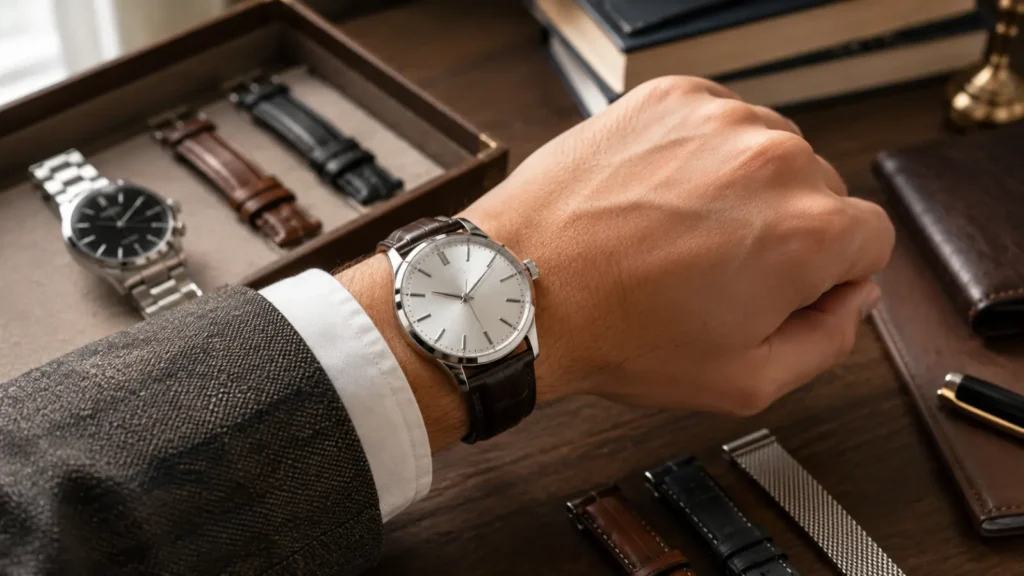
How to Choose the Right High End Watch
Buying a $20,000 watch requires a different mindset from buying a $200 watch. You should know exactly what you want the watch to do before choosing a brand.
1. Is it an everyday watch or a collector piece?
For daily wear, prioritize durability, water resistance, serviceability, and bracelet quality.
A Submariner or Overseas makes more sense for frequent wear than a delicate dress watch with minimal water resistance.
2. Do you care more about brand recognition or craftsmanship?
Rolex offers exceptional recognition and a strong ecosystem around its watches.
Patek Philippe and A. Lange & Söhne appeal more strongly to buyers who appreciate traditional mechanical craftsmanship and finishing.
Neither approach is inherently better.
3. What size actually works on your wrist?
Do not choose a watch solely from photographs.
Case diameter is only part of the equation. Lug-to-lug length, thickness, bracelet integration, dial opening, and case shape can make two watches with identical diameters wear completely differently.
4. Are you buying for yourself or resale?
If resale matters, research the specific reference rather than assuming every expensive watch is a good investment.
Liquidity, demand, condition, service history, originality, and purchase price all matter. A watch that costs $40,000 is not automatically a $40,000 asset on the secondary market.
5. Can you afford the ownership cost?
Luxury watch ownership does not end at the checkout counter.
Budget for servicing, insurance where appropriate, strap replacement, polishing decisions, and potential repairs. Complicated mechanical watches can be considerably more expensive to maintain than simpler time-only pieces.
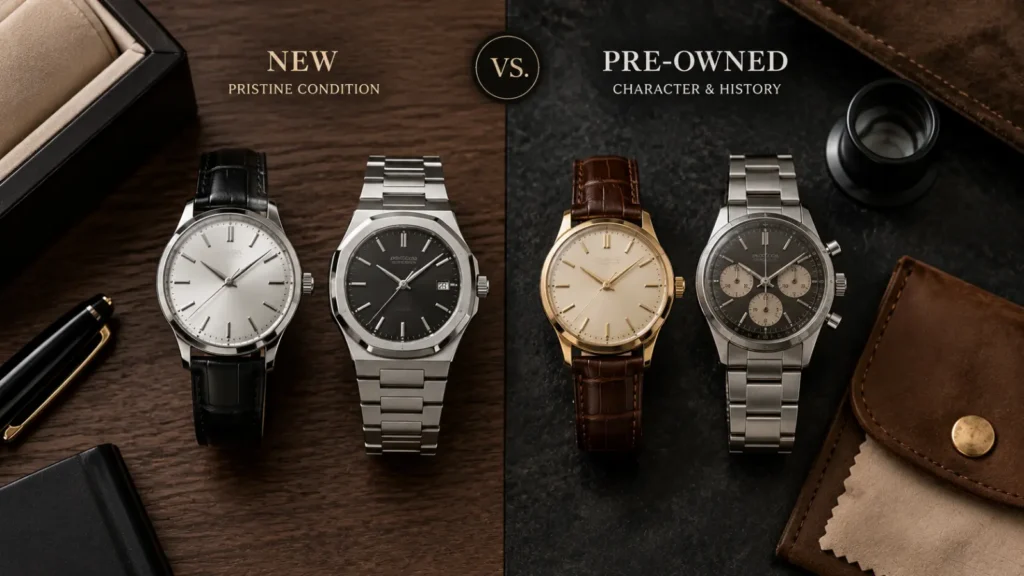
New vs. Pre-Owned High End Watches
Buying new gives you the cleanest ownership experience, but pre-owned can open doors to models that are discontinued, difficult to obtain, or significantly more expensive at retail.
The pre-owned market also creates additional risks.
Before buying an expensive used watch, verify:
- Reference and configuration
- Serial or identifying information where applicable
- Movement originality
- Case and dial condition
- Service documentation
- Box and papers, when relevant
- Seller reputation
- Return policy
- Current market pricing
A missing box is not automatically a deal-breaker. A suspiciously cheap watch from an unknown seller is a much bigger concern.
For particularly expensive purchases, professional authentication can be money well spent.
Common Mistakes to Avoid
Buying high end watches is easy to get wrong because the price itself can create false confidence. Expensive does not mean automatically authentic, comfortable, collectible, or suitable for your lifestyle.
Buying the Logo Instead of the Watch
A famous name can be appealing, but you should still ask whether you actually like the design and whether the watch fits your wrist.
Ignoring Servicing
A complicated mechanical watch may require specialist attention. Check service availability before committing to a lesser-known or highly complicated model.
Overpaying on the Secondary Market
Scarcity can produce enormous premiums. Compare current retail pricing with reputable secondary-market examples before paying above retail.
Assuming Every Luxury Watch Is an Investment
Some watches retain value extremely well. Others depreciate heavily.
Buy an expensive watch because you want to own it first. Treat potential appreciation as a bonus rather than the main reason to buy.
Ignoring Water Resistance
A $30,000 dress watch is not necessarily suitable for swimming.
The Lange 1, for example, has 3-bar water resistance, while the Vacheron Constantin Overseas Self-Winding referenced above is rated to 15 bar. Those specifications reflect very different intended uses.
Are High End Watches Worth It?
Yes, but only when you value what they offer beyond basic timekeeping. The jump from a $1,000 watch to a $10,000 watch is not simply about accuracy; it can involve finishing, materials, movement architecture, design history, exclusivity, and long-term ownership experience.
The value becomes increasingly subjective as prices rise.
A $50,000 watch will not tell time 50 times better than a $1,000 watch. What you are buying is craftsmanship, scarcity, heritage, design, and the emotional experience of owning something made to a much narrower standard.
That is why the best purchase is not necessarily the most expensive one.
The Final Talk
The most expensive watch in the room isn’t always the one worth owning.The best high end watches are ultimately defined by what they give you beyond the price tag. The Rolex Submariner remains the strongest all-rounder, while the GMT-Master II is a natural choice for frequent travelers. If traditional elegance matters most, the Patek Philippe Calatrava is difficult to overlook, while the A. Lange & Söhne Lange 1 stands out for exceptional movement design and finishing.
For buyers who want luxury sports-watch appeal with serious horological pedigree, the Vacheron Constantin Overseas deserves a close look. Each watch offers a different reason to spend big, so the smartest choice is the one that fits your taste, lifestyle, and expectations—not simply the one with the highest price.
Buy the watch you’ll still be excited to wear years from now, not the one that only looks impressive on a price tag.
FAQs
High end watches generally occupy the upper levels of the luxury market and combine premium materials, mechanical craftsmanship, finishing, heritage, exclusivity, or complicated functions. The category can begin around several thousand dollars and extend into six- or seven-figure collector territory.
There is no single winner. Rolex is exceptionally strong for everyday luxury and recognition, while Patek Philippe, Audemars Piguet, Vacheron Constantin, and A. Lange & Söhne offer different interpretations of high-level mechanical watchmaking.
They can be, if you value craftsmanship, design, materials, heritage, and exclusivity. They are not worth the premium purely for timekeeping accuracy because much cheaper watches can keep excellent time.
The Rolex Submariner and GMT-Master II are among the strongest choices for everyday luxury because they combine mechanical quality with robust construction and established service support.
The Patek Philippe Calatrava and A. Lange & Söhne Lange 1 are excellent choices for traditional high-end dress-watch collectors. The Calatrava is more classically restrained, while the Lange 1 has a more distinctive asymmetric design.
Discover More,
Wren Watches Review: Are They Really Worth It?
KUOE Watches: 7 Best Picks That Are Actually Worth It
Trump Watches on Amazon: The Truth Revealed in 2026
[author]