
Not every watch that claims 200 meters is ready to follow you beneath the surface.A great diving watch is more than a bold bezel and a water-resistance number printed on the dial. When you’re underwater, reliability matters clear luminous markers, a secure screw-down crown, a dependable timing bezel, and rugged construction can make the difference between a true tool watch and a timepiece that simply looks the part. In 2026, the best diving watches span everything from affordable Japanese options to serious Swiss and high-end Seiko models, giving divers and enthusiasts plenty of choices.
But which watches are genuinely built for the job? Let’s break down what makes a real dive watch stand out and the models worth considering.
What Is a Diving Watch?
A diving watch is a purpose-built watch designed to remain reliable underwater while allowing the wearer to monitor elapsed time. Traditional dive-watch design centers on a unidirectional rotating bezel, strong water resistance, high-contrast hands and markers, luminous displays, and a screw-down crown.
The important distinction is that a dive watch is designed around underwater legibility and timing rather than simply having a high water-resistance number.
A proper mechanical dive watch will commonly include:
- A unidirectional rotating bezel for tracking elapsed time
- Strong lume on the hands and hour markers
- A screw-down crown and secure case construction
- A high level of water resistance
- A bracelet or strap suitable for wet conditions
- A highly legible dial with minimal visual clutter
Some models are also certified against recognized diver-watch standards. Citizen, for example, explicitly identifies several Promaster models as ISO-compliant divers, while Seiko’s Prospex range includes watches designated as diver’s watches.
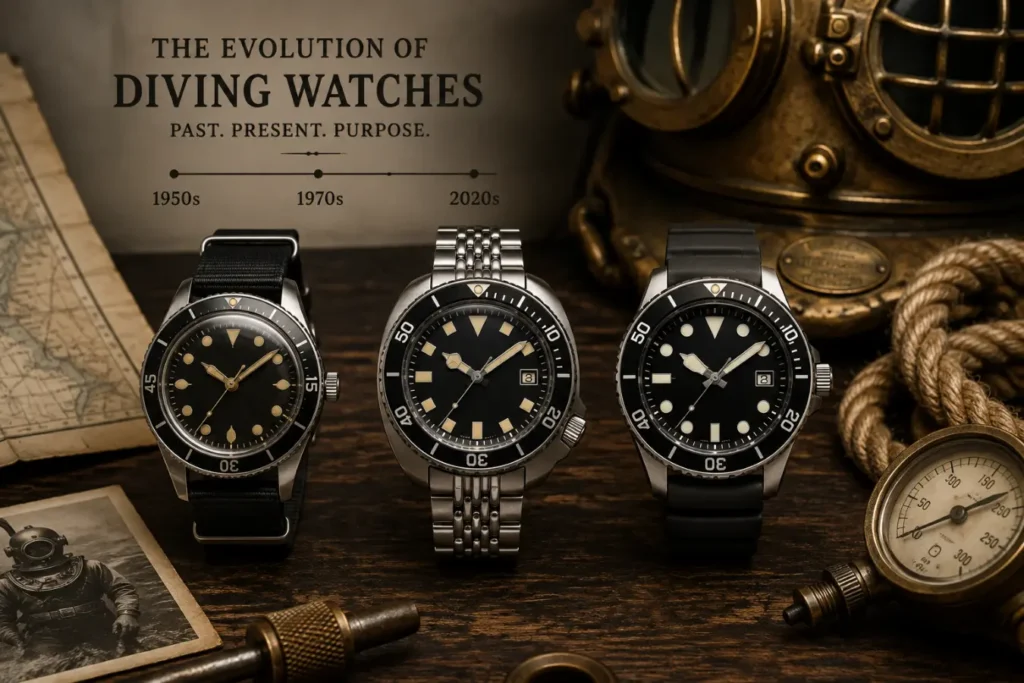
A Brief History of Diving Watches
Modern dive watches grew from the practical requirements of military and professional underwater work. Early designs established the features that still define the category today: rotating bezels for elapsed-time measurement, strong lume, robust cases, and improved resistance to water pressure.
Seiko has particularly deep roots in this category. Its first diver’s watch appeared in 1965, followed by a 300-meter diver in 1968. Seiko’s modern Prospex collection continues that lineage, including professional-grade models rated to 300 meters.
The category eventually moved beyond professional diving. Today, many people buy a dive watch because they want a durable everyday sports watch that happens to be capable underwater.
That makes the best modern divers surprisingly versatile.
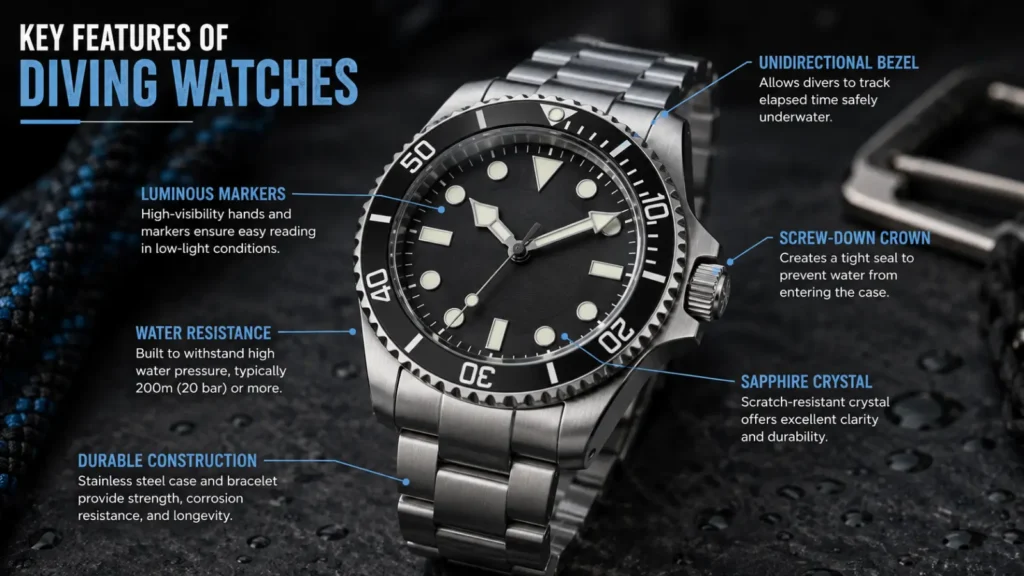
Key Features of Diving Watches
Not every feature deserves equal attention. A flashy bezel or oversized case means little if the watch is difficult to read underwater or uncomfortable on the wrist.
Water Resistance
Water resistance is the first specification most buyers notice, but it should not be viewed in isolation.
A watch rated to 200 meters is generally far more appropriate for recreational scuba diving than one rated to 50 or 100 meters. However, the actual construction, certification, crown design, gaskets, and condition of the watch also matter.
For serious diving, look for a watch specifically identified as a diver’s watch rather than assuming a high meter rating automatically makes it suitable.
Unidirectional Bezel
The rotating bezel is one of the defining features of a traditional dive watch.
Its purpose is simple: a diver can align the bezel’s zero marker with the minute hand before entering the water and then read elapsed time during the dive.
A unidirectional mechanism is particularly important because accidental movement can only reduce the indicated remaining time rather than falsely extending it.
Lume and Legibility
Underwater visibility changes quickly as depth increases. Good diving watches therefore use luminous hands and markers with strong contrast against the dial.
A beautifully finished dial that becomes difficult to read in low light is less useful underwater than a simpler dial with excellent contrast.
Crystal
Sapphire crystal is common on premium divers because of its excellent scratch resistance. Mineral crystal is also found on more affordable watches and can offer good impact resistance at a lower cost.
The choice depends on priorities, but for a watch intended to be worn frequently, sapphire is a valuable upgrade.
Crown and Case Construction
A screw-down crown helps protect the movement from water ingress and is a common feature on serious dive watches.
The case should also be designed around the watch’s intended water-resistance rating. This is one reason a purpose-built diver deserves more trust than an ordinary sports watch with an impressive-sounding water-resistance figure.
How to Tell a Good Dive Watch From a Bad One
The easiest mistake is judging a diver by its appearance. A large case, black bezel and bright lume can make almost any watch look ready for the ocean.
A better test is to examine whether the specifications support the watch’s intended purpose. The best diving watches feel coherent: the bezel, crown, lume, case, crystal and strap all serve the same job.
Look for:
- Purpose-built water resistance rather than marketing alone.
- A clear unidirectional bezel with useful minute markings.
- Strong, readable lume on the hands and indices.
- A screw-down crown on a serious mechanical diver.
- A case size you can actually wear comfortably.
- A reputable service network if buying an expensive mechanical model.
A watch can be technically excellent and still be the wrong choice if its case is too large or heavy for your wrist.
Best Diving Watches to Consider in 2026
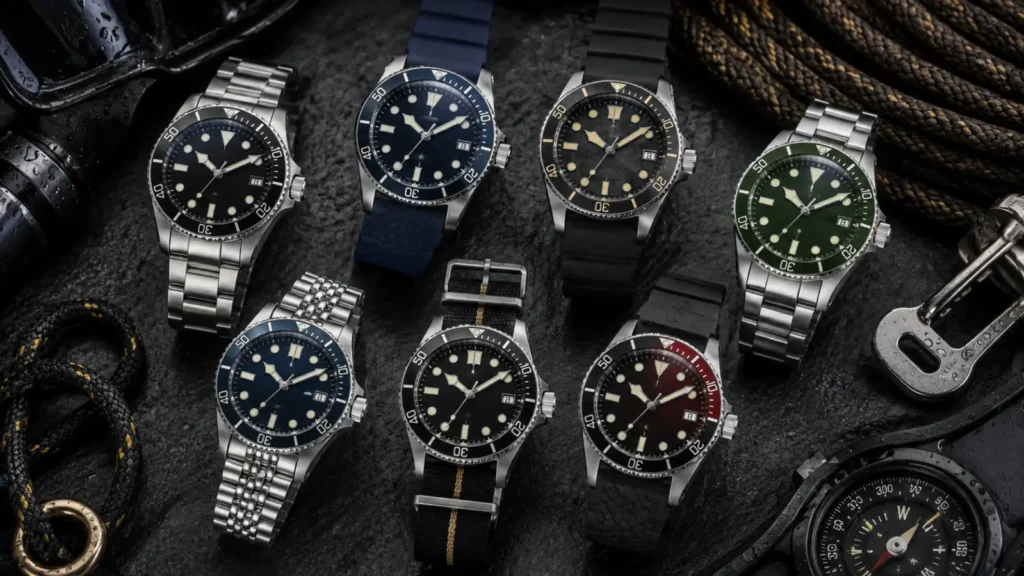
The best choice depends heavily on budget and intended use. An affordable diver can deliver nearly all the practical functionality needed for recreational diving, while premium models add finishing, movements, materials and brand heritage.
| Watch | Movement | Water Resistance | Case Size | Best For |
|---|---|---|---|---|
| Orient Diver Design RA-AA0003R | Automatic | 200m | 41.8mm | Budget mechanical diver |
| Citizen Promaster Dive | Eco-Drive / Automatic options | 200m | Varies by model | Low-maintenance diving |
| Seiko Prospex Diver | Automatic | 200m+ depending on model | Varies | Enthusiasts and collectors |
| Longines HydroConquest | Automatic or quartz | 300m | 39–43mm options | Premium everyday diver |
| Christopher Ward C60 Trident Pro 300 | Automatic | 300m | 38–42mm | Value-focused premium buyer |
| DOXA SUB 200 | Automatic | 200m | 42mm | Vintage-inspired enthusiasts |
| Tudor Black Bay 58 | Automatic | 200m | 39mm | Luxury compact diver |
Orient Diver Design RA-AA0003R — Best Budget Mechanical Choice
If the goal is to spend as little as possible while getting genuine mechanical dive-watch character, Orient deserves serious attention.
The RA-AA0003R uses an automatic mechanical movement, sapphire crystal, screw-down crown, rotating bezel and 200-meter water resistance. Its 41.8mm case makes it substantial without reaching the oversized dimensions of some tool watches.
Spec snapshot: automatic movement, 200m water resistance, 41.8mm case, sapphire crystal.
Best for: buyers who want an affordable mechanical diver with traditional proportions and strong specifications.
The downside is that its design is more utilitarian than refined. That’s exactly why it works so well as a first mechanical dive watch.
Citizen Promaster Dive
Citizen’s Promaster Dive collection is one of the strongest answers for anyone who values practicality over mechanical romance.
The Eco-Drive versions use light-powered quartz technology, while Citizen also offers automatic Promaster divers. Several models are ISO-compliant and rated to 200 meters, giving the range legitimate dive-watch credentials rather than merely dive-inspired styling.
Spec snapshot: Eco-Drive or automatic depending on model, commonly 200m water resistance, stainless steel or Super Titanium cases.
Best for: swimmers, travelers, recreational divers and anyone who does not want frequent battery changes or the ownership routine of a mechanical watch.
The Super Titanium models are particularly interesting because they reduce weight while maintaining a rugged tool-watch character. Citizen’s NB6005-05L, for example, combines a Super Titanium case, sapphire crystal, automatic movement and 200-meter ISO-compliant water resistance.
Seiko Prospex
Seiko Prospex remains one of the safest recommendations for someone who wants a dive watch with serious historical depth.
Seiko’s modern range spans affordable automatic divers through much more advanced professional models. Its heritage stretches back to Japan’s first diver’s watch in 1965, and the current Prospex line continues to emphasize robust construction and underwater legibility.
Spec snapshot: automatic or other movement types depending on model, 200m to 300m+ depending on model, stainless steel and premium materials across the range.
Best for: enthusiasts who care about Japanese dive-watch history and want a broad range of designs and price points.
At the upper end, the 2026 Prospex Marinemaster 1968 Heritage Diver uses Seiko’s 8L45 automatic movement, sapphire crystal, ceramic bezel and 300-meter diver’s water resistance in a 42.6mm case.
The catch is size and price: some Prospex models are unapologetically tool-like, while the premium pieces move into serious luxury-watch territory.
Longines HydroConquest
The HydroConquest is a particularly strong choice for someone who wants one watch that can handle water while still looking appropriate away from the beach.
The current collection includes both automatic and quartz models and offers water resistance up to 300 meters, with a unidirectional bezel, screw-in crown and screw-down case back. The redesigned collection also includes 39mm and 42mm options, making it easier to choose based on wrist size.
Spec snapshot: automatic or quartz, up to 300m, 39–43mm depending on model, sapphire crystal on the referenced automatic versions.
Best for: buyers who want Swiss finishing, everyday versatility and genuine dive-watch capability.
The 39mm automatic version is especially appealing for smaller and medium wrists, while the larger options create a more traditional modern dive-watch presence.
Christopher Ward C60 Trident Pro 300
Christopher Ward’s C60 Trident Pro 300 occupies an interesting middle ground between affordable enthusiast watches and traditional Swiss luxury brands.
The current technical specification includes a 300-meter water-resistance rating and multiple case sizes from 38mm to 42mm. The range uses an automatic Sellita SW200-1 movement in the cited technical documentation.
Spec snapshot: Sellita SW200-1 automatic, 300m water resistance, 38/40/42mm case options.
Best for: buyers who care about specifications and finishing but do not need the prestige premium of a major luxury brand.
Its biggest advantage is choice. Smaller wrists are not forced into a huge case simply because they want a serious mechanical diver.
DOXA SUB 200
DOXA is one of the names worth knowing if you want something more distinctive than the usual black-and-blue diver.
The SUB 200 combines a 42mm stainless-steel case with a Swiss automatic movement, sapphire crystal, screw-down crown, unidirectional bezel and 200-meter water resistance.
Spec snapshot: Swiss automatic, 200m water resistance, 42mm case, sapphire crystal.
Best for: enthusiasts who want strong diving credentials with unmistakable vintage-inspired personality.
The SUB 200’s biggest strength is character. It does not try to look like every other modern diver.
Tudor Black Bay 58
For buyers moving into luxury territory, the Tudor Black Bay 58 remains one of the most compelling compact dive watches.
The current 39mm stainless-steel version is rated to 200 meters and uses Tudor’s manufacture MT5400-U movement, with COSC and METAS certification. It also features a screw-down crown, unidirectional bezel and domed sapphire crystal.
Spec snapshot: automatic manufacture movement, 200m water resistance, 39mm case, sapphire crystal.
Best for: buyers who want a luxury mechanical watch that retains genuine dive-watch proportions.
Its 39mm diameter is a major selling point. Many modern divers become bulky on smaller wrists; the Black Bay 58 avoids much of that problem.
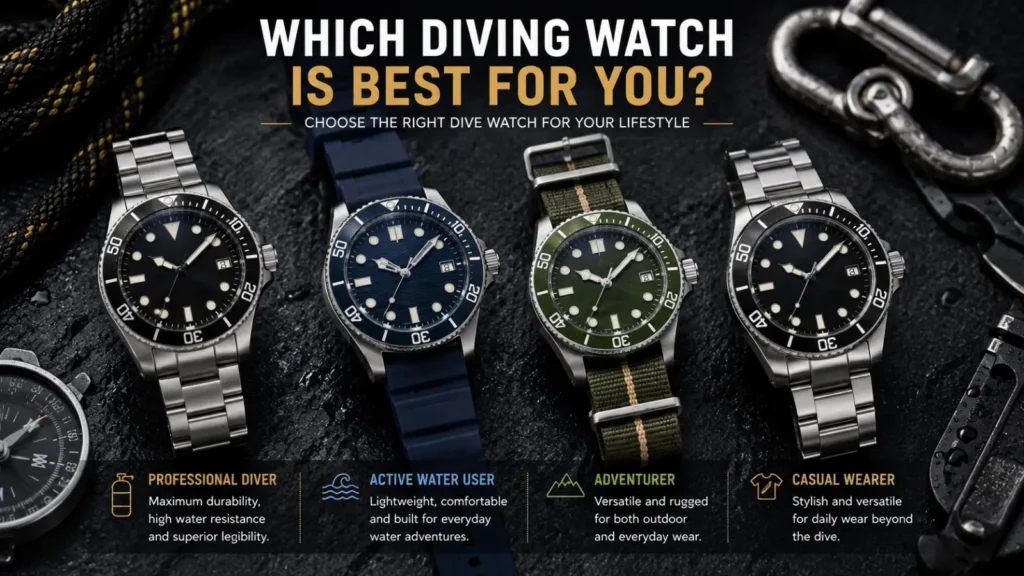
Which Diving Watch Is Best for You?
There is no single winner because the priorities change dramatically between a recreational diver, an enthusiast and a luxury buyer.
If you’re choosing your first watch, start with the intended use rather than the brand name.
- Under a tight budget: Orient’s Diver Design models make a strong mechanical starting point.
- For low maintenance: Citizen Promaster Eco-Drive is hard to ignore.
- For Japanese enthusiast appeal: Seiko Prospex offers tremendous variety.
- For Swiss everyday wear: Longines HydroConquest is one of the most balanced choices.
- For premium specifications: Christopher Ward C60 Trident Pro 300 is compelling.
- For distinctive vintage character: DOXA SUB 200 stands apart.
- For luxury and compact sizing: Tudor Black Bay 58 is the standout.
Common Mistakes to Avoid
Buying a dive watch is easier when you know which specifications actually matter. The biggest mistakes usually come from focusing too heavily on appearance, water-resistance numbers or brand prestige.
1. Assuming water resistance alone makes a watch a diver
A high water-resistance rating does not automatically give a watch the complete functionality of a purpose-built diver.
Look for a proper rotating bezel, strong lume, secure crown and clear dive-watch construction.
2. Buying a case that is too large
A 44mm or 46mm watch can look impressive in photographs but become uncomfortable after several hours.
Check case diameter and lug-to-lug length, not diameter alone.
3. Ignoring servicing
Mechanical diving watches are not maintenance-free. Water resistance also depends on seals and gaskets remaining in good condition.
If you actually dive with the watch, periodic water-resistance checks are more important than simply trusting an old rating printed on the dial.
4. Choosing style over legibility
A complicated dial may look impressive on Instagram but becomes less useful underwater.
High contrast, clear hands and strong lume should take priority over decorative details.
5. Treating a dive watch like disposable equipment
Even rugged watches have limits. Avoid operating the crown underwater unless the manufacturer specifically says it is designed for that use, and have the seals checked if the watch has been opened or serviced.
The Final Talk
The best diving watch isn’t the one with the biggest price tag it’s the one you’ll trust when it matters.The best diving watches prove that you don’t need to spend a fortune to get genuine underwater capability. Orient and Citizen offer impressive practicality at accessible prices, Seiko brings decades of dive-watch heritage, while Longines, Christopher Ward, DOXA, and Tudor step up the finishing, craftsmanship, heritage, and luxury appeal.
For most buyers, the smartest choice is to focus on comfortable sizing, authentic dive-watch construction, strong legibility, and enough water resistance for your actual needs rather than simply chasing the highest rating. If you want one versatile option that balances everyday wear with serious capability, the Longines HydroConquest remains a standout choice.
FAQs
A proper dive watch is designed for underwater use and typically combines substantial water resistance, a unidirectional timing bezel, luminous hands and markers, strong legibility, and a secure crown and case.
A properly specified 200-meter diver can be suitable for recreational scuba diving. The key is to confirm that the watch is actually designed and rated as a diver rather than relying only on the number printed on the dial.
Neither is automatically better. Automatic divers appeal to enthusiasts who enjoy mechanical movements, while quartz and solar-powered options generally offer greater convenience, accuracy and lower day-to-day maintenance.
Around 39mm to 42mm works well for many wrists, but lug-to-lug length and thickness matter just as much as diameter. The Tudor Black Bay 58 and Longines HydroConquest show why smaller case options can make a serious diver much easier to wear daily.
Yes. In fact, many modern dive watches are excellent everyday sports watches because they are durable, highly legible and water resistant. The main drawback is that larger cases can become uncomfortable with formal clothing or smaller wrists.
Discover More ,
Boldr Watches: 7 Rugged Picks Worth Buying
Diamond Watches: 7 Stunning Picks Worth Buying
Nordstrom Watches: 7 Best Picks Worth Buying
[author]