
Why settle for a watch that looks like every other watch on the wrist?Most watches follow the same familiar formula: a round case, traditional hands, standard indexes, and a bracelet or leather strap. Unique watches break that formula with unusual case shapes, rotating discs, artistic dials, skeletonized movements, and even liquid-based time displays.
From affordable conversation pieces to technically ambitious independent creations, these seven designs show how far watchmakers can push the idea of telling time.
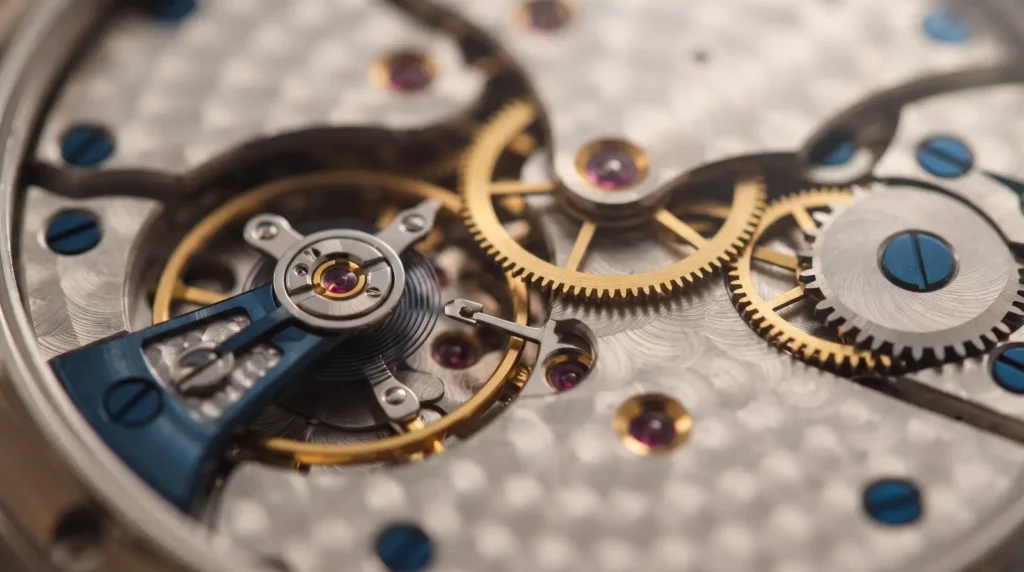
What Makes A Watch Truly Unique?
A watch does not need to look bizarre to be distinctive. Sometimes one unusual decision is enough: a shield-shaped case, a wandering-hour display, an artistic dial, or a movement that completely changes how you read the time.
Current watch-community discussions show a similar pattern. Enthusiasts regularly point toward Mr Jones Watches, Hamilton Ventura, Xeric, CIGA Design, Trilobe, and other independent makers when talking about watches that feel different from conventional Swiss designs.
The most interesting designs usually fall into a few categories:
- Unusual case shapes: triangular, asymmetric, tonneau, or heavily sculpted cases.
- Alternative displays: rotating discs, wandering hours, satellite systems, or fluidic indicators.
- Artistic dials: watches designed as miniature pieces of visual storytelling.
- Skeletonized construction: the movement becomes part of the visual identity.
- Experimental materials: titanium, ceramic, sapphire, meteorite, and other less conventional choices.
- Independent watchmaking: smaller brands often have more freedom to experiment than mass-market manufacturers.
The key distinction is whether the unusual design has a reason behind it. A watch can be loud without being interesting. The better examples have a clear idea that carries through the case, dial, movement, and way the time is displayed.
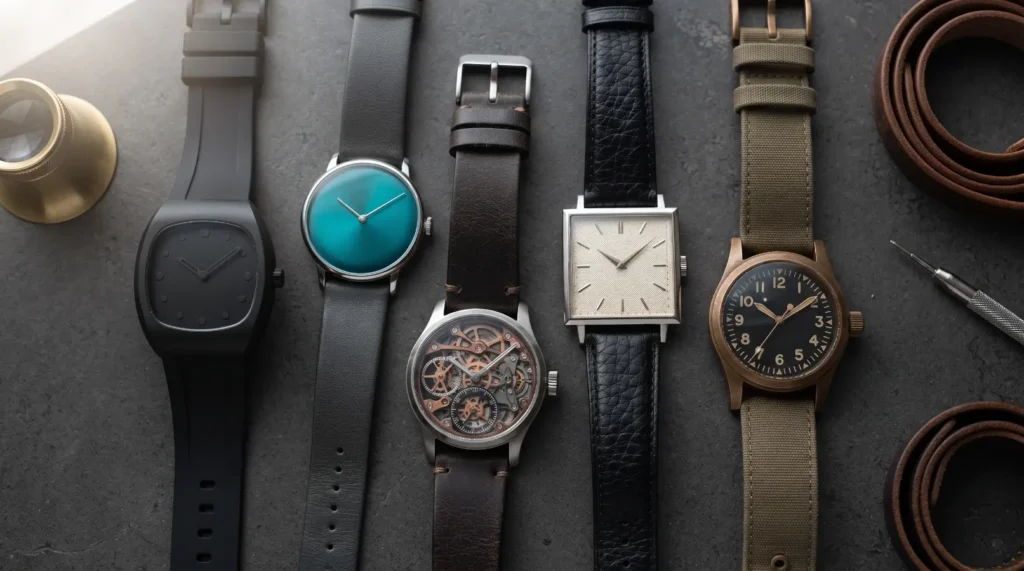
7 Distinctive Watches Worth Knowing
There is no single definition of “unique,” so this list deliberately covers different interpretations of the word. Some are affordable conversation pieces, while others represent experimental mechanical watchmaking at the highest level.
1. Hamilton Ventura: The Iconic Shield-Shaped Watch
Few mainstream watches look as immediately different as the Hamilton Watch Ventura. Its asymmetric shield-shaped case was introduced in 1957, and Hamilton describes the original as the world’s first electrical, battery-powered watch.
A current Ventura Quartz example measures 24mm × 36mm, uses a quartz movement, mineral crystal, and offers 50m water resistance. A larger 32mm × 50mm version is also available, with U.S. pricing around $1,075–$1,145 depending on configuration.
Specs at a glance:
| Feature | Hamilton Ventura Quartz |
|---|---|
| Movement | Quartz |
| Case | Stainless steel |
| Case size | 24 × 36mm or 32 × 50mm, depending on model |
| Crystal | Mineral |
| Water resistance | 50m |
| Approx. U.S. price | Around $1,075–$1,145 for current examples |
The Ventura makes sense for someone who wants a recognizable watch without following the usual round-case formula. It is especially strong as a statement piece rather than an all-purpose sports watch.
One practical warning: the large version has a 50mm case length, so wrist dimensions matter. The smaller Ventura is much easier to wear if you have a modest wrist.
2. Mr Jones Watches A Perfectly Useless Afternoon: Wearable Art
If your idea of an unusual watch is something playful rather than technically extreme, Mr Jones Watches belongs near the conversation.
The brand openly describes its watches as pieces that tell a story, start conversations, or simply make you smile. Its current collection includes A perfectly useless afternoon, Beam me up!, Sun and Moon, and other artistic designs, with several models priced around £245.
A perfectly useless afternoon is particularly memorable because it replaces conventional hands with illustrated discs. Mr Jones also says its watches are assembled by hand in its London workshop, with the printed components carefully assembled and tested.
Why it stands out: the watch is closer to wearable illustration than traditional luxury horology.
That does create a trade-off. If you want maximum legibility at a glance, a conventional three-hand watch is easier. If you want a watch that gives someone a reason to ask, “What is that?”, this is a completely different proposition.
3. Xeric NASA Trappist-1 Automatic: Space-Themed Timekeeping
Xeric takes the unconventional approach into science-fiction territory with the NASA Trappist-1 Automatic.
The design uses an orbiting planetary system to indicate the time. The inner luminous planet represents the hours while the outer planet represents the minutes, creating a display that feels more like a miniature solar system than a traditional watch dial.
The current NASA Trappist-1 Automatic Sapphire Saturn V is listed at $550 and uses a Miyota 82S0 automatic movement, sapphire crystal, a 44mm stainless-steel case, 47mm lug-to-lug measurement, and 5 ATM water resistance.
Specs at a glance:
- Movement: Miyota 82S0 automatic
- Case: 44mm stainless steel
- Lug-to-lug: 47mm
- Crystal: Sapphire
- Water resistance: 5 ATM
- Price: $550 for the cited current edition
The 44mm case is not small, but the concept is the real attraction. This is the sort of watch that makes sense when personality matters as much as conventional proportions.
Xeric also offers other experimental designs, including wandering-hour, regulator, retrograde, and space-themed watches.
4. CIGA Design Time CIPHER: A Modern Wandering-Hour Watch
CIGA Design takes a more mechanical approach with the Time CIPHER.
Instead of placing conventional hands at the center of the dial, the watch uses a wandering-hour display. The hour indication travels across the dial while the minute scale provides the reference for reading the time.
The current model uses a 316L stainless-steel case, sapphire crystal, 5 ATM water resistance, and an automatic movement. CIGA lists the case dimensions at 48 × 40.8mm and gives the movement an accuracy range of -10 to +30 seconds per day.
Why it is interesting: the unusual display is not just decoration. The mechanism changes the actual process of reading the time.
For someone who wants something modern without entering five-figure independent-watch territory, CIGA is an interesting middle ground. The larger case also means this is better suited to someone comfortable with a substantial wrist presence.
CIGA’s newer Falcon takes another route, using a back-to-front skeleton design and the self-developed CD-02 automatic caliber. The 43.5mm model is listed around $499–$629 depending on market and configuration.
5. Trilobe Les Matinaux: Three Rings Instead Of Hands
If you want something genuinely unconventional but still refined enough for formal wear, Trilobe offers one of the clearest alternatives to traditional hand-driven displays.
The Les Matinaux collection uses three rotating rings to display hours, minutes, and seconds. A fixed pointer tells you where to read each indication. Trilobe’s X-Centric automatic movement uses a micro-rotor and provides a 48-hour power reserve.
Depending on the version, the collection is available in 38.5mm and 40.5mm cases. The steel and titanium versions are tested to approximately 50m water resistance, with sapphire crystals and sapphire casebacks.
Specs at a glance:
| Feature | Trilobe Les Matinaux |
|---|---|
| Movement | X-Centric automatic micro-rotor |
| Power reserve | 48 hours |
| Case sizes | 38.5mm / 40.5mm |
| Crystal | Sapphire |
| Water resistance | Approx. 50m for steel/titanium |
| Display | Three rotating rings |
| Price | Luxury-watch territory; varies by configuration |
The result is unusual without being cartoonish. That matters. Some experimental watches are conversation pieces first and watches second. Trilobe is trying to make the unconventional display part of a genuinely elegant luxury watch.
6. HYT: When Liquid Becomes The Hour Hand
HYT sits in a completely different category.
The brand is known for using fluidic technology to display hours through a liquid-filled capillary system. Instead of relying exclusively on a conventional hour hand, the liquid itself becomes part of the time indication.
A current HYT S1 example uses a manually wound mechanical movement with 41 jewels, a 72-hour power reserve, a 45.3 × 46.3mm case, sapphire crystal, and 50m water resistance. The cited limited edition is priced at CHF 78,000 before taxes.
Specs at a glance:
- Movement: Manual mechanical
- Power reserve: 72 hours
- Case: 45.3 × 46.3mm
- Thickness: 17.2mm
- Crystal: Sapphire
- Water resistance: 50m
- Price: CHF 78,000 before taxes for the cited limited edition
This is not a watch you buy because you need the most practical timekeeper possible. It is closer to mechanical engineering and industrial sculpture for the wrist.
The size and thickness also make it a very deliberate purchase. Before spending this kind of money, try the case on your wrist rather than relying only on photographs.
7. URWERK UR-100V: Satellite Timekeeping
URWERK represents one of the most technically ambitious approaches to unconventional watch displays.
The UR-100V uses orbiting satellite hours and minutes rather than traditional hands. URWERK also incorporates astronomical and terrestrial indications into the concept, connecting the movement’s motion to the passage of time and movement through space.
A UR-100V Lightspeed Ceramic specification sheet lists the self-winding UR 12.02 movement, 48-hour power reserve, sapphire crystal, a 43 × 51.73mm case, 14.55mm thickness, and 50m water resistance. The published price is CHF 67,000 before tax.
This is where “unique” stops meaning unusual styling and starts meaning a fundamentally different mechanical architecture.
URWERK’s satellite system is visually complex, but the purpose is still simple: give the wearer a new way to experience the passage of time.
How These Designs Compare
The biggest difference between these watches is not simply price. It is how far each designer is willing to move away from conventional watchmaking.
| Watch | Main Idea | Movement | Case / Size | Water Resistance | Price Position |
|---|---|---|---|---|---|
| Hamilton Ventura | Shield-shaped case | Quartz | 24 × 36mm or 32 × 50mm | 50m | ~$1,075+ |
| Mr Jones A Perfectly Useless Afternoon | Artistic disc display | Mechanical/quartz depending on model | Model dependent | Model dependent | ~£245 |
| Xeric Trappist-1 | Planetary display | Automatic | 44mm | 5 ATM | ~$550 |
| CIGA Time CIPHER | Wandering hours | Automatic | 48 × 40.8mm | 5 ATM | Mid-range |
| Trilobe Les Matinaux | Three rotating rings | Automatic micro-rotor | 38.5/40.5mm | ~50m | Luxury |
| HYT S1 | Fluidic hours | Manual mechanical | 45.3 × 46.3mm | 50m | CHF 78,000 cited |
| URWERK UR-100V | Satellite display | Automatic | 43 × 51.73mm | 50m | CHF 67,000 cited |
The table also shows why comparing these watches purely on specifications misses the point. A $550 Xeric and a six-figure-independent-watch candidate can both be “unique,” but they achieve it in completely different ways.
Are Unusual Watches Actually Practical?
Some are. Some absolutely are not.
The mistake is assuming that visual creativity automatically means poor usability. Hamilton’s Ventura, for example, is still fundamentally a quartz watch with straightforward timekeeping. Xeric’s Trappist-1 uses a familiar automatic movement even though its display looks anything but conventional.
The practical concerns usually come from four areas:
- Case size: Experimental watches can be large, especially when the movement or display needs additional space.
- Legibility: Artistic or alternative displays can require more attention than traditional hands and indexes.
- Water resistance: A visually impressive watch is not automatically a sports watch.
- Servicing: Proprietary or highly complicated mechanisms may require specialist service.
That last point becomes increasingly relevant as you move from an unusual design into independent haute horlogerie.
How To Choose A Distinctive Watch Without Regretting It
The best way to buy an unusual watch is to decide what kind of unusual you actually want.
If you simply want something that looks different from a Rolex-style round watch, the Ventura or a CIGA Design model can accomplish that without entering extreme pricing territory. If you want artistic expression, Mr Jones Watches takes that idea much further.
For someone interested in mechanical innovation, Trilobe, HYT, and URWERK are different propositions entirely.
Before buying, ask:
- Can I read it quickly? If not, decide whether that compromise bothers you.
- Will the case fit my wrist? Check lug-to-lug as well as diameter.
- Is the movement serviceable where I live? This matters more with independent or proprietary calibers.
- What am I actually paying for? Design, movement architecture, finishing, materials, limited production, or all of them?
- Will I still like the design in five years? Novelty is not the same thing as lasting appeal.
Common Mistakes To Avoid
Buying a strange-looking watch can be more complicated than buying a conventional one because specifications are easier to overlook when the design grabs your attention.
Ignoring Wrist Fit
A 44mm watch with a 47mm lug-to-lug measurement can wear very differently from a compact 44mm case with short lugs. Always check both dimensions where they are available.
Assuming 50m Water Resistance Means Dive Ready
It does not. Water-resistance ratings need to be considered alongside case construction, crown design, intended use, and the manufacturer’s instructions.
Paying For Novelty Alone
A unique dial is not automatically what makes unique watches good watchmaking. Look at the movement, case finishing, crystal, bracelet or strap quality, warranty, and service arrangements too.
Buying A Complicated Watch Without Thinking About Service
A simple quartz Ventura and a complex independent mechanical watch have completely different ownership requirements. The latter can require specialist attention and considerably more expensive servicing.
Choosing From Photos Alone
This is particularly risky with unconventional cases. A watch that looks perfect in a product photograph may feel oversized, thick, or awkward once it is actually on the wrist.
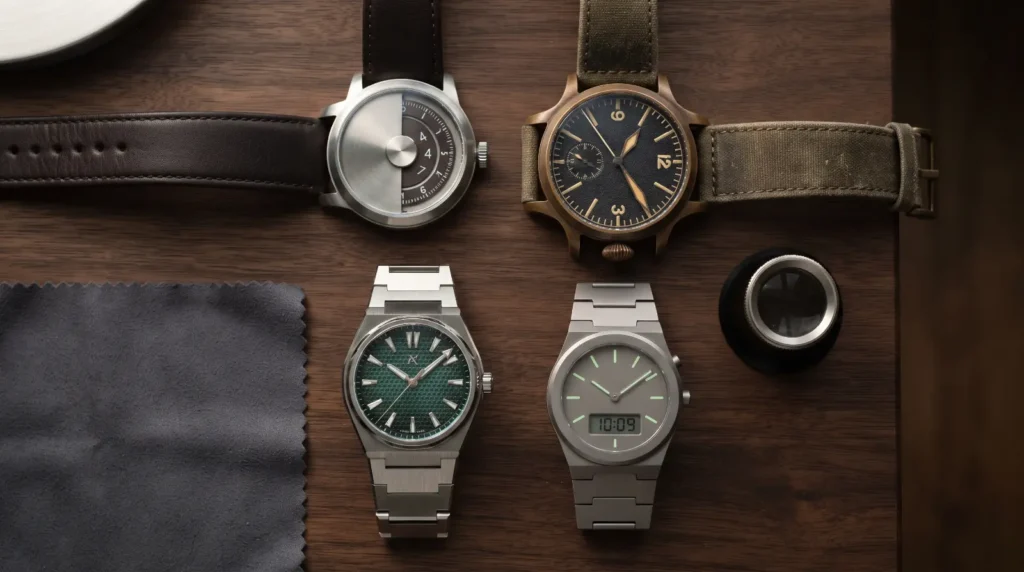
What Do Watch Enthusiasts Consider Unique?
There is no universal answer. Recent enthusiast discussions repeatedly mention brands such as Mr Jones Watches, Tokyo Flash, Xeric, CIGA Design, and other independent makers when people ask for unique watches that break from conventional designs.
That is useful because it highlights an important distinction: “unique” does not have to mean expensive.
A $200–$600 watch with an unusual display can feel more individual than a conventional luxury watch costing tens of thousands of dollars. Conversely, independent brands such as Trilobe, HYT, and URWERK create unique watches around unconventional displays as part of much deeper mechanical and design philosophies.
The right choice depends on whether you want visual personality, mechanical innovation, artistic expression, or all three.
The Final Talk
A great watch tells the time. A truly distinctive watch gives people a reason to ask, “What are you wearing?”The best unusual watches are not simply the strangest ones. They are the watches with a clear idea behind them, whether that means Hamilton’s unmistakable case, Mr Jones’ artistic storytelling, Xeric’s unconventional displays, or the radical mechanical concepts of Trilobe, HYT, and URWERK.
If ordinary watches blend into the crowd, these designs are built to stand apart. Choose the one that matches your personality, wrist, and tolerance for unconventional timekeeping rather than simply buying the watch that looks the wildest.
FAQs
A watch can be considered one of the unique watches because of its case shape, dial architecture, time display, materials, artistic design, or mechanical construction. The strongest examples usually combine several of these elements into one coherent concept.
Some unique watches are practical for everyday wear, particularly models with conventional quartz or automatic movements and moderate case dimensions. Others are better treated as statement or collector watches because of their size, fragility, limited water resistance, or complicated mechanisms.
Mr Jones Watches, Xeric, CIGA Design, Trilobe, HYT, and URWERK all create unique watches with noticeably different approaches to watch design. Their price levels and technical ambitions vary dramatically.
Yes. Mr Jones Watches and Xeric offer unique watches with distinctive designs at prices far below high-end independent watchmakers, while some Hamilton and CIGA Design models provide unconventional cases or displays without entering ultra-luxury pricing.
The Ventura is particularly relevant if you want a recognizable brand with a genuinely unconventional case. Its shield-shaped design dates back to 1957, making it one of the unique watches that still feels distinctive today. Current quartz versions retain the distinctive profile and 50m water resistance.
Discover More,
Minimalist Watches: 7 Stunning Picks Worth Buying in 2026
Teddy Watches: 7 Best Picks You’ll Want to See in 2026
Norqain Watches: 5 Standout Picks You’ll Want in 2026
[author box]