
Why settle for a watch that needs attention when you can wear one that simply gets the job done?Quartz watches remain one of the smartest and most reliable choices for anyone who wants accurate timekeeping without the hassle of a mechanical movement. They deliver remarkable accuracy, low maintenance, slim designs, and impressive value, with options ranging from affordable daily beaters to sophisticated high-end precision watches.
But here’s the catch: not every quartz watch is worth buying. A rugged Casio, a convenient solar Citizen, and a refined Grand Seiko offer completely different experiences. This guide reveals the standout picks, explains what makes quartz technology so effective, compares it with automatic movements, and shows you the key details that can make or break your purchase.
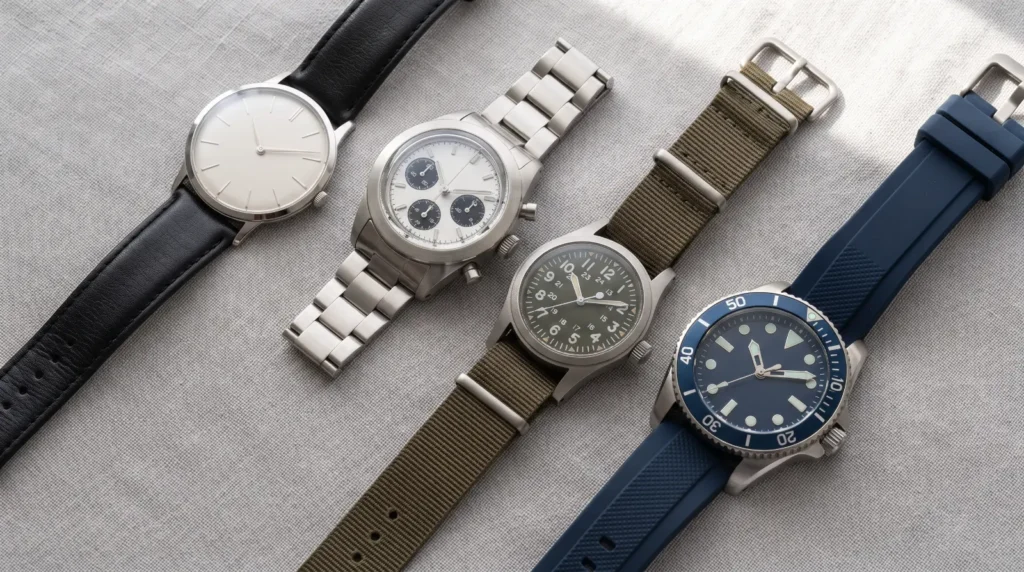
1. THE BEST QUARTZ WATCHES AT A GLANCE
There is no single “best” quartz watch for everyone. A swimmer needs something different from an office wearer, while a collector who cares about accuracy may have very different priorities from someone who simply wants a reliable daily watch.
| Watch | Movement | Water Resistance | Case Size | Best For |
|---|---|---|---|---|
| Casio Duro MDV106 | Quartz | 200m | 44–46mm depending on version | Budget durability |
| Citizen Garrison BM8180 | Eco-Drive | 100m | 37mm | Everyday wear |
| Seiko SUR527 | Quartz 6N52 | 100m | 40.2mm | Affordable dress/everyday |
| Tissot PR 100 | Swiss quartz | 100m | 40mm | Swiss value |
| Bulova Lunar Pilot | High-Precision Quartz | 50m | 43.5mm | Chronograph enthusiasts |
| Grand Seiko SBGX261 | 9F62 quartz | 100m | 37mm | Luxury precision |
| Seiko Astron GPS Solar | GPS Solar quartz | Model dependent | Model dependent | Frequent travelers |
The prices range from roughly the budget segment to several thousand dollars, so the important question is not simply which one is most expensive. It is which movement, case, crystal, and feature set actually matter to you.
2. WHAT IS A QUARTZ WATCH?
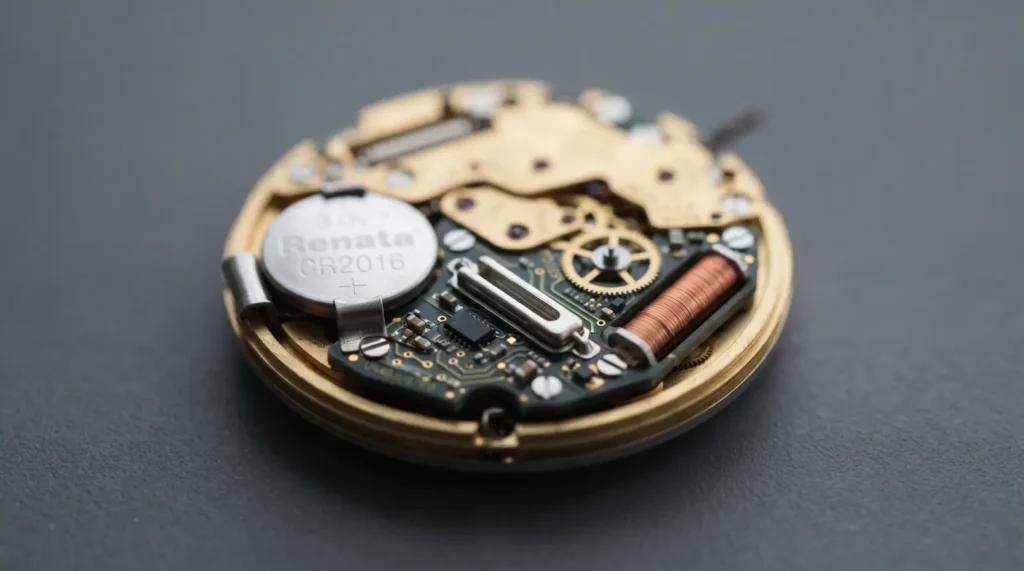
A quartz watch uses an electronic movement regulated by the vibration of a quartz crystal. An electrical circuit sends energy through the crystal, counts its oscillations, and converts that signal into accurate timekeeping. In a conventional analog model, a small motor then drives the hands.
The technology became commercially viable in wristwatches with the Seiko Quartz Astron in 1969. That launch transformed the industry because quartz offered a combination of accuracy, practicality, and manufacturing efficiency that mechanical watches struggled to match.
That history is worth remembering because “quartz” does not automatically mean “cheap.” Modern movements range from basic battery-powered calibers to thermocompensated high-accuracy systems and sophisticated solar or GPS-controlled mechanisms.
3. HOW QUARTZ MOVEMENT TECHNOLOGY ACTUALLY WORKS
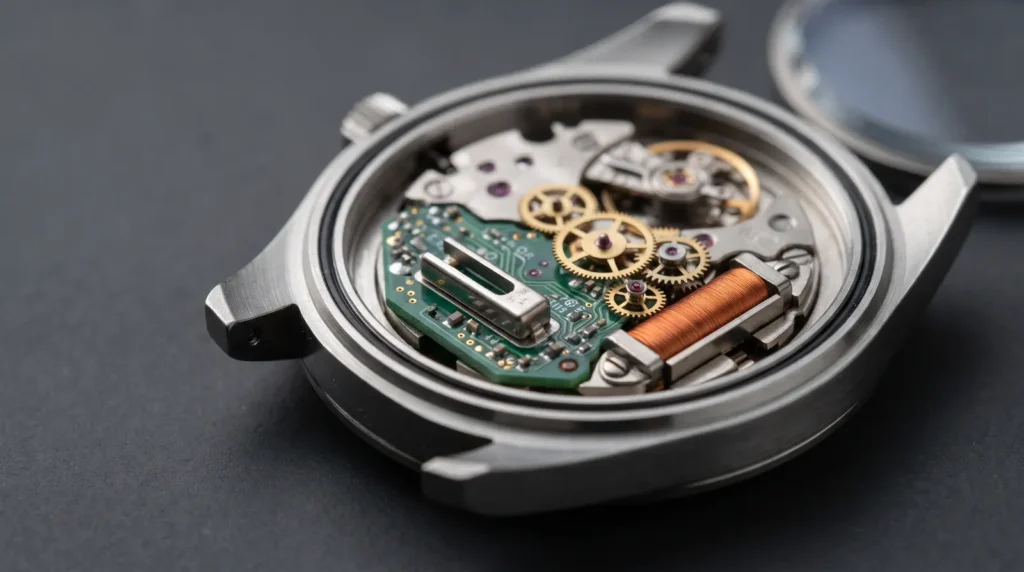
The appeal is surprisingly simple. A battery or rechargeable power source supplies electricity, the quartz crystal oscillates at a highly stable frequency, and the circuitry translates those oscillations into a precise time signal.
A typical quartz movement therefore has three fundamental jobs:
- Power: supplies electrical energy to the movement.
- Regulation: the quartz crystal provides the timing reference.
- Display: circuitry and a step motor translate the signal into movement of the hands.
This simplicity is a major advantage for daily wear. There are fewer mechanical components constantly interacting than in a traditional mechanical movement, which helps explain why quartz watches are generally accurate, robust, and inexpensive to maintain.
But quartz quality varies. A basic movement and a high-accuracy caliber should not be treated as interchangeable simply because both carry the word “quartz.”
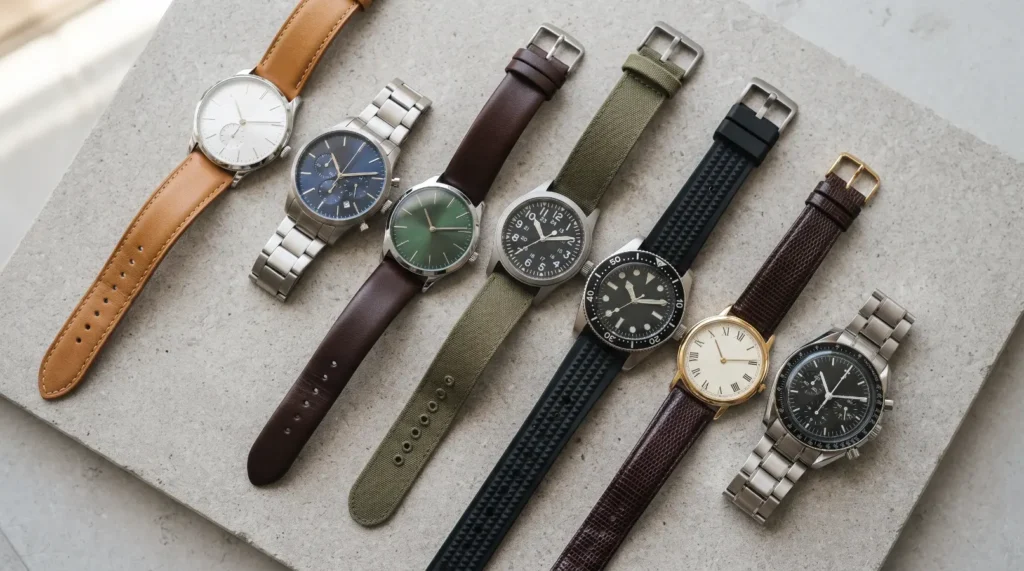
4. 7 QUARTZ WATCHES WORTH CONSIDERING
1. Casio Duro MDV106 — Best Budget Quartz Dive-Style Watch
The Casio Duro is the watch for someone who wants to spend very little and still get a genuinely useful tool watch. Its 200-meter water resistance, screw-lock crown, rotating bezel, and straightforward three-hand layout make it much more serious than its price suggests. Casio rates the MDV106 at approximately three years of battery life and ±20 seconds per month.
Specs: Quartz | 200m water resistance | 44.2mm or 46.3mm case width depending on version | Mineral crystal | Approx. 3-year battery life
The catch is size. This is not a small, discreet watch, particularly on smaller wrists. It is also a dive-style watch rather than an ISO-rated dive watch, so don’t confuse its 200-meter rating with the specifications of a professional dive instrument.
Best for: swimmers, casual wear, outdoor use, and buyers who want maximum value.
2. Citizen Garrison BM8180 — Best Everyday Solar Quartz
The Citizen Garrison takes a different approach. Instead of relying on a conventional disposable battery, its Eco-Drive system converts light into energy. Citizen describes the BM8180 as powered by light and says it does not require routine battery replacement. The 37mm case, day-date display, luminous hands, and 100-meter water resistance make it especially easy to live with.
Specs: Eco-Drive | 100m water resistance | 37mm case | Mineral crystal | Day-date
This is one of the strongest choices if you want a grab-and-go watch without the visual bulk of many sports models.
The mineral crystal is the obvious compromise against more expensive watches using sapphire, but the overall package makes sense for an everyday piece.
Best for: daily wear, smaller wrists, commuters, and anyone who dislikes battery changes.
3. Seiko SUR527 — Best Affordable All-Rounder
The Seiko SUR527 shows why affordable quartz deserves more attention. Its 6N52 quartz movement is rated to ±15 seconds per month, with approximately three years of battery life. It also combines a 40.2mm stainless-steel case with sapphire crystal and 100-meter water resistance.
Specs: Seiko 6N52 quartz | 100m water resistance | 40.2mm case | Sapphire crystal | Approx. 3-year battery
That combination is difficult to criticize at this level. Sapphire is particularly valuable because the watch is likely to spend more time on a desk, in a car, or around door frames than underwater.
It is not the most exciting watch on this list. That’s exactly why it works.
Best for: office wear, everyday use, and buyers who want a clean analog watch without mechanical-watch maintenance.
4. Tissot PR 100 — Best Swiss Quartz Value
If you want a Swiss-made quartz watch that looks more refined than its price suggests, the Tissot PR 100 deserves a serious look.
The current 40mm PR 100 three-hand model uses a Swiss quartz movement, sapphire crystal, 316L stainless steel construction, and 100-meter water resistance. Tissot lists the U.S. price at $350 for the referenced blue-dial version.
Specs: Swiss quartz | 100m water resistance | 40mm case | Sapphire crystal | Date
The 8.25mm thickness is another advantage. It slips easily under a shirt cuff without feeling like a fragile dress watch.
The PR 100 is less characterful than some enthusiast favorites, but if your priorities are clean design, Swiss manufacture, sapphire, and practicality, it is an unusually sensible purchase.
Best for: office wear, first Swiss watches, and buyers who want one watch for formal and casual settings.
5. Bulova Lunar Pilot — Best Quartz Chronograph
The Lunar Pilot is where quartz stops being merely practical and starts becoming genuinely interesting from a horological-history perspective.
Its high-precision quartz movement operates at 262 kHz, considerably higher than conventional quartz frequencies. The current 96K111 version has a 43.5mm stainless-steel case, sapphire crystal, chronograph functionality, and 50-meter water resistance.
Specs: 262 kHz high-precision quartz | 50m water resistance | 43.5mm case | Sapphire crystal | Chronograph
The story matters here. Bulova’s lunar-watch connection gives the Lunar Pilot something most quartz chronographs cannot manufacture with styling alone.
But the 43.5mm case is substantial. If your wrist is small or you prefer understated watches, this is not the obvious choice.
Best for: chronograph fans, space-history enthusiasts, and collectors who want quartz with personality.
6. Grand Seiko SBGX261 — Best Luxury Quartz
This is the watch that destroys the lazy idea that quartz is inherently inferior.
The Grand Seiko SBGX261 uses the 9F62 quartz caliber, rated to ±10 seconds per year. Its 37mm stainless-steel case has sapphire crystal, a screw case back, and 10-bar water resistance. Grand Seiko currently lists the U.S. price at $2,700.
Specs: 9F62 quartz | ±10 seconds/year | 100m water resistance | 37mm case | Sapphire crystal | $2,700
The movement is also far more sophisticated than the word “quartz” suggests. The 9F62 incorporates Grand Seiko’s Twin Pulse Control Motor, Backlash Auto-Adjust mechanism, and a regulation system designed for fine adjustment during servicing.
This is not a watch you buy because quartz is cheap. You buy it because the manufacturer took quartz seriously.
The case finishing and restrained 37mm proportions also make it one of the easiest luxury watches here to wear every day.
Best for: collectors, accuracy obsessives, and anyone who wants luxury finishing without mechanical timekeeping compromises.
7. Seiko Astron GPS Solar — Best for Frequent Travelers
The Astron represents another branch of quartz technology: solar power combined with GPS timekeeping.
Modern Astron models go far beyond a conventional battery-powered three-hander. GPS connectivity allows the watch to receive time information from satellites and adjust to the appropriate time zone, while solar technology supplies its power. Seiko’s Astron lineage traces back to the original 1969 Quartz Astron, while the modern GPS Solar generation introduced a radically different approach to precision and travel convenience.
Specs: GPS Solar quartz technology | Solar-powered | GPS time adjustment | Model specifications vary
The downside is complexity. You are paying for a feature set that makes the most sense if you actually travel frequently.
Best for: international travelers, technology enthusiasts, and people who want their watch to handle time-zone changes automatically.
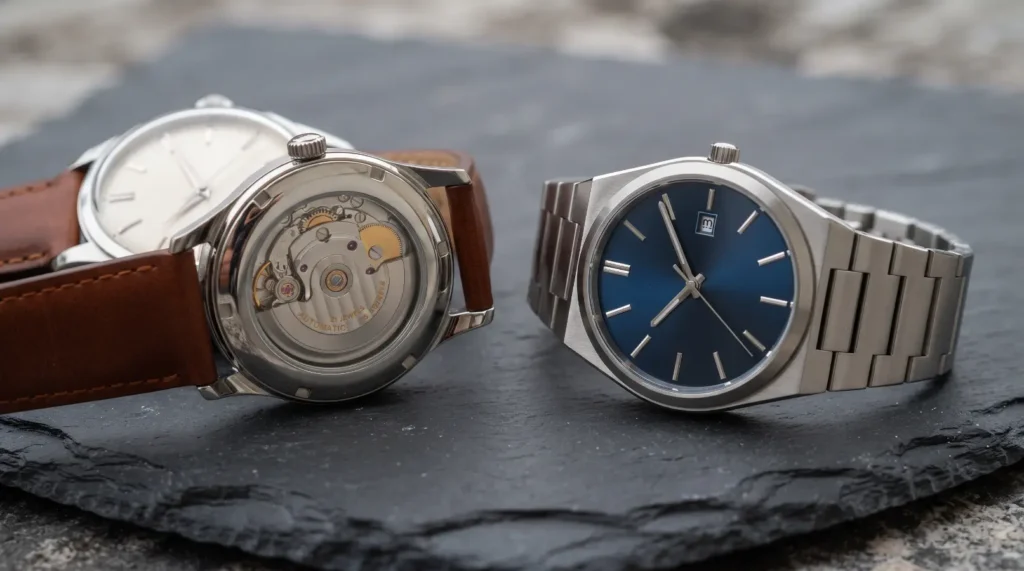
5. QUARTZ VS AUTOMATIC: WHICH IS BETTER?
The answer depends on what “better” means.
For pure accuracy and convenience, quartz wins. A conventional quartz watch can maintain time far more closely than a typical mechanical watch, while high-accuracy quartz movements push precision dramatically further. Enthusiast discussions regularly highlight accuracy, low maintenance, shock resistance, and grab-and-go convenience as reasons to return to quartz.
Automatic watches have a different appeal. Their mechanical construction, finishing, visible movement architecture, and relationship with traditional watchmaking can make them more emotionally rewarding to collectors.
| Factor | Quartz | Automatic |
|---|---|---|
| Accuracy | Excellent | Good to excellent, depending on caliber |
| Maintenance | Generally low | Higher |
| Battery | Usually required, unless solar | No battery |
| Grab-and-go convenience | Excellent | Can stop when unworn |
| Shock resistance | Generally strong | More sensitive to shocks |
| Mechanical craftsmanship | Limited/varies | Major attraction |
| Thin cases | Often easier to achieve | Depends on movement |
| Long-term collector appeal | Model dependent | Often strong |
So don’t buy an automatic simply because someone told you quartz is “lesser.” Buy mechanical if you genuinely enjoy mechanical watchmaking. Buy quartz if accuracy and convenience matter more.
6. Are High-Accuracy Quartz Movements Worth Paying More For?
Usually, only if you care about precision.
A standard quartz movement is already accurate enough for most people. Spending thousands to move from ordinary quartz accuracy to a few seconds per year is a luxury decision, not a practical necessity.
But the engineering can be fascinating. Grand Seiko’s 9F, Citizen’s high-accuracy movements, Bulova’s 262 kHz Precisionist technology, and Seiko’s GPS Solar Astron show that manufacturers can take the basic quartz principle in dramatically different directions. Teddy Baldassarre’s 2026 overview similarly highlights Grand Seiko, Citizen, Bulova, Breitling, and Seiko as leaders in high-accuracy quartz technology.
The practical rule is simple:
- Under a few hundred dollars: prioritize case quality, crystal, water resistance, and fit.
- Midrange: solar, sapphire, better finishing, and specialized movements become more interesting.
- Luxury: precision can become part of the watch’s identity rather than simply a practical feature.
7. SOLAR QUARTZ VS BATTERY QUARTZ
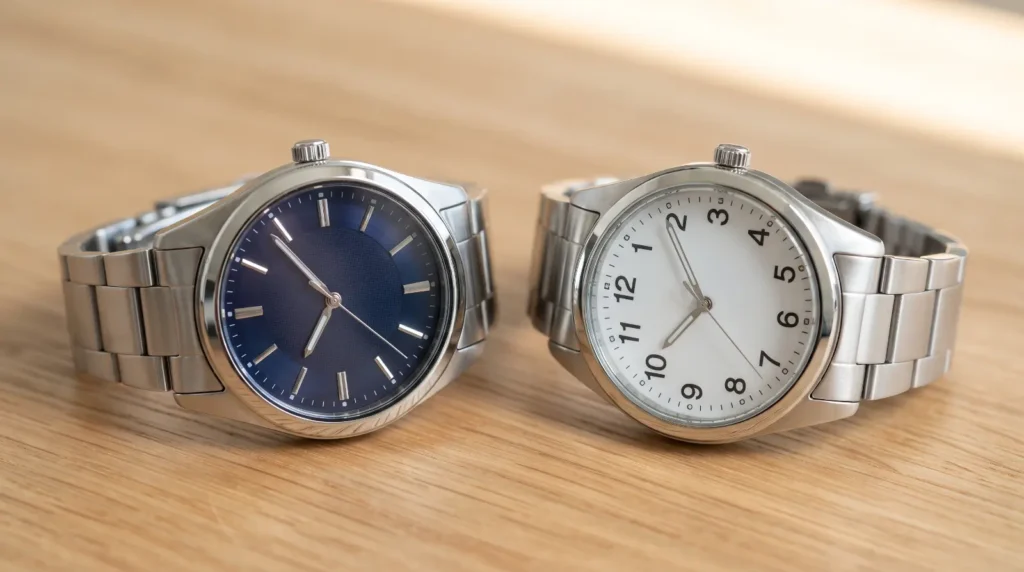
Solar quartz is often the smartest choice for someone who hates maintenance. Citizen’s Eco-Drive is a well-known example: the movement is powered by light rather than requiring routine battery replacement.
Traditional battery quartz still makes plenty of sense, particularly when the watch is inexpensive and simple.
Think of it this way:
Battery quartz: cheap, simple, widely available, easy to understand.
Solar quartz: better for long-term convenience and fewer routine battery changes.
Neither is automatically superior. A beautifully designed battery-powered watch can still be a better purchase than a mediocre solar model.
8. What Makes a Good Quartz Watch?
The movement is only one part of the equation. A great quartz watch should make sense as a complete object.
Case Size and Fit
Don’t choose a watch based on diameter alone. Lug-to-lug distance, thickness, bracelet design, and case shape can make two 40mm watches wear completely differently.
The Grand Seiko SBGX261 is a useful example: its 37mm case and 44.6mm lug-to-lug measurement create a compact profile that works particularly well for people who prefer understated watches.
Crystal
Sapphire is highly scratch resistant and becomes increasingly worthwhile as the watch price rises. Mineral crystal can be perfectly reasonable on affordable watches, especially when replacement cost is low.
Water Resistance
100 meters is a useful everyday rating, while 200 meters provides more headroom for swimming and water-heavy use. But water resistance is not the only consideration for serious diving; case construction, crown design, testing, and dive-watch standards matter too.
Movement Quality
Don’t stop reading when a listing says “quartz.”
Look for the actual caliber when the manufacturer provides it. Seiko’s 6N52, Grand Seiko’s 9F62, Bulova’s high-frequency quartz technology, and Citizen’s Eco-Drive platform illustrate how dramatically quartz movements can differ.
COMMON MISTAKES TO AVOID
Quartz is easy to buy badly because inexpensive watches can look convincing in product photos. A few simple checks prevent most regrets.
- Buying purely for brand name: A recognizable logo does not guarantee a good case, crystal, or movement.
- Ignoring case dimensions: A 44mm watch can wear dramatically larger than a 40mm model.
- Assuming every quartz movement is equally accurate: Basic and high-accuracy calibers are very different.
- Confusing water resistance with dive certification: A high meter rating alone does not make a watch a professional dive instrument.
- Overpaying for precision you don’t need: ±10 seconds per year sounds incredible, but ordinary quartz may already meet your practical needs.
- Forgetting battery care: If a battery-powered watch stops, replace the battery rather than leaving an exhausted cell inside indefinitely.
9. How to Choose the Right One
Start with your lifestyle rather than the movement.
If you want a cheap, tough watch for weekends and swimming, the Casio Duro makes more sense than a luxury quartz model. If you want something compact that can stay on your wrist every day with minimal fuss, the Citizen Garrison is harder to beat.
For a smarter office watch, the Seiko SUR527 or Tissot PR 100 makes more sense. If you are buying as a collector, the Grand Seiko SBGX261 gives you a very different experience: exceptional finishing and a genuinely sophisticated quartz caliber.
Ask yourself these five questions:
- How much do I actually want to spend?
- Do I prefer battery or solar power?
- Will I swim with it?
- What case size fits my wrist?
- Do I care about extreme accuracy, or is normal quartz accuracy enough?
Those answers will narrow the field much faster than scrolling through hundreds of listings.
THE FINAL TALK
The smartest watch on your wrist might be the one you never have to think about.The best quartz watches prove that precision doesn’t need to come with a complicated movement or a luxury price tag. From the rugged Casio Duro and effortless Citizen Garrison to the refined Tissot PR 100 and exceptionally precise Grand Seiko SBGX261, there is a quartz watch for almost every kind of wearer.
For most buyers, the sweet spot is solar or conventional quartz between $100 and $500. You get outstanding accuracy, dependable everyday performance, and low maintenance without paying for features you’ll never use.
And that’s the real appeal of quartz. You don’t buy it because mechanical watches are boring. You buy it because sometimes the smartest watch is the one that simply works.
FAQs
Yes. Standard quartz movements are generally much more accurate than ordinary mechanical watches, while high-accuracy quartz can reach precision measured in only a few seconds per year. Grand Seiko’s 9F62, for example, is rated to ±10 seconds per year.
A conventional battery often lasts around two to several years depending on the movement and functions. For example, Casio rates the MDV106 at approximately three years, while Grand Seiko lists approximately three years for its 9F62 caliber.
They are better if your priorities are accuracy, convenience, low maintenance, and reliable grab-and-go use. Automatic watches have the advantage when mechanical craftsmanship, traditional watchmaking, and collector appeal matter more.
They usually require less routine attention than mechanical watches, but they are not maintenance-free. Battery-powered models need battery replacement, seals can eventually require attention, and higher-end movements may be serviceable when necessary.
For many daily-wearers, yes. Solar systems such as Citizen Eco-Drive reduce the need for routine battery replacement by converting light into energy.
DISCOVER MORE,
Norqain Watches: 5 Standout Picks You’ll Want in 2026
Credor Watches: 5 Stunning Japanese Luxury Picks
Best Automatic Watches: 10 Picks From $200 to $1,000+
[author box]