
Choosing a watch can get confusing when the same-looking dials hide very different mechanisms. Some watches use replaceable batteries, others draw energy from wrist movement, and some convert light into electrical power. Movement watches are watches classified by the mechanism that measures and displays time. Understanding the movement helps you compare accuracy, maintenance, power reserve, and long-term ownership costs before choosing a watch.
The six main movement categories worth knowing are quartz, automatic, manual-wind mechanical, solar, kinetic, and Spring Drive. They differ in how they generate or regulate timekeeping, not simply in price or appearance. A mechanical movement can offer intricate craftsmanship, while a quartz movement often delivers better everyday accuracy with less maintenance. Neither is automatically the right choice for everyone.
Movement Watches at a Glance
- Definition: Watches use different movement systems to keep time, power the hands, and control timekeeping accuracy.
- Six useful categories: Quartz, automatic, manual-wind mechanical, solar, kinetic, and Spring Drive.
- Key distinction: A movement’s power source and its timekeeping regulator are related but not always the same thing.
- Common misconception: Automatic watches do not automatically outperform quartz watches in accuracy.
What Watch Movements Actually Mean
A watch movement is the mechanism inside a timepiece that keeps time and drives its display. In an analogue watch, the movement controls the hands; in a digital watch, it manages the electronic time display.
The phrase movement watches is sometimes used loosely to describe watches with particular internal mechanisms. More precisely, watch enthusiasts discuss watch movements and classify them by how they obtain energy and regulate time.
Mechanical movements store energy in a wound mainspring. Quartz movements use an electronic oscillator to regulate timekeeping, while a small motor usually drives the hands. Solar watches are generally quartz watches that convert light into electrical energy. Kinetic watches generate electricity from wrist movement, and Spring Drive combines a mechanical power source with an electronic regulating system.
These categories are not all mutually exclusive. Solar and kinetic describe ways of generating or storing power, while quartz describes a timekeeping technology. Knowing this distinction makes comparisons much more useful than simply labelling a watch mechanical or electronic.
The Main Types, Compared
| Movement type | Power source | Typical accuracy | Main advantage | Main limitation |
|---|---|---|---|---|
| Quartz | Replaceable or rechargeable cell | Often around ±15 seconds per month; varies by calibre | Accurate and convenient | Conventional batteries eventually need replacement |
| Automatic | Wound mainspring, replenished by wrist motion | Often around −10 to +30 seconds per day, depending on calibre | Mechanical craftsmanship | Needs regular wear or winding |
| Manual-wind | Wound mainspring | Often around −10 to +30 seconds per day, depending on calibre | Direct, traditional winding experience | Must be wound regularly |
| Solar | Light-charged storage cell | Usually quartz-level accuracy | Low routine battery-maintenance needs | Needs adequate light and eventual servicing |
| Kinetic | Wrist-powered generator and rechargeable storage cell | Usually quartz-level accuracy | Converts movement into electricity | Storage cell may eventually require replacement |
| Spring Drive | Mechanical mainspring with electronic regulation | Certain models are rated around ±1 second per day | Smooth hand motion and strong accuracy | More specialised and potentially costly servicing |
Accuracy figures are broad illustrative ranges, not guarantees. Manufacturer specifications vary by movement, and real-world performance depends on conditions, age, and adjustment.
Read next: Steinhart Watches: 5 Top-Rated Models to Consider in 2026
1. Quartz Movement
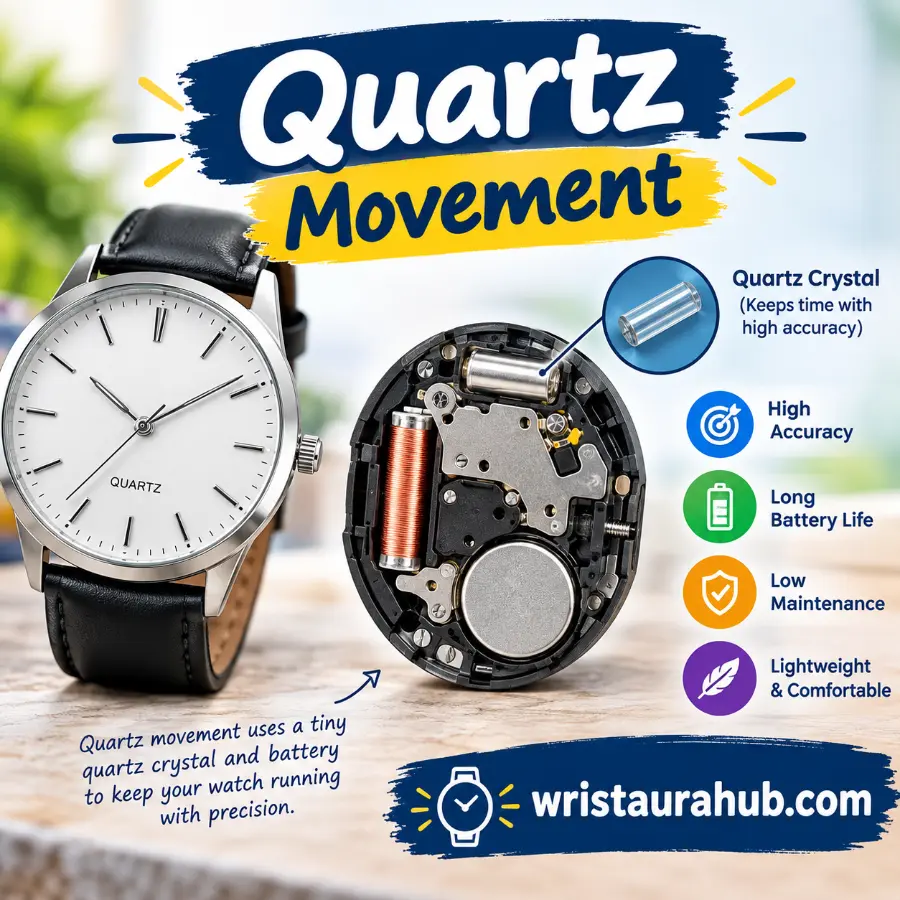
A quartz movement uses a vibrating quartz crystal and electronic circuitry to regulate time. In a conventional analogue watch, a small motor moves the hands according to electrical signals from the circuit.
Quartz watches are popular because they are usually accurate, easy to use, and comparatively affordable to maintain. Many ordinary quartz movements vary by seconds per month rather than seconds per day, although premium and specialised examples can be considerably more accurate.
Best for: Daily wear, office use, travel, and anyone who wants reliable timekeeping without frequent adjustments.
Limitation: A conventional battery-powered quartz watch eventually needs a battery change. The movement can also require servicing if its electronics, motor, seals, or other components develop problems.
2. Automatic Movement
An automatic movement is a mechanical mechanism powered by a mainspring. A weighted rotor turns as the wrist moves, winding the spring and storing energy for the watch to use.
Most automatic watches can continue running for a period after you remove them. This duration is called the power reserve. Depending on the calibre, it might be around 38–42 hours, 70–80 hours, or another specified period. When the stored energy runs out, the watch stops until it is wound again.
Automatic watches appeal to people who appreciate mechanical engineering, visible rotors, and traditional watchmaking.
Best for: Enthusiasts who enjoy mechanical construction and wear their watches regularly.
Limitation: Automatic movements are generally less accurate than good quartz movements, and they require periodic professional servicing. A watch can also stop if left unworn longer than its power reserve.
3. Manual-Wind Mechanical Movement
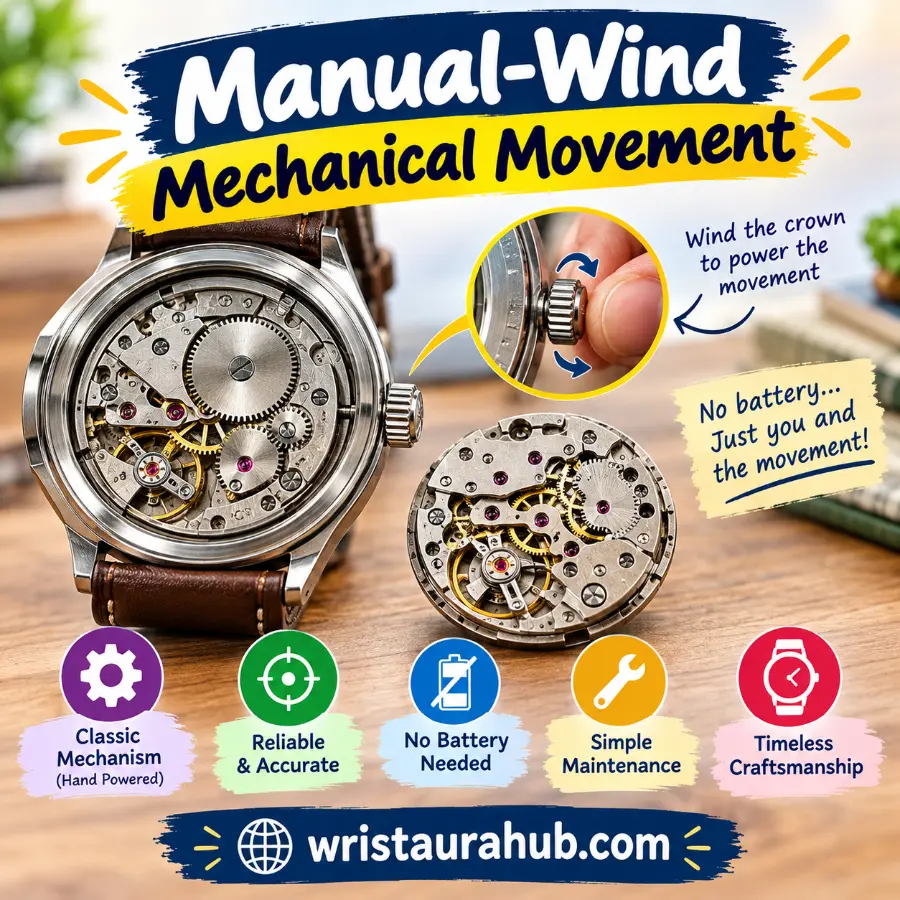
A manual-wind movement also stores energy in a mainspring, but the wearer winds it using the crown rather than relying on an automatic rotor.
Winding becomes part of the daily routine. Depending on the movement, the watch may need winding every day or at another specified interval. The power reserve determines how long it can run between windings.
Because there is no automatic winding rotor, some manual-wind watches can have simpler movement layouts or thinner profiles. However, overall thickness depends on the full movement and case design, not just the absence of a rotor.
Best for: People who enjoy a hands-on ritual, traditional watchmaking, and mechanical watches with a direct connection between wearer and mechanism.
Limitation: You must remember to wind it. Overwinding or forcing a crown against resistance can damage components, so follow the manufacturer’s instructions.
4. Solar Movement
Solar watches collect light through the dial or another light-receiving surface and convert it into electricity. The energy is stored in a rechargeable cell that powers the watch.
Many solar watches use quartz timekeeping, giving them the convenience and accuracy associated with electronic movements. Citizen’s Eco-Drive technology is one established example of light-powered watchmaking. Its official documentation explains that light charges the system and regular battery replacement is not required.
Best for: People who want accurate everyday timekeeping with less routine battery maintenance.
Limitation: A solar watch still needs adequate light exposure. Long periods in darkness can deplete its stored energy, and its rechargeable storage cell may eventually need professional replacement.
5. Kinetic Movement

Kinetic watches use wrist movement to operate a small electrical generator. The generator charges an internal storage cell, and the resulting electricity powers a quartz timekeeping system.
This differs from an automatic mechanical watch. Both can use a moving rotor, but an automatic movement winds a mainspring, whereas a kinetic movement generates electricity.
ye link remove kr do plz
Seiko describes its Kinetic technology as converting wrist motion into electrical energy stored in a rechargeable battery.
Best for: People who want quartz-style timekeeping without relying on a conventional disposable battery as the primary energy source.
Limitation: Kinetic watches are less common than standard quartz models, and their rechargeable storage components can age. If a watch sits unused for extended periods, it may stop and need recharging according to its instructions.
Read next: Top Cartier Watches for Women Reviewed: 7 Best Picks in 2026
6. Spring Drive
Spring Drive is a specialised movement system developed by Seiko. It uses a mainspring as its source of mechanical energy but regulates the release of that energy through an electronic control system rather than a conventional mechanical escapement.
This combination produces the smooth, continuous movement of the seconds hand associated with Spring Drive, along with accuracy beyond that of many conventional mechanical watches. Seiko specifies approximately one second per day for its Spring Drive technology, although the exact specification depends on the model.
Best for: Enthusiasts who want mechanical power, distinctive hand motion, and higher accuracy than many traditional mechanical movements offer.
Limitation: Spring Drive is a specialised system with a narrower selection of watches and potentially higher servicing costs than a basic quartz watch.
How to Identify a Watch’s Movement
You can often identify the movement without opening the case. Follow these steps in order.
- Check the dial and case-back. Look for markings such as Quartz, Automatic, Solar, Kinetic, or Spring Drive. These labels can identify the technology, although their absence does not tell you which movement is inside.
- Look at the seconds hand. Many conventional quartz watches move once per second, while mechanical watches often have a smoother series of small steps. This is a clue, not proof: high-frequency quartz and specialised mechanical designs can behave differently.
- Check the manufacturer’s specifications. Search the watch’s exact reference number on the official website or in its manual. Confirm the movement type, accuracy tolerance, power reserve, and recommended servicing.
- Inspect the case-back if it is transparent. An automatic movement may show a rotor, while a manual-wind movement usually lacks one. However, a solid case-back can hide either mechanism.
- Confirm the power source. A battery-powered quartz watch, light-powered solar watch, and kinetic watch can all use quartz timekeeping, but their energy systems differ.
Do not open a sealed watch just to identify its movement. Doing so can damage the seals or compromise water resistance if the case is not closed correctly.
Which Movement Suits Your Needs?
The right choice depends on how you use a watch, how much maintenance you tolerate, and what you value most.
| Your priority | Movement to consider | Why it fits |
|---|---|---|
| Low-maintenance daily wear | Quartz | Accurate and straightforward to operate |
| Fewer routine battery changes | Solar | Uses light and stores energy |
| Mechanical craftsmanship | Automatic | Winds through wrist movement |
| Traditional winding ritual | Manual-wind | Requires deliberate winding |
| Quartz convenience with motion-generated power | Kinetic | Generates electricity from wrist movement |
| Mechanical power with specialised regulation | Spring Drive | Combines a mainspring with electronic regulation |
What about movement watches for men?
The movement does not need to be chosen by gender. For men’s watches, as with women’s watches, start with accuracy, case size, thickness, comfort, and intended use. A slim quartz watch can suit formal clothing, while an automatic field watch may suit someone who prefers mechanical construction.
For smaller wrists or a watch that must slide under a shirt cuff, check the actual case diameter and thickness. Movement type alone does not determine how large or comfortable the finished watch feels.
Are Swiss movements better than Japanese movements?
Swiss and Japanese movements both cover a broad range of quality levels. The label describes manufacturing origin or sourcing, not an automatic ranking of accuracy or durability.
Swiss movement watches can range from affordable quartz models to intricate mechanical calibres. Japanese movements likewise include economical quartz mechanisms, automatic movements, solar systems, and advanced technologies.
Compare the specific calibre, stated accuracy, servicing options, parts availability, and warranty rather than paying more simply for a country-of-origin label.
How to Spot a Good Movement
A good movement should suit the watch’s purpose and have credible specifications. Use these checks before judging a timepiece by its price or appearance.
- Verified accuracy: Look for a stated tolerance rather than vague claims that the watch is exceptionally precise. Compare mechanical accuracy in seconds per day with quartz accuracy in seconds per month or year.
- A practical power reserve: For mechanical watches, check how long the watch runs when fully wound. A longer reserve is convenient, but it does not automatically mean better accuracy or construction.
- Clear servicing guidance: The manufacturer should provide care instructions and a route to authorised or competent repair services. Service intervals depend on the movement and manufacturer; there is no single interval that suits every watch.
- Accessible replacement parts: Conventional quartz batteries are generally straightforward to replace, but rechargeable storage cells, electronic modules, and specialised mechanical components may require more specific expertise.
- A credible warranty: Check what is covered, where repairs can be performed, and whether the warranty excludes particular types of damage.
- Appropriate construction: The movement is only one part of the watch. Crystal material, case finishing, crown design, water resistance, and strap quality also influence everyday usefulness.
A more expensive movement is not automatically a better choice. If you want dependable timekeeping and minimal fuss, an ordinary quartz watch may serve you better than an elaborate mechanical watch that needs frequent adjustments.
Common Misconceptions About Watch Movements
Automatic watches are always more accurate. They are not. Quartz movements are generally more accurate than conventional mechanical movements, although performance varies by calibre.
Every quartz watch needs a disposable battery. Many conventional quartz watches do, but solar watches use light to charge a storage cell, and kinetic watches generate electricity from wrist movement.
Swiss movements are always superior to Japanese movements. Country of origin alone cannot establish quality. Compare the actual movement, specifications, reliability, and service support.
An automatic watch never needs winding. Automatic winding replenishes the mainspring while you wear the watch, but a stopped watch may need manual winding and resetting. Some automatic movements also offer hand-winding.
A more complicated movement is always better. Additional mechanisms can provide useful functions, but they can also increase complexity and servicing costs. Choose complications that you will actually use.
The Final Talk
The best movement is the one that fits your routine. Quartz suits people who choose accuracy and convenience; solar offers similar practicality with light-powered charging; and automatic or manual-wind watches appeal to those who value mechanical engineering. Kinetic and Spring Drive offer different approaches to combining mechanical motion and electronic timekeeping.
Before choosing, compare the movement’s accuracy, power reserve, maintenance requirements, and servicing availability. A clear understanding of these differences will help you choose a watch for the way you actually live, rather than assuming that the most expensive or complex mechanism must be the best.
Frequently Asked Questions
A quartz movement uses a vibrating quartz crystal and electronic circuitry to regulate time. Most analogue quartz watches use a small motor to drive the hands. They are generally accurate, practical, and require less frequent adjustment than conventional mechanical watches.
Most conventional quartz watches use a replaceable battery. Solar quartz watches use light to charge a storage cell, while kinetic quartz watches generate electricity from wrist movement. The exact maintenance requirements depend on the technology and model.
It depends on the movement, not the country. Japanese quartz watches commonly use batteries, while Japanese automatic and manual-wind mechanical watches use a mainspring. Solar and kinetic movements have different energy-storage systems.
The phrase usually refers to a movement made in Japan or sourced from a Japanese manufacturer. It is not one specific movement type. Japanese watchmaking includes quartz, automatic, manual-wind, solar, kinetic, and specialized systems such as Spring Drive.
Rolex watches use mechanical movements, predominantly self-winding automatic mechanisms. The exact movement and its specifications depend on the model and reference. Check Rolex’s official documentation for the particular watch rather than assuming every model has identical movement features.
They can be worth it if you appreciate mechanical craftsmanship, enjoy wearing a watch regularly, and accept periodic servicing. If your main priorities are maximum everyday accuracy and minimal maintenance, a quartz or solar watch may be the more practical option.