
Choosing a watch gets confusing when one timepiece is described as automatic, another as a dive watch, and a third as a chronograph. These labels do not all describe the same thing. The types of watches fall into two main classification systems: movement, which explains how a watch keeps time, and style or purpose, which explains how it looks and what it is designed to do.
A watch can belong to both systems at once. For example, a dive watch can use an automatic or quartz movement, while a dress watch can also be mechanical. Understanding this distinction makes watch terminology easier to follow and helps you recognize the features that matter, from case thickness and crystal material to water resistance, accuracy, and strap design.
Types of Watches at a Glance
- Definition: Watches can be classified by their timekeeping mechanism, design, display, or intended use.
- Main categories: Common styles include dress, dive, field, pilot, chronograph, digital, and smartwatch designs, while common movements include quartz, automatic, and manual-winding mechanisms.
- Most important distinction: Movement describes how a watch runs; style describes its design or purpose.
- Common misconception: Automatic, mechanical, and dive are not interchangeable labels. They describe different characteristics.
What Watch Categories Actually Mean
Watch terminology becomes much easier once you separate the mechanism inside the case from the design you see on the outside.
A watch movement is the mechanism responsible for keeping time. Quartz movements use an electronic oscillator regulated by a quartz crystal. Mechanical movements use springs and gears, with automatic watches winding themselves through wrist movement and manual watches requiring the wearer to wind them.
A watch style, by contrast, describes the design, features, or intended setting. A dress watch usually emphasizes a slim case and restrained dial. A dive watch prioritizes underwater legibility and timing. A field watch favors straightforward readability and practical construction.
These categories overlap rather than compete. A single watch might be an automatic dive watch, a quartz chronograph, or a solar-powered field watch. Digital and smartwatches introduce another distinction: how the time and additional information are displayed.
Understanding these separate labels helps you compare watches accurately without assuming that one category automatically means better quality.
The Main Categories Compared
The table separates common movement types from watch styles. These are different classification axes, so a watch may fit one category from each group.
| Category | What defines it | Main advantage | Main limitation |
|---|---|---|---|
| Quartz | Battery-powered electronic timekeeping | Accurate and low-maintenance | Usually needs a battery or rechargeable power source |
| Automatic | Self-winding mechanical movement | No regular battery replacement | Requires servicing and may stop when unworn |
| Manual-winding | Mechanism wound by hand | Direct, traditional interaction | Needs regular winding |
| Solar | Light-powered rechargeable system | Less frequent battery-related maintenance | Needs sufficient light over time |
| Dress | Slim, understated design | Fits formal clothing | Often fewer practical features |
| Dive | Underwater-focused design | Legibility and elapsed-time bezel | Can be bulky; ratings must be checked |
| Field | Clear, practical dial | Easy everyday reading | Usually offers fewer specialized functions |
| Pilot | Aviation-inspired legibility | Large markers and clear layout | Some designs are oversized |
| Chronograph | Stopwatch function | Measures elapsed time | Extra controls and dial clutter |
| Smartwatch | Digital display and connected features | Notifications and activity tracking | Needs charging and software support |
Quartz Watches

A quartz watch uses a battery or another electrical power source to drive an electronic circuit regulated by a quartz crystal. The crystal vibrates at a stable frequency, helping the watch keep time accurately. Most conventional quartz watches are straightforward to operate and need relatively little maintenance beyond battery replacement, where applicable, and occasional seal checks.
Quartz is a practical choice if you want to pick up a watch and trust it to be running without winding it. It is available in inexpensive everyday watches as well as premium designs. Accuracy varies by movement, so check the manufacturer’s stated tolerance rather than assuming every quartz watch performs identically.
Its main limitation is that a conventional battery-powered model needs a suitable replacement when its battery runs out. A dead battery should not be left inside the watch indefinitely because leakage can damage the movement.
Automatic Watches
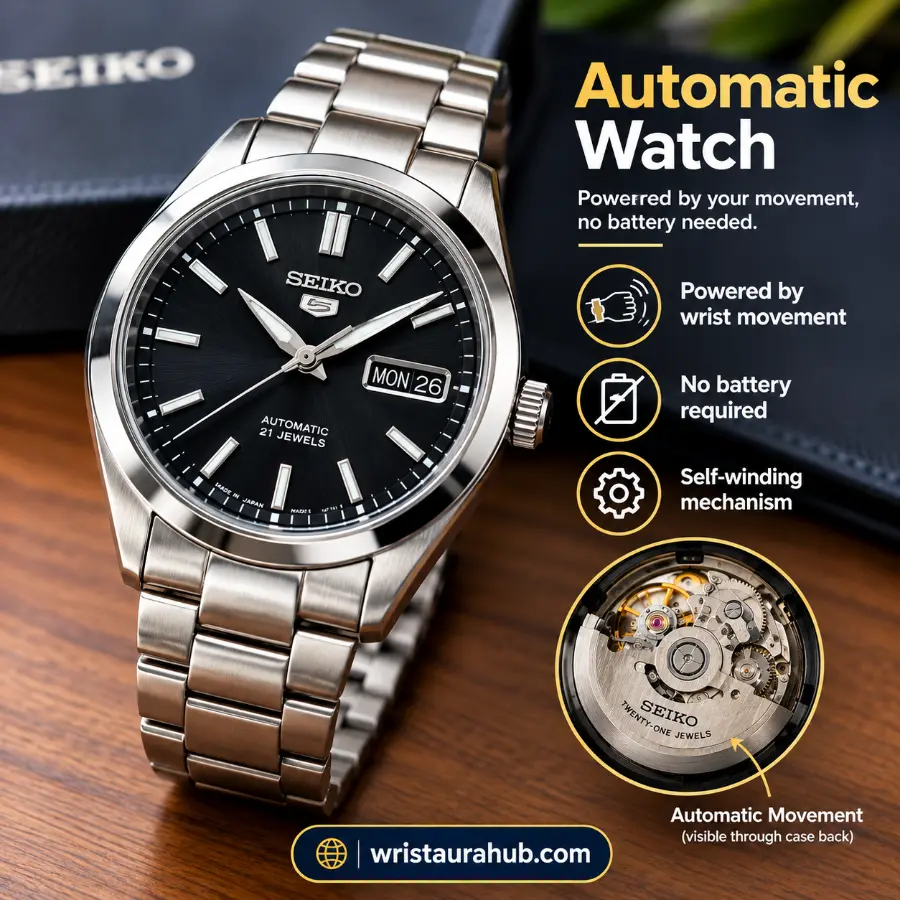
An automatic watch is a mechanical watch that winds its mainspring through a moving rotor, usually responding to the wearer’s wrist motion. The stored energy powers a system of gears and an escapement that regulates the movement of the hands.
Many enthusiasts enjoy automatic watches for their mechanical construction and the experience of wearing a miniature machine. Some offer a transparent caseback that reveals the movement. Power reserve varies by calibre, and the watch may stop after being left unworn longer than its reserve allows.
The trade-off is maintenance. Mechanical movements generally need periodic inspection and servicing, and they are usually less accurate than a good quartz movement. An automatic watch is not automatically superior: its appeal depends on whether you value mechanical craftsmanship enough to accept its extra cost and care.
Manual-Winding Watches
Manual-winding watches use a mechanical mainspring but lack the automatic winding rotor. You wind the crown by hand to store energy, then the mechanism releases that energy gradually to keep time.
This arrangement can allow a relatively slim movement and gives the owner a direct daily connection with the watch. It also suits traditional designs, including some dress watches and historically inspired timepieces.
The limitation is simple: you must wind it regularly according to the movement’s instructions. Forgetting to wind it means the watch will stop, and forcing the crown after it reaches its intended winding limit can damage the mechanism. Manual winding is best for someone who enjoys the routine rather than someone seeking the least effort possible.
Solar Watches
A solar watch converts light into electrical energy and stores it in a rechargeable cell. Unlike a conventional quartz watch that relies on a disposable battery, a solar-powered model can operate for extended periods between full charges when it receives adequate light.
Solar technology works particularly well for everyday watches because it combines quartz timekeeping with reduced battery-replacement needs. Many designs can charge from ordinary indoor light, although charging speed depends on the light source and the particular watch.
Solar does not mean maintenance-free forever. Rechargeable cells can lose capacity with age, and a watch stored in darkness for a long period may stop. Follow the manufacturer’s charging guidance and avoid assuming that every solar model has the same reserve or charging performance.
Dress Watches
A dress watch is designed to complement formal or smart clothing rather than perform a specialized task. Typical features include a restrained dial, a relatively thin case, modest detailing, and a leather strap or slim metal bracelet. Hours, minutes, and perhaps a date display are often enough.
Case thickness matters as much as diameter. A watch that slips neatly beneath a shirt cuff is generally more practical for formal wear than a tall case with prominent pushers or a rotating bezel. Traditional dress watches tend to use simple designs, but modern conventions are flexible: a clean steel watch on a bracelet can work in many business settings.
The limitation is practical durability. A slim dress watch may offer less water resistance and less grip-friendly controls than a sports watch. Do not infer its water capability from its appearance; check its actual rating and condition before exposing it to water.
Dive Watches
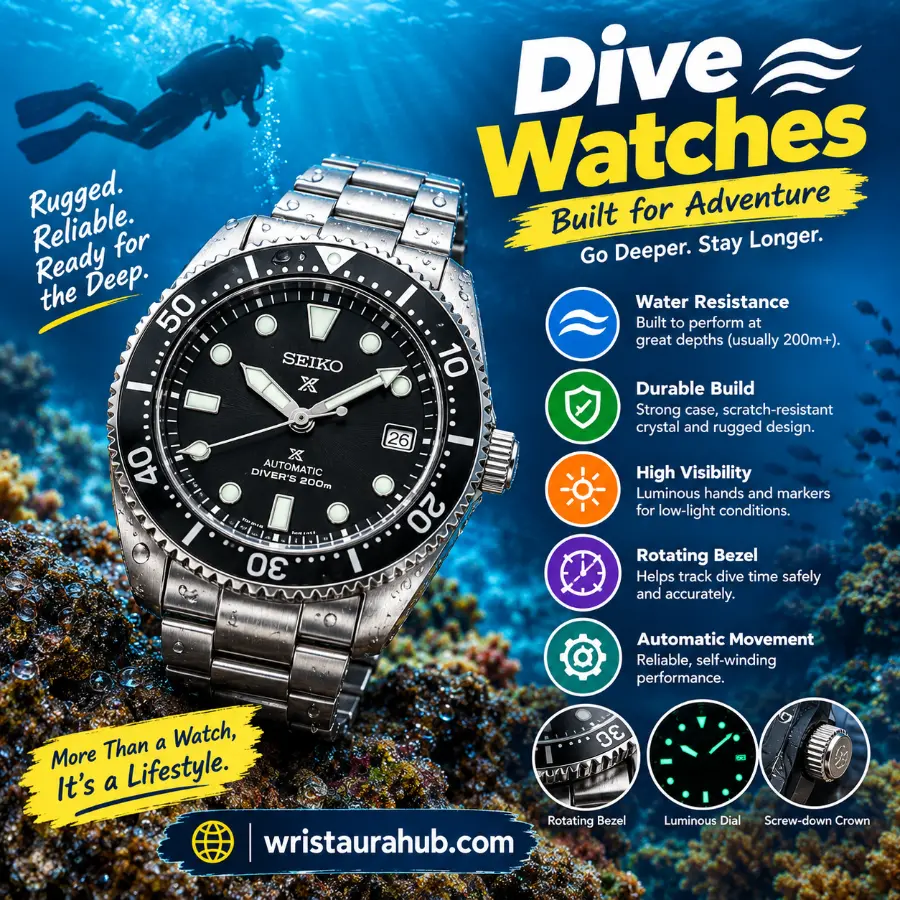
Dive watches are designed around underwater legibility, reliable elapsed-time tracking, and water resistance. Common features include luminous hands and markers, a rotating bezel with a minute scale, and a case built to protect the movement from water pressure.
The unidirectional bezel is especially important. A diver aligns its zero marker with the minute hand at the start of a dive. If the bezel is accidentally knocked, it can indicate less elapsed time rather than more, which helps reduce the risk of underestimating time underwater. This safety logic is why a proper dive bezel should not simply rotate in either direction.
A watch labelled water-resistant is not necessarily certified for diving. The ISO 6425 standard specifies requirements and testing for divers’ watches, including water resistance at depths of at least 100 metres. Always check the watch’s stated rating, certification, and condition before using it underwater.
The limitation is that dive watches can be thick, heavy, and visually sporty. Also, a rating printed on the case does not guarantee that an older watch remains sealed; gaskets age, and seals can be damaged. Have a watch pressure-tested before relying on it for swimming or diving.
Field Watches
Field watches emphasize clear reading, practical construction, and uncomplicated operation. Their designs draw inspiration from military and outdoor timepieces, often using high-contrast Arabic numerals, a straightforward minute track, luminous hands, and a durable strap.
A field watch can be a useful everyday choice because it avoids much of the visual clutter found on more complicated designs. Canvas, nylon, leather, and rubber straps can all suit the category, depending on the model and intended use.
The limitation is that the label alone does not promise ruggedness. A field-inspired watch may have a basic water-resistance rating, a fragile finish, or weak lume. Check the construction and specifications instead of assuming that military styling means the watch can withstand every outdoor activity.
Pilot Watches
Pilot watches are designed around quick, clear reading. Many feature large numerals, prominent hands, strong contrast, and a generous crown that is easy to grip. Some aviation-inspired models also use slide-rule bezels, additional time-zone displays, or chronograph functions.
Not all pilot watches are enormous. Some prioritize a clean, compact layout, while traditional cockpit-inspired designs can have larger cases and busy dials. The right design depends on whether you value immediate readability or specialist functions.
Their limitation is that a large dial and oversized crown may feel awkward on a smaller wrist or catch on clothing. Pilot styling also does not automatically mean a watch has aviation certification or specialized magnetic protection. Those qualities must be confirmed individually.
Chronograph Watches
A chronograph is a watch with a stopwatch function. Separate pushers commonly start, stop, and reset the timing mechanism, while subdials display elapsed seconds, minutes, or hours. Some models also include a tachymeter scale for estimating speed over a known distance.
Chronographs are useful for measuring intervals during exercise, cooking, motorsport, or other activities. They are also popular for their technical appearance and layered dial design.
The limitation is complexity. Extra components can increase servicing costs, while multiple scales and subdials may make the time less immediately readable. If you rarely measure elapsed time, a simpler watch may be more convenient. A chronograph is a functional feature, not merely a dial with decorative circles.
Smartwatches and Digital Watches

Digital watches display time using numerals or electronic graphics rather than relying solely on traditional hour and minute hands. A basic digital watch may provide alarms, a stopwatch, a timer, and a backlight without requiring a phone connection.
A smartwatch goes further by offering connected features such as notifications, activity tracking, navigation, or health-related sensors. Its capabilities depend on the model, operating system, paired phone, and available software support.
These categories overlap: many smartwatches have digital displays, but not every digital watch is smart. Some modern designs also combine analogue hands with electronic features.
The limitation is power and long-term support. Smartwatches usually require frequent charging compared with ordinary quartz watches, and some features depend on compatible phones or subscriptions. Consider battery life, privacy settings, repair options, and software support before choosing one.
How to Identify a Watch by Looking at It
You can often identify a watch’s style without knowing its brand or model. Use this order to avoid confusing appearance with actual capability.
- Look at the display. Traditional hands suggest an analogue watch; numerical screens suggest digital or smartwatch designs. A hybrid can use both.
- Inspect the controls. Two pushers beside the crown often indicate a chronograph. A rotating bezel may provide elapsed-time tracking or another scale.
- Read the dial. Large, high-contrast numerals suggest a field or pilot design. Minimal markings and a slim profile often point to a dress watch.
- Check the case and strap. A thick case, prominent bezel, and rubber strap are common on sports watches. Thin cases and understated straps are common on dress watches, though neither combination is a rule.
- Verify the specifications. Check the movement, crystal, case material, water-resistance rating, and any stated certification. A watch’s appearance cannot establish these details reliably.
A GMT watch, for example, often has an additional 24-hour hand or scale to track another time zone. A tachymeter bezel or scale is used to calculate speed over a measured distance. These features describe functions, not necessarily entirely separate styles.
Which Watch Type Fits Your Needs?
The most useful choice is the watch that suits your daily routine, clothing, and tolerance for maintenance.
| Your situation | Suitable category | What to prioritize |
|---|---|---|
| Office, suits, formal events | Dress | Slim case, clear dial, cuff comfort |
| Swimming or diving | Dive | Appropriate rating, condition, verified specifications |
| Everyday casual wear | Field or simple sports | Legibility, comfort, durability |
| Travel across time zones | GMT or travel watch | Clear second-time-zone display |
| Timing intervals | Chronograph | Readable scale and easy controls |
| Low-maintenance timekeeping | Quartz or solar | Accuracy, power source, battery service |
| Mechanical craftsmanship | Automatic or manual | Movement quality, service access |
| Notifications and activity tracking | Smartwatch | Compatibility, battery life, software support |
Consider your wrist size
Case diameter is only part of the fit. Lug-to-lug length—the distance from one end of the case to the other—determines whether the watch extends beyond your wrist. Case thickness also affects comfort under sleeves.
If you have a smaller wrist, start by trying compact cases with shorter lug-to-lug measurements rather than automatically choosing a smaller diameter. Large crowns, wide bezels, and integrated bracelets can change how a watch wears.
Consider your budget and maintenance
A basic quartz watch is often the sensible starting point when reliability and affordability matter most. Solar models can reduce routine battery replacement, while mechanical watches appeal to people who appreciate traditional engineering and accept servicing costs.
Set aside money for straps, battery replacements where applicable, water-resistance checks, and mechanical servicing. A lower purchase price does not always mean a lower lifetime cost.
How to Recognize Quality Beyond the Label
A watch’s category tells you What a watch category is designed to do does not establish how well the watch is made. When comparing different types of watches, check these quality indicators before making a judgment.
- Movement: Look for documented accuracy, a credible warranty, and accessible servicing. Mechanical finishing can be attractive, but decoration alone does not prove reliability.
- Case and bracelet: Check for clean finishing, secure links, comfortable edges, and a clasp that closes reliably.
- Crystal: Sapphire is generally more scratch-resistant than mineral glass, while mineral glass can be less expensive to replace. Neither material makes a watch indestructible.
- Dial and hands: Markers should align cleanly, hands should be well finished, and the time should be easy to read in the intended conditions.
- Water resistance: Check the stated rating and the manufacturer’s instructions. Water resistance can decline as seals age or after repairs.
- After-sales support: Confirm the warranty terms and whether qualified watchmakers can obtain parts or service the movement.
The best types of watches do not necessarily have the most features. A clear dial, dependable movement, comfortable fit, and accessible servicing can matter more than an impressive specification sheet. Focus on these practical quality indicators to choose a watch that suits your needs and offers lasting value.
Common Misconceptions About Watch Categories
“Automatic watches are always better than quartz.” The different types of watches use different technologies. Quartz generally offers easier ownership and strong accuracy, while mechanical movements appeal to people who value traditional engineering.
“Every dive-style watch is suitable for diving.” A rotating bezel and sporty case do not prove diving suitability. Check the water-resistance rating, condition, and relevant certification. ISO 6425 is a specific divers’ watch standard, not a general synonym for water resistance.
“A 30-metre rating means I can dive to 30 metres.” Water-resistance markings are not guarantees of safe operating depth in every situation. A 30 m rating is generally intended for limited exposure to splashes, not swimming or diving. A 50 m rating should not automatically be treated as suitable for every swimming activity. Follow the manufacturer’s guidance and choose a watch explicitly designed for your intended water activities.
“More complications mean better quality.” Extra functions can be useful, but they can also increase complexity and make a dial harder to read. When comparing different types of watches, prioritize the functions you will actually use.
“A watch can only belong to one category.” A watch may be an automatic dive watch, a quartz chronograph, or a solar field watch. Movement and style are separate classification systems, which is why one watch can fit multiple categories.
“Expensive materials guarantee a better watch.” Sapphire crystal, titanium, precious metals, and elaborate finishing can add value, but they do not replace good design, reliable construction, accurate timekeeping, or dependable service. The best types of watches are those that meet your needs and offer the right balance of quality, comfort, and practicality.
The Final Talk
Understanding the different types of watches starts with one simple distinction: movement explains how a watch keeps time, while style defines its design and purpose. Quartz and solar watches suit people who prefer convenient timekeeping, whereas automatic and manual-winding watches appeal to those who appreciate mechanical craftsmanship.
For everyday wear, formal occasions, travel, or sports, choose a watch that matches your routine, comfort, and maintenance preferences. Rather than judging a watch by its appearance or price alone, compare its features, durability, accuracy, and practical limitations. Once you understand these differences, choosing the right watch becomes much easier..
Frequently Asked Questions
The main categories include dress, dive, field, pilot, chronograph, GMT, digital, and smartwatches. Quartz, automatic, manual-winding, and solar describe how watches are powered or keep time.
Popular choices include dress watches for formal clothing, field watches for everyday use, dive watches for sporty styling, chronographs for timing, and GMT watches for travel. These categories are not exclusive to men; fit, comfort, and personal preference matter more than gender labels.
Watch brands vary by their specialty, price range, and design philosophy. Some focus on accessible quartz watches, others on mechanical craftsmanship, sports watches, luxury timepieces, or smartwatches. Compare individual models and their specifications rather than assuming every watch from one brand shares the same features.
Apple Watch families include the standard Apple Watch Series, the Apple Watch SE, and the rugged Apple Watch Ultra line. Features and water-resistance capabilities vary by model and generation. Series 2 and later support shallow-water activities such as swimming, while Ultra models support additional activities within their stated limits. Water resistance can decline with wear, and not every band is suitable for water.
Common Rolex families include the Submariner, Datejust, Day-Date, GMT-Master II, Explorer, Daytona, and Oyster Perpetual. They serve different design and functional purposes, including diving, travel, formal wear, and everyday timekeeping. Exact configurations vary by reference and production period.
There is no single permanent number because Rolex’s collection includes multiple model families, variants, dial configurations, materials, and generations. The most useful approach is to group them by purpose, such as professional sports, travel, diving, and classic everyday watches, then compare the specific references.
Discover More to Learn
Steinhart Watches: 5 Top-Rated Models to Consider in 2026
Top Cartier Watches for Women Reviewed: 7 Best Picks in 2026