
The most expensive watches are valued for far more than precious metals or complicated movements. At the highest end of the market, a watch can become a historical artifact, a unique commission, or a collector’s prize with a documented connection to a famous owner. Public auction results offer a useful way to compare these extraordinary timepieces because they show what buyers actually paid at a particular sale.
The rankings below focus on documented auction results rather than advertised retail prices. They include wristwatches and a pocket watch, so readers can distinguish the overall auction record from records for particular types of timepieces. Prices are historical results, not current offers or guarantees of future value.
At a Glance
- Overall auction record: The Patek Philippe Grandmaster Chime Ref. 6300A-010 sold for CHF 31 million at Christie’s in Geneva on November 9, 2019.
- Famous pocket-watch record: The Henry Graves Jr. Supercomplication sold for approximately $24 million at Sotheby’s in November 2014.
- Notable modern wristwatch result: The stainless-steel Patek Philippe Ref. 1518 sold for CHF 14.19 million in Geneva in November 2025.
- Important distinction: An auction result differs from a manufacturer’s retail price, a private asking price, or an estimated valuation.
The Most Expensive Watches Ranked by Verified Auction Results
Figures last verified October 2026. Original sale currencies are retained where practical; USD equivalents are those reported by the auction source and should not be treated as today’s currency conversions.
| Watch | Maker | Reported auction result | Auction and date |
|---|---|---|---|
| Grandmaster Chime Ref. 6300A-010 | Patek Philippe | CHF 31,000,000 | Christie’s, November 9, 2019 |
| Henry Graves Jr. Supercomplication | Patek Philippe | About $24 million | Sotheby’s, November 2014 |
| Paul Newman’s Daytona Ref. 6239 | Rolex | $17,752,500 | Phillips, October 26, 2017 |
| Perpetual Calendar Chronograph Ref. 1518, stainless steel | Patek Philippe | CHF 14,190,000 | Phillips, November 2025 |
| Grande and Petite Sonnerie Ref. 6301A-010 | Patek Philippe | CHF 15,700,000 | Christie’s, May 10, 2024 |
| FFC Prototype | F.P. Journe | $10,775,000 | Phillips, December 2025 |
These entries are selected landmark sales, not a strict descending ranking across every type of watch. For example, the 2024 Patek Philippe Ref. 6301A-010 sold for more in Swiss francs than the 2025 Ref. 1518, while the 2017 Rolex Daytona’s reported dollar result was higher than the 2025 steel 1518’s reported dollar equivalent. Different currencies and sale dates make a single cross-year ordering less straightforward.
1. Patek Philippe Grandmaster Chime Ref. 6300A-010
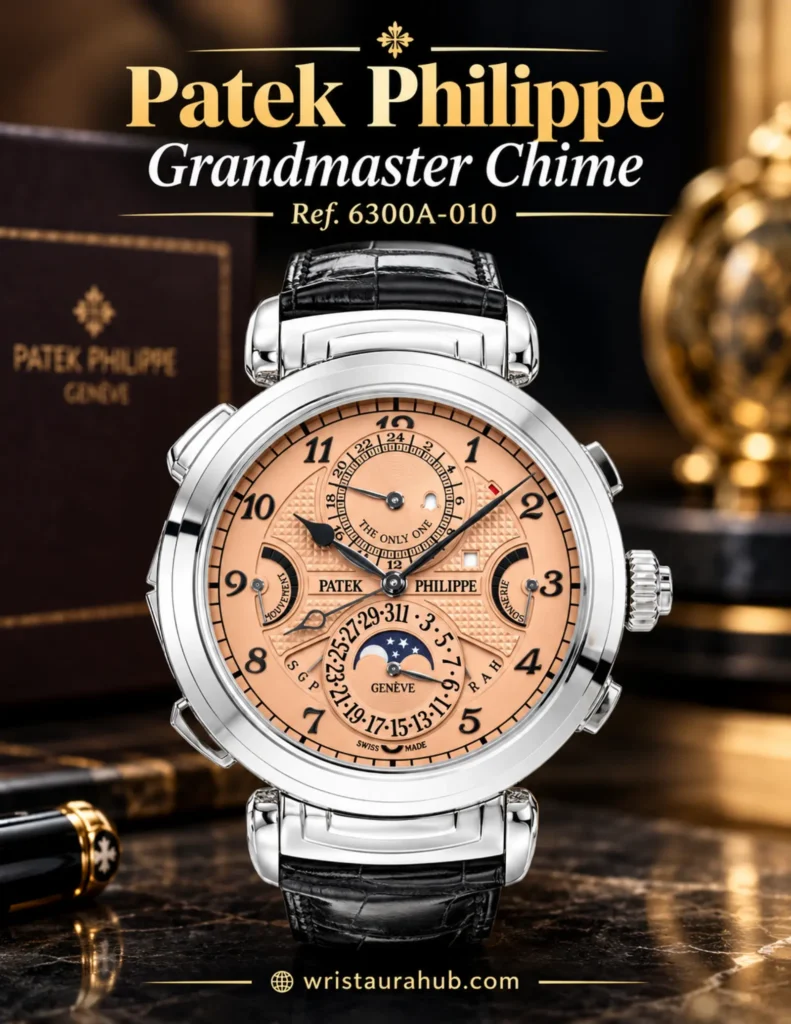
Sold for CHF 31 million at Christie’s, Geneva, on November 9, 2019.
The stainless-steel Grandmaster Chime Ref. 6300A-010 holds the widely recognized record for the most expensive watch sold at auction. Patek Philippe created this unique version for the Only Watch charity auction, and its case bears the inscription “The Only One.”
Its appeal comes from a combination of rarity and technical ambition. The reversible case has two dials, and the watch contains 20 complications, including multiple chiming functions. Such mechanisms require sophisticated engineering and extensive specialist work.
The charitable context also matters. The sale supported research into Duchenne muscular dystrophy, giving the auction a purpose beyond acquiring a luxury object. Still, the record reflects the specific watch, the event, and the bidders involved—not a price that every Grandmaster Chime would command.
2. Patek Philippe Henry Graves Jr. Supercomplication
Sold for approximately $24 million at Sotheby’s, Geneva, in November 2014.
The Henry Graves Jr. Supercomplication is a landmark pocket watch commissioned by American banker and collector Henry Graves Jr. It took eight years to create, from 1925 to 1933, and contains 24 complications. These include a perpetual calendar, a minute repeater with Westminster chimes, and a celestial chart depicting the night sky over New York.
Its importance lies in both its technical complexity and its place in watchmaking history. Before modern computer-aided design became commonplace, producing such a mechanism required painstaking calculations, specialist craftsmanship, and extensive coordination.
The watch also illustrates why the most expensive timepieces are not always worn on the wrist. Pocket watches can command extraordinary sums when their provenance, condition, historical significance, and mechanical achievements converge.
3. Rolex Daytona Ref. 6239 Owned by Paul Newman
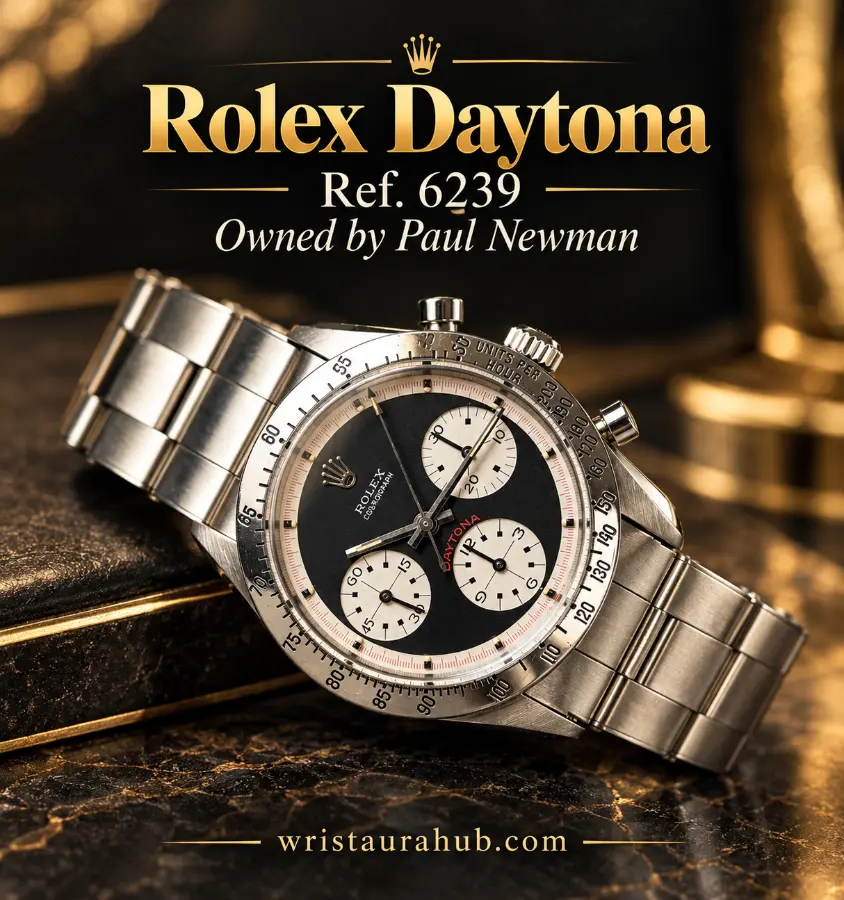
Sold for $17,752,500 at Phillips, New York, on October 26, 2017.
This stainless-steel Rolex Daytona became famous partly because of its association with actor and racing enthusiast Paul Newman. Its distinctive dial helped inspire the collector nickname “Paul Newman Daytona,” but the record-setting watch was particularly important because it was his personal example.
Phillips reported that the watch sold after a 12-minute bidding contest. The final price included the buyer’s premium, an important detail when comparing auction results.
The Daytona’s story shows the power of provenance. A standard production model can be desirable because of its design and racing heritage, but a documented connection to a famous owner can make one particular example far more valuable than comparable watches.
4. Patek Philippe Perpetual Calendar Chronograph Ref. 1518 in Stainless Steel
Sold for CHF 14,190,000 at Phillips, Geneva, in November 2025.
Introduced in 1941, the Ref. 1518 was the first serially produced perpetual-calendar chronograph wristwatch model. The stainless-steel example sold by Phillips in November 2025 was particularly rare: the auction house described it as one of only four known steel examples.
The watch combines a chronograph, which measures elapsed time, with a perpetual calendar designed to account for month lengths and leap years. Combining those functions in a compact wristwatch was a major achievement for its era.
Steel is not inherently more expensive than gold or platinum. In this case, rarity, historical importance, and collector demand helped drive the result. The same reference in a different material or condition would not automatically achieve a comparable price.
5. Patek Philippe Grande and Petite Sonnerie Ref. 6301A-010
Sold for CHF 15.7 million at Christie’s, Geneva, on May 10, 2024.
This stainless-steel Patek Philippe was offered at the Only Watch charity auction in 2024. Its manually w
The movement features grande and petite sonnerie functions alongside a minute repeater, allowing the watch to chime the time in different ways. Its blue-green handcrafted dial adds another layer of specialist artistry.
Striking watches are among the most technically demanding mechanical timepieces. The movement must coordinate multiple components to produce the correct sequence of sounds, and the mechanism needs careful adjustment.
The auction result reflects the combination of acoustic engineering, finishing, rarity, and the event itself. It is a useful reminder that the highest prices are often attached to unusual combinations of functions and craftsmanship rather than to simple timekeeping alone.
6. F.P. Journe FFC Prototype
Sold for $10,775,000 at Phillips, New York, on December 6–7, 2025.
The FFC Prototype attracted major attention at auction because of its distinctive approach to displaying time and its connection to filmmaker Francis Ford Coppola, from whose collection it was consigned. The watch sold for $10.775 million.
The watch stands apart from traditional dial layouts. Its unusual display and bespoke character make it an example of how independent watchmaking can reach the same collector conversation as historic pieces from larger manufacturers.
Its result should not be read as a typical price for F.P. Journe watches. A prototype associated with a prominent owner is an exceptional object, and the market for such a piece differs substantially from the market for a regular production model.
What Makes a Luxury Watch Worth Millions?
An extraordinary auction price usually comes from several factors working together. A precious-metal case alone rarely explains a record-setting result.
Provenance and ownership
Provenance is the documented history of a watch, including who commissioned it, who owned it, and how it passed between collections. A watch linked to a famous collector or a significant historical event can attract interest that an otherwise similar example cannot.
Mechanical complications
A complication is any watch function beyond the basic display of hours, minutes, and seconds. Chronographs, perpetual calendars, minute repeaters, and astronomical displays can demand considerable engineering and finishing. More complications do not automatically mean a higher price, but unusual combinations can distinguish a watch from its competitors.
Rarity and originality
A unique commission or an exceptionally rare reference can attract intense competition. Original components, an authentic dial, and a well-documented history may matter more than a case made from a costly material. Replacement parts or poorly documented modifications can weaken a collector’s confidence.
Condition and auction competition
Condition affects both appearance and originality. Heavy polishing, damage, replacement parts, and incomplete documentation may reduce desirability. Even a well-preserved watch can sell for less than expected if bidding is weak, while two determined collectors can push an exceptional piece far beyond its estimate.
Which Brands Make the World’s Most Valuable Watches?
Patek Philippe dominates several of the landmark results above, but it is not the only manufacturer associated with exceptional auction prices.
- Patek Philippe — Known for complicated mechanical watches, historic references, and highly collectible limited or unique pieces.
- Rolex — Its strongest auction stories often combine recognizable designs, rarity, and significant ownership histories.
- F.P. Journe — An independent maker whose technically distinctive and individually important pieces can attract major collector interest.
- Audemars Piguet — Known for high-end mechanical watchmaking and important designs, including the Royal Oak family.
- Richard Mille — Associated with contemporary designs, advanced materials, and highly limited production.
These manufacturers operate in different parts of the luxury market. A brand’s reputation can help establish demand, but it does not mean every model is rare, appreciates in value, or will sell for an extraordinary amount.
What Buyers Often Get Wrong About Record-Price Watches
The most expensive watch is not necessarily the most practical. A record-setting mechanical masterpiece may require specialist maintenance and careful handling. Someone who needs an accurate, reliable daily timekeeper may be better served by a much less expensive watch.
Retail prices and auction results are not interchangeable. A manufacturer’s retail price reflects a selling price for a particular model. An auction result reflects a completed transaction for a particular example, at a particular time, under particular conditions.
Gold and diamonds do not guarantee the highest value. Collectors may pay more for a rare steel watch than for a gold version if the steel example has exceptional historical importance or is much harder to find.
A famous owner’s name is not enough by itself. The association should be supported by credible documentation. Unverified stories can create misleading expectations about a watch’s value.
Record prices do not guarantee future appreciation. Auction markets change with collector tastes, economic conditions, and the availability of exceptional pieces. A past result is evidence of one sale, not a promise of investment returns.
The Final Talk
The highest auction prices reveal what collectors value when rarity, craftsmanship, history, and competition meet. Patek Philippe’s Grandmaster Chime leads the landmark results discussed here, while the Henry Graves Super complication demonstrates that a pocket watch can remain a major horological treasure. Rolex and independent makers such as F.P. Journe show how provenance and distinctive design can also create extraordinary demand.
The key takeaway is simple: judge a watch by its documented story, technical achievement, originality, and verified sale history—not by its price tag alone.
Frequently Asked Questions
The Patek Philippe Grandmaster Chime Ref. 6300A-010 holds the widely recognized overall auction record, selling for CHF 31 million at Christie’s in Geneva on November 9, 2019. Other landmark sales include the Henry Graves Super complication and Paul Newman’s Rolex Daytona.
Exceptional women’s watches can command high prices when they combine rare designs, precious stones, fine craftsmanship, and strong provenance. However, there is no single permanent ranking for women’s watches: results vary by the individual piece and auction. A reliable comparison should use completed sales with documented dates and prices.
Patek Philippe is responsible for several of the most notable auction-record timepieces. Rolex and independent maker F.P. Journe also have landmark results. The maker alone does not determine a watch’s value; rarity, condition, provenance, and collector demand all matter.
No. Retail prices are the amounts charged through a brand or authorized seller, while auction results record a completed sale. Depending on the auction and the figure reported, the result may include a buyer’s premium. Always check the sale terms before comparing prices.
Not necessarily. Rare watches can appreciate, but prices can also decline, and insurance, servicing, auction fees, and resale costs affect the outcome. Buy a watch for its craftsmanship or collecting appeal rather than assuming it will deliver a profit.
Start with the auction house’s own sale report or lot record. Confirm the watch reference, sale date, original currency, final reported amount, and whether the buyer’s premium is included. Treat unsourced social media claims and asking prices as unverified until they can be checked against a reliable record.
Pingback: Teddy Watches Review: Best Watches, Prices & Store Details