
A watch can do more than display hours, minutes, and seconds. Some models also track the changing appearance of the Moon, adding an astronomical indication to the dial. Moon phase watches use a dedicated complication to show where the Moon is in its approximately 29.53-day lunar cycle. The display might appear inside a small dial, through a curved aperture, or on a rotating disc decorated with stars.
Although the feature is often associated with traditional mechanical watchmaking, it is also available in other movement types. Understanding its mechanism, accuracy, and different display styles makes it easier to recognize what separates a simple lunar indicator from a sophisticated astronomical complication.
Moon Phase Watches at a Glance
- Definition: A watch complication that displays the Moon’s changing appearance during its lunar cycle.
- Main types: Six useful classifications based on display design, movement, and mechanical complexity.
- Key distinction: A traditional moon phase display tracks the lunar cycle rather than simply showing the date.
- Common misconception: Every moon phase mechanism does not have the same accuracy or require the same adjustment schedule.
What Are Moon Phase Watches?
A moon phase watch is a timepiece equipped with an additional indication showing the Moon’s visible illuminated portion as observed from Earth. The display follows the lunar cycle, moving through new moon, crescent, quarter, gibbous, and full moon phases.
Watchmakers classify this feature as a complication because it adds another function beyond basic timekeeping. It can work alongside a date display, calendar, chronograph, or perpetual calendar.
Most traditional designs use a rotating disc with two illustrated moons. A shaped opening in the dial reveals part of the disc, creating the appearance of the Moon gradually appearing and disappearing.
The complication is primarily an astronomical display rather than a practical timekeeping requirement. It does not replace a calendar or tell the time of sunrise and sunset. Its purpose is to represent the lunar cycle accurately and attractively.
How Different Moon Phase Displays Compare
Moon phase mechanisms can be classified by their display design and the technology driving them. The following comparison covers six useful variations.
| Display type | How it works | Main characteristic | Limitation |
|---|---|---|---|
| Traditional aperture | Rotating disc appears through a dial opening | Classic moon illustration | Usually needs periodic correction |
| Subdial indicator | Small dedicated dial displays lunar progress | Clear separation from main dial | Can make the dial busy |
| Hand-operated display | A hand points to lunar phase markings | Easy-to-read indication | Less visually detailed |
| Three-dimensional moon | A spherical moon rotates to show illumination | Sculptural appearance | More complex construction |
| Quartz moon phase | Electronic timekeeping drives the display | Convenient timekeeping | Less traditional mechanical appeal |
| High-precision mechanical | Specialized gearing improves lunar accuracy | Longer correction intervals | Greater engineering complexity |
[readmore url=”https://wristaurahub.com/michael-kors-watches/”]
1. Traditional Aperture Display

The traditional aperture is one of the most recognizable designs in watchmaking. A curved opening reveals a rotating disc decorated with two moon illustrations against a dark background.
As the disc moves, the visible Moon gradually changes from a crescent to a full circle and then disappears again. The design gives the impression of watching the actual lunar cycle through a small window.
This arrangement is popular in dress watches because it adds visual interest without taking over the entire dial.
Limitation: Conventional mechanisms approximate the lunar cycle, so they eventually require manual correction.
2. Subdial Moon Phase Display
A subdial places the lunar indication inside a separate circular section of the watch face. Some designs use a small rotating moon disc, while others include markings representing different stages of the lunar month.
This layout works well when the watch also includes a date, small seconds, or calendar functions. Each indication has its own visual space.
The result can look balanced when the dial proportions are carefully designed.
Limitation: Multiple subdials can make a compact watch difficult to read at a glance.
3. Hand-Indicated Lunar Display
Some watchmakers use a dedicated hand instead of a rotating illustrated disc. The hand moves across a scale marked with lunar phases or symbols.
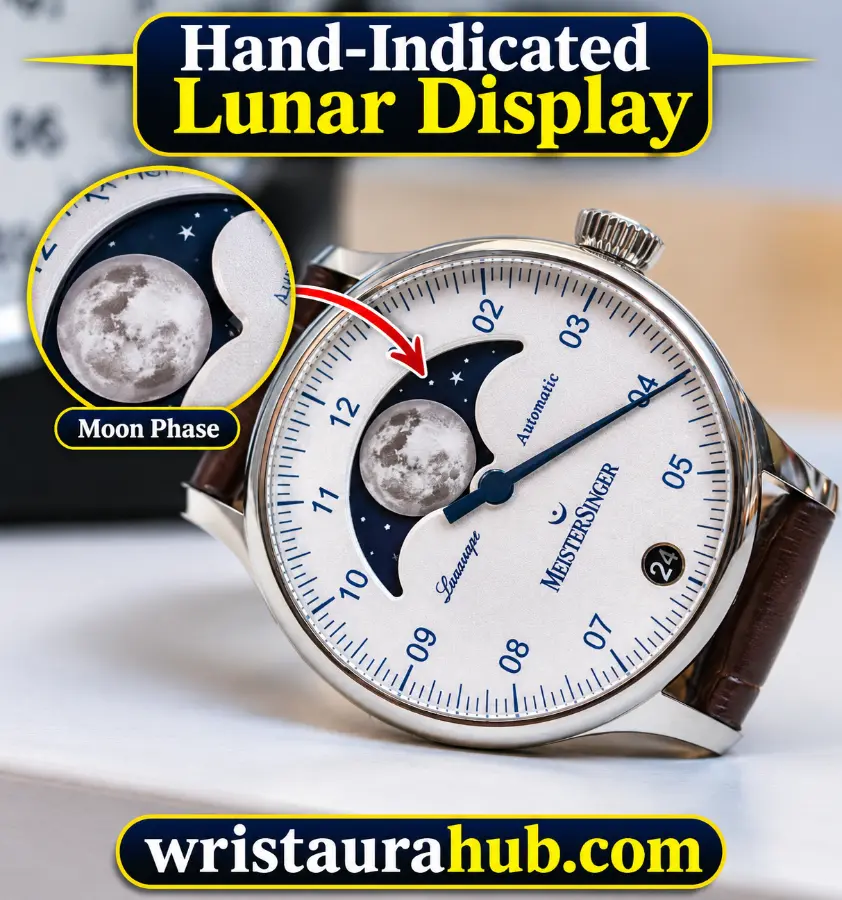
This arrangement presents the information more directly. Rather than looking through an aperture, the wearer reads the hand’s position against the markings.
It can also provide a clean alternative for watches with limited dial space.
Limitation: The display may lack the visual depth of a traditional moon illustration.
4. Three-Dimensional Moon Display
A three-dimensional moon display uses a small spherical element to represent the illuminated and dark portions of the Moon.
As the mechanism rotates the sphere, its visible appearance changes according to the lunar cycle. Some designs place the miniature Moon against a star-filled background.
This approach requires more specialized engineering than a basic printed disc.
Limitation: The additional construction can increase manufacturing complexity and servicing requirements.
5. Quartz-Powered Lunar Display
Quartz watches can also display lunar information. Their electronic timekeeping system controls the movement of the moon phase indicator.
Depending on the design, the indication may use a motor-driven disc or another electronic display arrangement.
Quartz construction offers dependable everyday timekeeping without requiring the wearer to wind a mechanical movement.
Limitation: The experience may appeal less to collectors who specifically value traditional mechanical construction.
6. High-Precision Mechanical Display
A high-precision mechanism uses more sophisticated gearing to follow the lunar cycle more closely.
Traditional moon phase systems commonly approximate a lunar month as 29.5 days. More advanced designs use additional gear calculations to reduce the difference between the displayed and actual lunar phases.
Some manufacturers combine this complication with a perpetual calendar, allowing several calendar indications to work together.
Limitation: Greater mechanical complexity can make the watch more expensive to manufacture, maintain, and repair.
[readmore url=”https://wristaurahub.com/japan-movement-watch/”]
How Does a Moon Phase Work on Watches?
The Moon takes approximately 29 days, 12 hours, 44 minutes, and 3 seconds to complete the cycle from one new moon to the next. Watchmakers refer to this interval as a synodic month.
A traditional mechanical mechanism uses a 59-tooth gear to represent two lunar cycles. Since 59 divided by two gives 29.5, the arrangement approximates the actual lunar month.
Here’s how the mechanism operates:
- A gear connected to the timekeeping movement drives the moon phase mechanism.
- A small driving finger advances the lunar disc once every 24 hours.
- The disc gradually changes the portion of the illustrated Moon visible through the aperture.
- The second moon illustration becomes visible as the first moves out of view.
- The cycle repeats as the mechanism continues running.
The small difference between 29.5 days and the actual lunar cycle gradually accumulates. A conventional mechanism therefore gains approximately one day of error every two years and eight months.
More sophisticated mechanisms use additional gearing to reduce this error substantially. Understanding Moon Phases in Timekeeping+2
Mechanical Accuracy and the Lunar Cycle
Accuracy is one of the most important differences between basic and advanced lunar displays.
A standard mechanism is not designed to reproduce the lunar cycle to the exact second. Its 29.5-day approximation makes the construction relatively simple and compact.
More advanced designs improve the calculation through specialized gear ratios. The difference becomes especially noticeable over long periods.
| Mechanism | Approximate correction requirement |
|---|---|
| Traditional 59-tooth system | Around every 2 years and 8 months |
| More precise mechanical system | Can extend to decades or centuries |
| Advanced astronomical mechanism | Some designs claim accuracy over thousands of years |
These are general categories, not guaranteed intervals for every watch. Always follow the manufacturer’s instructions for the particular movement.
IWC provides a notable example of advanced engineering. Its Double Moon display on certain perpetual calendar watches shows the lunar phases for both the northern and southern hemispheres. Selected traditional IWC mechanisms have a stated deviation of one day after 577.5 years.
The Portugieser Eternal Calendar goes further, with a theoretical deviation of one day in 45,361,055 years, according to IWC and Guinness World Records. IWC Schaffhausen+2
What Makes IWC’s Lunar Complication Different?
IWC moon phase watches demonstrate how a traditional complication can become a major engineering achievement.
The manufacturer’s Double Moon display shows the Moon as viewed from both hemispheres. This is a useful distinction because the apparent orientation of the lunar phases differs between northern and southern observers.
Selected IWC perpetual calendar movements also coordinate the lunar indication with calendar information. This integration requires more than simply placing a moon illustration on a rotating disc.
The Portugieser collection is particularly associated with this approach. Its perpetual calendar models demonstrate how lunar indications can become part of a larger astronomical and calendar system.
However, not every IWC moon phase watch has identical technology. Accuracy, display design, and adjustment requirements depend on the specific reference and movement.
Why Are Moon Phase Watches So Expensive?
A moon phase indication does not automatically make a watch expensive. The cost depends on the movement, materials, finishing, brand, and complexity of the complete timepiece.
Several factors explain why some examples command higher prices.
Additional Mechanical Components
A mechanical moon phase complication needs additional gears, a rotating disc, and other supporting components. These parts must work together with the main movement without interfering with normal timekeeping.
More advanced constructions require additional engineering and assembly work.
Precision Engineering
The difference between a basic 59-tooth mechanism and a highly accurate astronomical display can be substantial.
Producing a mechanism that maintains its indication over decades or centuries requires careful calculations and specialized manufacturing.
Perpetual Calendar Integration
Some watches combine the lunar indication with a perpetual calendar. This adds another layer of mechanical programming because the movement must account for different month lengths and leap years.
Such watches are generally more complicated than models displaying only the date and lunar cycle.
Materials and Finishing
Precious-metal cases, sapphire crystals, hand-finished movements, and detailed dial decoration can raise production costs.
These elements are separate from the moon phase complication itself, but they contribute to the final price.
Brand Positioning and Production
Luxury manufacturers may charge more because of their production methods, heritage, distribution, and finishing standards.
A moon phase watch from an established haute horlogerie manufacturer can therefore cost considerably more than a straightforward quartz example.
The important distinction: A higher price does not automatically mean a more accurate lunar display. Compare the actual movement and correction interval rather than relying on the brand name alone.
[readmore url=”https://wristaurahub.com/wren-watches/”]
How to Choose the Right Lunar Display
Choosing a suitable design depends on how much mechanical complexity you want and how you plan to wear the watch.
For Everyday Wear
A quartz-powered model can make sense if you want convenient timekeeping and an additional lunar display. It generally requires less daily attention than a manually wound mechanical watch.
For Traditional Watchmaking
An automatic or manually wound model offers a more traditional mechanical experience. The rotating disc and gear arrangement are part of the appeal.
For Formal Occasions
A slim case, restrained dial, leather strap, and balanced aperture can complement formal clothing. Avoid oversized displays if you prefer a cleaner appearance.
For Collectors
More advanced astronomical displays, double moon indications, and perpetual calendar integration offer greater mechanical interest. However, servicing costs and adjustment procedures deserve attention.
For Different Wrist Preferences
Moon phase watches for men are often marketed with larger cases and more prominent complications, but the display is not restricted by gender. Case thickness, lug-to-lug distance, and dial proportions matter more when choosing a comfortable fit.
How to Recognize a Well-Made Moon Phase Complication
A decorative Moon illustration alone does not tell you whether the mechanism is well constructed. Look beyond the appearance.
- Movement information: Check whether the manufacturer identifies the movement and explains how it drives the lunar display.
- Accuracy specification: Look for a stated deviation or correction interval.
- Adjustment system: Confirm whether the watch uses a crown, corrector button, or another setting method.
- Dial alignment: The Moon should move smoothly and remain properly aligned with its aperture or scale.
- Calendar integration: If the watch includes a date or perpetual calendar, check how the indications interact.
- Servicing support: Confirm that qualified service is available for the particular movement.
A well-made basic mechanism can be a better choice than an unnecessarily complicated watch with limited servicing support.
Common Misconceptions About Lunar Complications
Every Moon Phase Display Is Equally Accurate
This is incorrect. Traditional 59-tooth mechanisms have a predictable accumulated error, while more sophisticated gear systems can extend the correction interval significantly.
The Moon Phase Indicator Shows the Date
The two functions are different. A date display tracks the calendar, while a lunar indicator represents the Moon’s position in its cycle.
Automatic Watches Never Need Adjustment
An automatic movement can stop when its power reserve runs out. Depending on the mechanism, the lunar indication may then need to be reset.
A More Expensive Watch Always Has Better Accuracy
Price reflects several factors, including materials, finishing, brand positioning, and movement complexity. It does not provide a direct measure of lunar accuracy.
Moon Phase Watches Are Only Decorative
Although the complication has strong aesthetic appeal, it also represents a real astronomical cycle. Some advanced designs provide impressive mechanical precision.
The Final Talk
A lunar indication adds something different to a traditional timepiece. It connects mechanical watchmaking with an astronomical cycle that has been observed for centuries.
For a first purchase, a simple and well-made aperture display is often sufficient. Collectors interested in technical achievement may prefer advanced gearing or perpetual calendar integration.
The best choice is not necessarily the most complicated one. Prioritize reliable construction, readable design, and an adjustment system you can understand. That combination makes the complication enjoyable rather than merely decorative.
Frequently Asked Questions
They use a rotating disc or another mechanical or electronic indicator to represent the Moon’s changing appearance. Traditional mechanical designs commonly use a 59-tooth wheel to approximate two lunar cycles.
A moon phase display shows the Moon’s visible illuminated shape. A moon age indication represents the time elapsed since the last new moon.
A conventional 59-tooth mechanism generally needs correction after approximately two years and eight months. More precise movements can operate much longer before requiring adjustment.
Yes. Quartz, manually wound, and automatic watches can all incorporate lunar indications. The mechanism depends on the watch’s movement design.
Yes. They can be worn daily, provided the watch has suitable construction, comfortable dimensions, and appropriate water resistance. The complication itself does not determine durability.
They require the same general care as their underlying movement, although the additional complication may make servicing more specialized. Follow the manufacturer’s service recommendations and adjustment instructions.
Discover More to Learn
Best Watch Brands for Women: Top Choices for Every Style
Square Watches: Best Luxury, Dress & Everyday Designs
[authorbox]