
Crossing time zones is easy; keeping track of home time shouldn’t be.The best GMT watches let you track a second time zone without doing mental math every time you land somewhere new. But not all GMTs work the same way. True GMT and caller GMT movements handle local and home time differently, which can matter a lot for frequent travelers.
In this guide, we compare seven standout GMT watches across budget, travel, everyday wear, and luxury to help you find the right fit.
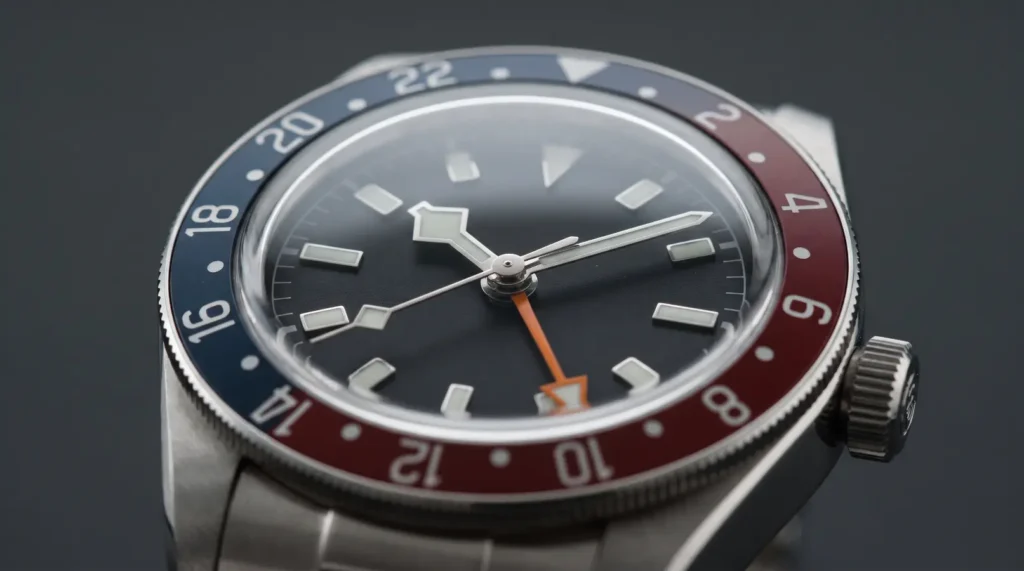
What Is a GMT Watch?
A GMT watch is designed to display a second time zone alongside your local time. Most use a dedicated 24-hour GMT hand that completes one rotation per day, paired with a 24-hour scale on the dial or bezel.
The useful part is not simply having another hand. The movement determines how easily you can change time zones, which is why frequent travelers should understand the difference between a true GMT and a caller GMT before buying.
True GMT vs Caller GMT
A true GMT, also called a traveler GMT, lets you jump the local hour hand independently when you arrive in a new time zone. The GMT hand stays anchored to your reference or home time.
A caller GMT works differently. The GMT hand is normally the independently adjustable hand, while the main hour hand remains tied to the movement’s timekeeping.
| Feature | True GMT / Traveler GMT | Caller GMT / Office GMT |
|---|---|---|
| Independent adjustment | Local hour hand | GMT hand |
| Best for | Frequent travelers | Tracking another time zone from home |
| Airport usefulness | Excellent | Good |
| Typical complexity | Higher | Usually simpler |
| Common examples | Longines Zulu Time, Rolex GMT-Master II | Seiko 5 Sports GMT |
This distinction is one of the biggest gaps in many GMT buying guides. A watch can display two time zones perfectly well while still being less convenient for someone constantly crossing borders.
7 GMT Watches Worth Considering in 2026
There is no need to spend Rolex money to get a useful dual-time watch. Current options range from inexpensive automatic models to sophisticated Swiss and Japanese travel watches, with meaningful differences in movement design, finishing, size, and price.
1. Seiko 5 Sports GMT SSK001 — Best Affordable Entry
The Seiko 5 Sports GMT SSK001 is one of the easiest ways into the category without turning the purchase into a major financial commitment. Its design borrows heavily from the familiar Seiko sports-watch formula, but the added 24-hour hand and rotating two-color bezel give it genuine travel-watch utility.
The official specifications list a 42.5mm stainless-steel case, 46mm lug-to-lug measurement, automatic 4R34 movement, approximately 41 hours of power reserve, Hardlex crystal, and 10-bar water resistance. Seiko currently lists the SSK001 at $460 on its Middle East product page.
Specs: Automatic 4R34 | 42.5mm | 10 bar | Hardlex | ~$460 listed by Seiko
Best for: First-time GMT buyers and larger wrists
The main compromise is the size. At 42.5mm with a 46mm lug-to-lug span, this is not the first watch I’d suggest for someone with a small wrist. The movement also represents the more straightforward caller-GMT approach rather than a premium traveler-GMT system.
Still, for the money, it delivers the essential GMT experience without making the watch feel precious.
2. Citizen Series8 880 GMT — Best Japanese Upgrade
Citizen’s Series8 880 GMT takes the formula considerably further. It combines a more refined integrated-bracelet sports-watch design with a modern automatic GMT movement and sapphire crystal.
The current Series8 880 GMT uses Citizen’s Caliber 9054. The 41mm stainless-steel watch has a bidirectional bezel, 100m water resistance, sapphire exhibition caseback, 50-hour power reserve, and an independently set hour hand for local and travel time displays.
Specs: Automatic Caliber 9054 | 41mm | 100m | Sapphire | ~$1,000+ range
Best for: Daily wear with genuine travel functionality
This is a particularly interesting choice if you want something more polished than the typical entry-level GMT but don’t want the visual language of a traditional pilot watch.
The 41mm case is also easier to live with than the larger Seiko SSK001 for many wrists.
3. Christopher Ward C63 Sealander GMT — Best Value Swiss Option
Christopher Ward has made a name for itself by putting serious specifications into watches that sit below traditional Swiss luxury pricing. The C63 Sealander GMT is a good example.
Current 2026 versions are offered in multiple sizes, including 36mm, 39mm, and 42mm, with pricing reported from roughly $1,395 on leather to around $1,675 on a higher-end bracelet configuration. The watch uses the Swiss Sellita SW330-2 GMT movement and offers 150m water resistance.
Specs: Sellita SW330-2 GMT | 36/39/42mm | 150m | Sapphire | ~$1,395+
Best for: Buyers who want Swiss mechanical GMT value
The 39mm version is particularly appealing because it avoids the oversized feel found on many traditional sports GMTs.
Its biggest drawback is also part of the brand’s identity: Christopher Ward does not have the same mainstream recognition or resale profile as Rolex, Tudor, or Longines. If you are buying the watch to wear rather than trade, that matters much less.
4. Longines Spirit Zulu Time — Best All-Round Traveler GMT
The Spirit Zulu Time is where the GMT category starts becoming seriously impressive. Longines combines aviation-inspired styling with a genuine traveler-GMT movement, COSC certification, and a silicon balance spring.
The current 39mm version uses Longines’ exclusive GMT caliber, has a ceramic bidirectional bezel, automatic winding, and up to 72 hours of power reserve. Longines also offers a 42mm version for those who prefer a larger presence.
Specs: Longines Caliber L844 | 39/42mm | 100m | Ceramic bezel | ~$3,000+
Best for: Frequent travelers who want one watch to do almost everything
The 39mm model is the one I’d look at first. It has enough wrist presence to feel like a proper sports watch without becoming cumbersome under a shirt cuff.
Longines also gets the important mechanical detail right: the local hour can be adjusted independently, which makes the watch genuinely useful when crossing time zones.
5. Tudor Black Bay GMT — Best Rugged Swiss Travel Watch
The Tudor Black Bay GMT takes the classic vintage-inspired sports-watch formula and adds a serious travel complication. It is larger and more tool-watch-oriented than the Longines, but that is precisely why some buyers will prefer it.
The current Black Bay GMT uses Tudor’s manufacture MT5652 COSC movement, measures 41mm, has a 200m water-resistance rating, sapphire crystal, and approximately 70 hours of power reserve. Tudor currently lists steel-bracelet versions around the mid-$5,000 range in the US.
Specs: MT5652 COSC automatic | 41mm | 200m | Sapphire | ~$5,000+
Best for: Travelers who want a rugged sports GMT
There is a lot to like here, but the 14.6mm case thickness is worth considering. It is not a discreet dressy travel watch.
Instead, the Black Bay GMT feels like something you can take through an airport, wear on a weekend trip, and leave on the wrist when the trip turns adventurous.
6. Grand Seiko SBGE255 — Best Spring Drive GMT
Grand Seiko approaches the travel-watch idea from a very different angle. The SBGE255 uses Spring Drive rather than a conventional mechanical escapement, giving it the distinctive smooth seconds-hand motion associated with the technology.
Grand Seiko’s current US collection lists the SBGE255 at $6,900. The brand’s GMT lineup describes its Spring Drive GMT watches as capable of changing time zones without impairing their precision, while the rotating bezel and GMT hand can be used to display up to three time zones.
Specs: Spring Drive GMT | Sport Collection | 3-zone capability | $6,900 listed
Best for: Collectors who prioritize movement technology and finishing
This is less about chasing the traditional Pepsi-bezel GMT aesthetic and more about appreciating Japanese case finishing, dial execution, and Spring Drive engineering.
If your main priority is simply getting from one time zone to another, cheaper watches make more sense. If movement technology is part of the reason you collect watches, the Grand Seiko becomes much more compelling.
7. Rolex GMT-Master II — The Luxury Benchmark
The Rolex GMT-Master II remains one of the defining luxury travel watches, and its reputation is closely tied to the category itself. The current collection uses Rolex Caliber 3285 and a bidirectional 24-hour bezel, with an independently adjustable hour hand for the second time zone.
Current Rolex specifications show a 40mm case, 100m water resistance, sapphire crystal, approximately 70 hours of power reserve, and Superlative Chronometer certification.
Specs: Rolex Caliber 3285 | 40mm | 100m | Sapphire | Luxury pricing
Best for: Buyers specifically seeking the Rolex GMT experience
The GMT-Master II is expensive, but its appeal is not just the complication. The proportions, bracelet options, bezel execution, movement architecture, and decades of design continuity all contribute to the watch’s identity.
There is also an important buying consideration: Rolex itself advises buyers to use official Rolex jewelers for authenticity and servicing.
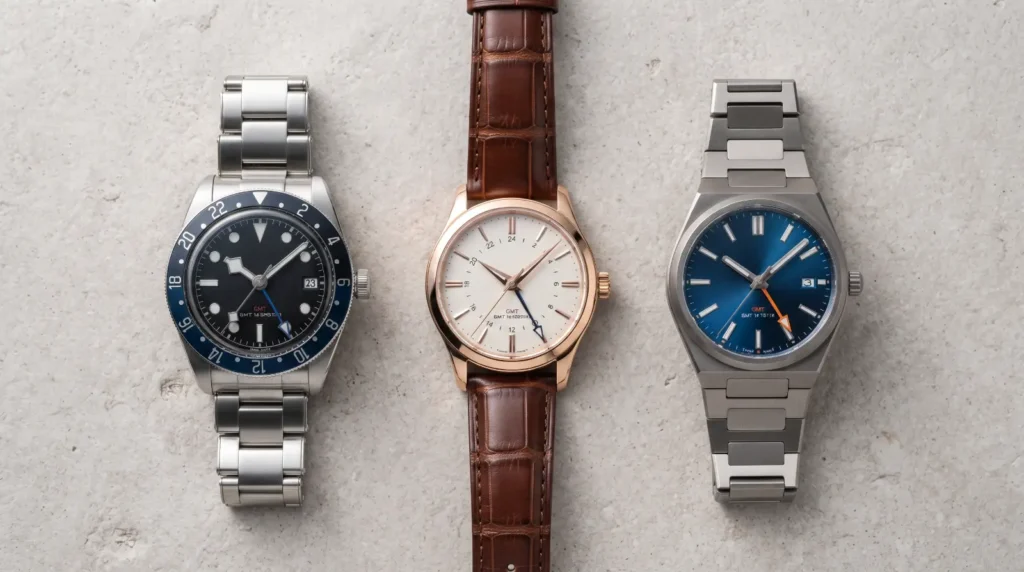
GMT Watch Comparison: Which Type Fits You?
The most useful way to compare these watches is not simply by price. Think about how you actually use the GMT function.
| Watch | Movement | Case | Water Resistance | GMT Style | Best Use |
|---|---|---|---|---|---|
| Seiko 5 Sports GMT | Automatic 4R34 | 42.5mm | 100m | Caller | Budget travel |
| Citizen Series8 880 GMT | Automatic 9054 | 41mm | 100m | Traveler | Daily/travel |
| Christopher Ward C63 GMT | Sellita SW330-2 | 36–42mm | 150m | Dual-time GMT | Swiss value |
| Longines Spirit Zulu Time | Automatic L844 | 39/42mm | 100m | Traveler | Frequent travel |
| Tudor Black Bay GMT | MT5652 COSC | 41mm | 200m | Traveler | Rugged travel |
| Grand Seiko SBGE255 | Spring Drive GMT | Sport case | Sport-oriented | Multi-zone | Collecting |
| Rolex GMT-Master II | Caliber 3285 | 40mm | 100m | Traveler | Luxury travel |
Specifications vary by reference and configuration, so verify the exact model before buying. The comparison above is intended to show the practical differences rather than suggest that one complication is universally better.
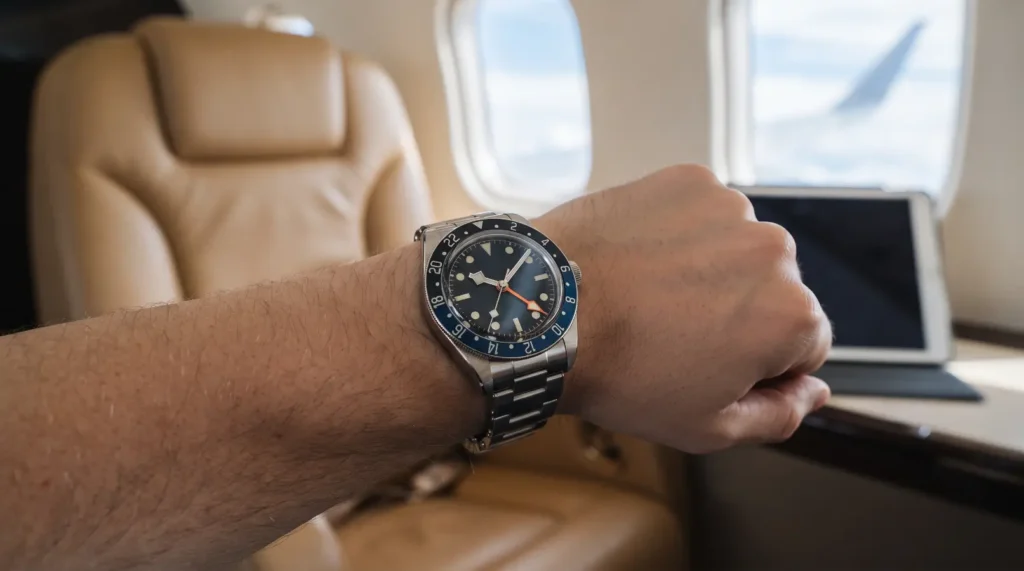
How to Choose the Right Travel GMT
The best travel watch depends heavily on your wrist, travel habits, and tolerance for size and complexity. A beautiful GMT that feels uncomfortable after six hours on a flight is not a particularly successful travel watch.
Start with these questions:
- Do you actually travel across time zones?
If yes, prioritize a true GMT with an independently adjustable local hour hand. - Do you mainly want to track another time zone?
A caller GMT can be perfectly practical for remote work, family abroad, or business communication. - How large is your wrist?
Case diameter is only part of the story. Lug-to-lug length and thickness often determine whether a GMT wears comfortably. - Do you need serious water resistance?
A 100m watch is more than adequate for normal daily wear, while 200m models such as the Tudor offer more of a tool-watch margin. - Do you care about mechanical sophistication?
Entry-level automatic GMTs can provide the function affordably. Higher-priced watches increasingly add chronometer certification, silicon components, proprietary movements, or Spring Drive technology.
Common GMT Buying Mistakes
A GMT watch is easy to understand at first glance, but several buying mistakes repeatedly catch people out.
Buying a Caller GMT for Frequent Travel
This is probably the biggest one. If you fly regularly, check exactly which hand moves independently before purchasing. The phrase “GMT” alone does not tell you how the movement behaves.
Ignoring Case Thickness
A 41mm watch can look reasonable on paper and still feel bulky if the case is thick. Tudor’s 14.6mm Black Bay GMT, for example, wears very differently from a slimmer everyday GMT.
Assuming More Water Resistance Means a Better GMT
Water resistance and GMT functionality solve different problems. A 200m rating is useful for a rugged sports watch, but it does not make the GMT mechanism itself superior.
Choosing by Bezel Color Alone
Pepsi, Batman, black-and-grey, and other two-tone designs are visually recognizable, but the bezel color tells you little about movement quality or travel usability.
Forgetting Service and Warranty Support
A mechanical GMT is more complicated than a basic three-hand watch. Before spending several thousand dollars, check the manufacturer’s warranty, service network, and availability of authorized support in your region.
Are GMT Watches Actually Useful?
Yes, but mainly if you regularly need to know two time zones. For someone who travels internationally, works with overseas clients, has family abroad, or frequently communicates across borders, the complication can become one of the most useful features on the wrist.
For someone who rarely needs a second time zone, a GMT may be more about the design and mechanical interest than practical necessity.
That distinction matters. The extra hand and 24-hour scale are not automatically better simply because they add complexity.
The Final Talk
The right GMT watch can make every time-zone change feel effortless.The best GMT watches are not always the most expensive. A Seiko 5 Sports GMT offers an affordable way into the complication, while Christopher Ward and Longines provide more refinement and stronger travel-focused functionality. Tudor and Rolex add luxury appeal, while Grand Seiko takes a distinctly technical Japanese approach.
If you travel across time zones regularly, start with the GMT movement type, then consider case size, thickness, legibility, and service support. The bezel matters, but the right movement and comfortable fit should come first.
FAQs
GMT watches are used to track a second time zone while displaying your primary local time. They are particularly useful for international travel, remote work, and communicating with people overseas.
A true GMT lets you independently adjust the local hour hand, making it convenient when traveling. A caller GMT normally adjusts the GMT hand independently, making it especially useful for tracking another time zone from home.
Yes. Many modern GMT models combine the complication with automatic movements, sapphire crystals, stainless-steel cases, and useful water resistance, making them practical daily watches.
Look for a true traveler GMT with an independently adjustable local hour hand. Models such as the Longines Spirit Zulu Time, Tudor Black Bay GMT, and Rolex GMT-Master II use this approach.
Seiko’s 5 Sports GMT models offer an accessible way to experience the complication, with automatic movements, rotating 24-hour bezels, and 100m water resistance on models such as the SSK001.
Discover More,
Diesel Watches for Men: 7 Best-Looking Picks for 2026
Speed Watches: 7 Best Racing-Inspired Picks for 2026
Unique Watches: 7 Bold Designs That Break The Mold in 2026
[author box]