
A watch bezel can be a decorative ring around the dial or a practical tool for measuring elapsed time, tracking a second time zone, estimating speed, or finding direction. Understanding bezel watches becomes easier once you know that bezels differ in both construction and purpose. Some remain fixed, while others rotate and use markings to help you read information quickly.
Dive watches often use a one-way rotating bezel for a specific safety reason, while GMT watches may use a two-way bezel to track another time zone. Fluted bezels add texture and visual character, and ceramic inserts offer a different combination of durability and appearance. The key is to identify what the bezel does before judging its design.
Bezel Watches at a Glance
- Definition: A bezel is the ring surrounding a watch crystal, dial, or display. It may be fixed, rotating, functional, or decorative.
- Main types: Seven useful functional and design categories are fixed, dive, GMT, tachymeter, pulsometer, compass, and decorative bezels.
- Most important distinction: A bezel’s markings and movement determine its purpose; a rotating ring is not automatically a timing tool.
- Common misconception: Ceramic describes a material, while fluted describes a surface design. Neither term alone tells you the bezel’s function.
What a Watch Bezel Actually Means
The bezel is the component around the outer edge of a watch face. Depending on the design, it can hold the crystal in place, protect its edge, frame the dial, or provide a scale that works with the watch’s hands.
On a simple dress watch, the bezel may be narrow, polished, and fixed in place. On a dive watch, a rotating bezel with elapsed-minute markings helps the wearer monitor time underwater. A GMT bezel can work with an additional hour hand to show another time zone, while a tachymeter scale can help estimate speed over a measured distance.
The word bezel does not identify one particular style or mechanism. It describes a component that can take many forms. Likewise, ceramic bezel watches refers to watches with ceramic bezel components or inserts, not one specific watch category.
A useful way to classify a bezel is to ask three questions: Does it rotate? What do its markings represent? What material or surface treatment does it use? Those answers tell you far more than appearance alone.
The Main Types, Compared
The most useful way to understand a bezel is to compare its markings, movement, and intended job. The table below covers the main functional and decorative categories.
| Bezel type | Movement | Main purpose | How to read it |
|---|---|---|---|
| Fixed | Does not rotate | Frames the dial or provides a permanent scale | Read its markings with the relevant hands or display |
| Unidirectional dive | Rotates one way | Tracks elapsed time | Align zero with the minute hand and read elapsed minutes |
| Bidirectional GMT | Rotates both ways on many designs | Helps track another time zone | Combine the bezel scale with the GMT hand |
| Tachymeter | Usually fixed | Estimates average speed | Use a chronograph and a known distance |
| Pulsometer | Usually fixed | Estimates heart rate | Follow the scale after counting the specified heartbeats |
| Compass | Rotates, or works with the watch’s orientation | Helps estimate direction | Align the bezel with a direction reference |
| Decorative or fluted | Usually fixed | Adds texture and visual character | Judge its design rather than treating it as a measuring tool |
These categories describe purpose and construction, not seven mutually exclusive designs. A GMT bezel, for example, may also be made from ceramic, while a fixed bezel may have fluted edges.
Unidirectional Dive Bezel
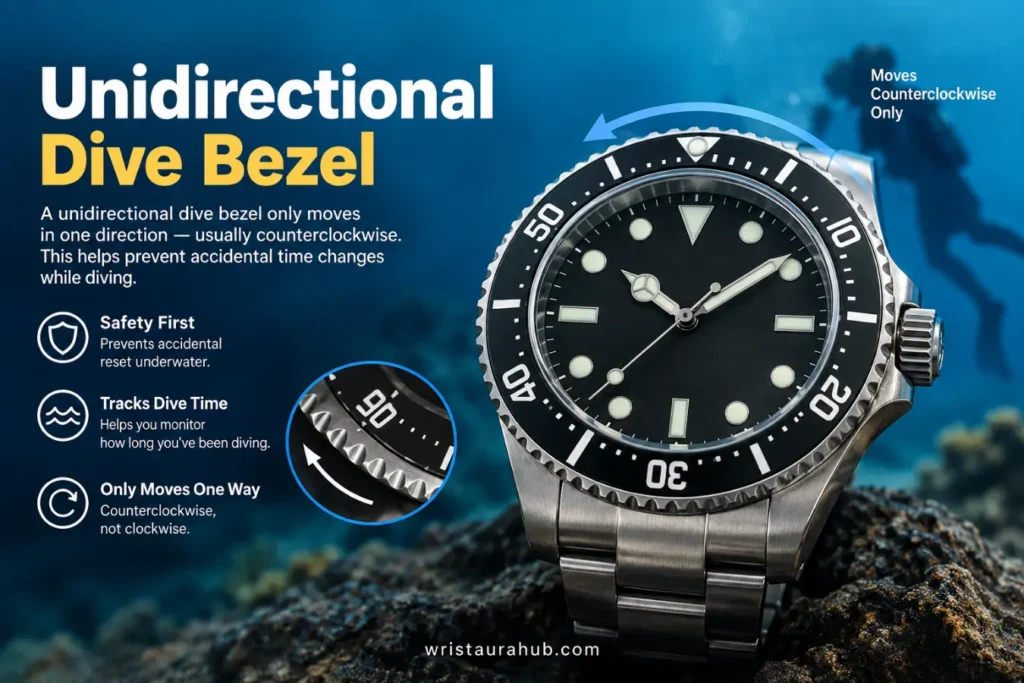
A dive bezel is designed to help the wearer monitor elapsed time. Before starting an activity, the user aligns the zero marker—often a triangle—with the minute hand. As the hand advances, the bezel indicates how many minutes have passed.
Its one-way movement is the most important safety feature. If the bezel is accidentally knocked counterclockwise, the displayed elapsed time becomes longer than the actual time. The wearer is therefore less likely to underestimate time underwater because of that particular mistake. A bezel that can move in both directions could create the opposite problem if accidentally adjusted.
A rotating bezel is still only a timing aid. It does not measure depth, remaining air, or decompression limits, and it cannot replace dive training or a suitable dive computer. A proper dive watch also needs appropriate water resistance and other features suited to the activity.
Fixed Bezel
A fixed bezel stays in place and commonly frames the crystal. It may be narrow and polished on a dress watch, broad and brushed on a sports watch, or marked with a scale for a specific purpose.
A fixed design is straightforward because there is no rotating mechanism to operate. However, not every fixed bezel is purely decorative. A tachymeter scale may be printed around the outer edge of the dial or on a fixed bezel, depending on the watch.
When inspecting one, check the finish, symmetry, and alignment with the dial. A misaligned scale can make a functional design harder to use, while uneven finishing can make a simple decorative bezel look poorly made.
Bidirectional GMT Bezel
A GMT bezel is commonly marked with a twenty-four-hour scale. On compatible watches, the GMT hand completes one rotation in twenty-four hours, allowing the wearer to track a second time zone. Rotating the bezel can help display another time zone, depending on the movement and hand arrangement.
For example, someone working with colleagues abroad might keep local time on the main hands while using the GMT hand and bezel to check the time elsewhere. The bezel’s direction of rotation varies by design; bidirectional operation is common, but it is not universal.
Do not assume that every watch with a twenty-four-hour bezel has a GMT movement. The hand configuration and movement determine whether the watch can independently display another time zone. The bezel alone does not create that function.
Tachymeter Bezel
A tachymeter scale helps estimate average speed over a known distance. It is usually associated with chronograph watches, which have a stopwatch function.
Imagine a vehicle travelling along a measured one-kilometre stretch. Start the chronograph as it passes the beginning and stop it at the end. If the journey takes thirty seconds, the tachymeter scale can indicate an average speed of approximately 120 kilometres per hour, provided the scale is calibrated for the relevant distance and units.
The scale is not a speed sensor and cannot determine speed from a stationary reading. It also becomes less practical for very slow speeds, which may fall outside the useful range of the scale. Read the scale alongside the chronograph’s elapsed time rather than treating the bezel as a standalone instrument.
Pulsometer Bezel
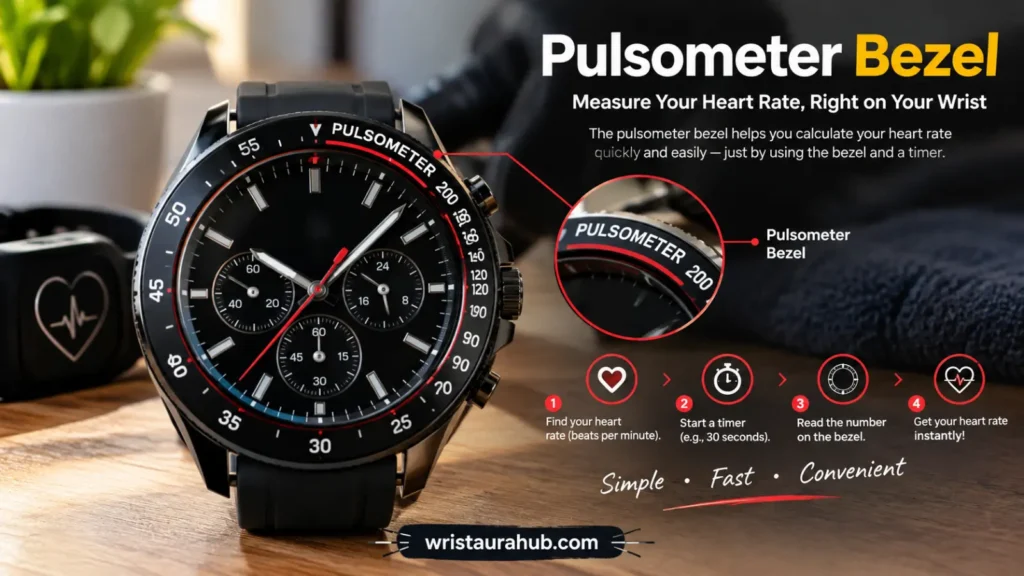
A pulsometer scale estimates heart rate by timing a predetermined number of heartbeats. The scale may appear around the dial or on the bezel, and its markings indicate beats per minute.
To use one, start the chronograph with the first heartbeat and stop it when the specified count is reached. Read the corresponding rate from the scale. The exact number of beats to count depends on the scale’s calibration.
This is a traditional watch complication, not a substitute for a medical device. Movement, counting errors, and the way the scale is calibrated can affect the result. Many modern users will find a dedicated heart-rate monitor more convenient, but the pulsometer remains an interesting example of a bezel or dial scale performing a real task.
Compass Bezel

A compass bezel carries directional markings, often including north, east, south, and west. Some designs are intended to work with the sun and the watch’s hour hand to estimate direction in suitable conditions. Others are used alongside an actual compass.
A rotating bezel does not contain a magnetic compass merely because it has directional labels. The wearer must understand the intended method and account for the hemisphere and conditions where applicable. The technique is approximate and should not replace a reliable navigation instrument when getting lost would be dangerous.
For outdoor use, look for markings that are easy to read and a bezel that stays in position after adjustment. A decorative compass-style ring may look practical without offering the accuracy or convenience of a dedicated compass.
Decorative and Fluted Bezels

Decorative bezels prioritise appearance, proportions, and finishing rather than measurement. A smooth bezel creates a clean outline, while a fluted bezel has repeated ridges or grooves that catch the light and give the watch a more textured look.
The term fluted bezel watches refers to this ridged design. Fluting describes the surface, not the material or the bezel’s function. A fluted bezel is commonly fixed, although the exact construction depends on the watch.
Decorative designs can still be well engineered. Look for even ridges, clean transitions, consistent polishing, and a bezel that sits evenly against the case. The limitation is simple: a decorative ring cannot provide elapsed-time or navigation functions unless it has been specifically designed and marked to do so.
Ceramic, Metal, and Other Bezel Materials
The material is a separate classification from the bezel’s purpose. A dive bezel can use ceramic or another material, and a decorative bezel can be made from steel, gold, or a combination of materials.
| Material or finish | Strengths | Limitations |
|---|---|---|
| Ceramic insert | Generally highly resistant to surface scratches and fading from ultraviolet exposure | Can chip or crack under a sufficiently hard impact |
| Stainless steel | Tough, repairable in some cases, and available in many finishes | Can scratch and show wear |
| Aluminium insert | Lightweight and often economical to produce | Usually more vulnerable to scratches and fading than ceramic |
| Gold or precious-metal bezel | Distinctive appearance and compatibility with dress designs | Softer precious metals can scratch or dent more easily |
| Fluted metal finish | Adds texture and reflected light | Grooves can collect dirt and require careful cleaning |
Ceramic Bezels
Ceramic bezel watches are popular because ceramic inserts can resist everyday surface scratching and retain their colour well. Some manufacturers use proprietary ceramic formulations, so properties vary between products.
Ceramic is not indestructible. A hard impact against a sharp edge can chip or crack it, and replacing a damaged insert may be more involved than refinishing some metal surfaces. Ceramic can be a good choice if surface wear is a concern, but it should not be treated as a guarantee against damage.
Metal Bezels and Inserts
Metal bezels offer a wide range of finishes, from brushed tool-watch surfaces to highly polished dress designs. Steel is a practical all-round option, while precious metals usually place more emphasis on appearance and can require extra care.
Aluminium inserts are often found on watches designed around a more traditional tool-watch aesthetic. They can develop scratches and colour changes over time. Some owners enjoy this ageing, while others prefer a material that keeps a more uniform appearance.
The best material depends on how the watch will be used. A scratch-resistant insert may suit daily wear, but construction quality, bezel security, and ease of servicing also matter.
How to Tell Different Bezel Designs Apart
You can identify most bezels without knowing the watch brand. Follow this inspection order.
- Check whether the ring moves. A fixed ring is often decorative or carries a permanent scale. A rotating ring may support timing, travel, or navigation.
- Read the markings. Elapsed-minute graduations suggest a dive timer. A twenty-four-hour scale may support a GMT function. Speed figures suggest a tachymeter, while compass directions suggest a navigation aid.
- Look at the hands. A separate twenty-four-hour hand can indicate GMT functionality. Stopwatch subdials and pushers suggest a chronograph that may work with a tachymeter or pulsometer scale.
- Inspect the surface. Ridges suggest fluting; a smooth ring may be polished or brushed. The insert may be ceramic, aluminium, or another material.
- Test the mechanism gently. If the bezel is intended to rotate, it should operate consistently and hold its position as designed. Never force a stiff bezel, and do not test a watch’s water resistance at home.
The crucial point is to separate appearance from capability. A watch may look like a dive watch without meeting the requirements for actual diving. Water resistance alone does not establish compliance with the ISO 6425 diver’s-watch standard.
Which Bezel Suits Your Needs?
Choose the bezel according to the task you expect it to perform, not just its appearance.
- For swimming and diving: Choose purpose-built dive watches with a clear elapsed-time scale and suitable water resistance. For scuba diving, use equipment appropriate to the dive and follow proper training.
- For travel: Bezel watches with a GMT function are useful when you regularly check another time zone. Confirm that the watch has the necessary GMT hand and compatible bezel arrangement.
- For motorsports and timing: A chronograph with a tachymeter can estimate average speed over a known distance. It is less useful if you rarely need a stopwatch.
- For outdoor navigation: A compass-style bezel may help with approximate orientation, but a proper compass is the better choice when accurate navigation matters.
- For formal wear: A slim, polished or fluted fixed bezel often suits a dress watch because it adds character without making the dial look busy.
- For everyday durability: When choosing bezel watches, consider the entire watch, including the case, crystal, bezel construction, and serviceability. Ceramic can resist scratches well, but metal may be easier to refinish in some circumstances.
Wrist size also affects the overall look. A wide bezel can make the dial appear smaller, while a narrow bezel can create the impression of a larger dial. If you prefer a restrained look or have a smaller wrist, compare the watch’s actual case diameter and thickness rather than judging the bezel alone.
How to Spot a Well-Made Bezel
A good bezel should suit its intended job and feel consistent with the rest of the watch. These checks are more useful than relying on a premium-looking finish alone.
- Alignment: Markers should line up correctly with the dial and chapter ring. On a rotating bezel, check that the zero marker aligns as intended.
- Legibility: Important markings should be easy to distinguish in the lighting conditions for which the watch is designed. Dive bezels benefit from a clearly visible zero marker.
- Mechanism: A rotating bezel should move predictably and hold its setting. Dive designs should operate in their intended direction.
- Finishing: Look for even brushing, consistent polishing, clean engraving, and uniform fluting.
- Material disclosure: Check whether the manufacturer identifies the insert as ceramic, aluminium, or another material. Colour alone does not reveal composition.
- Construction and service: A bezel should fit evenly and have no obvious looseness or rattling beyond what its design permits. Replacement parts and repair options matter if the watch is intended for long-term use.
A high price does not automatically mean a better bezel. A simple, accurately aligned steel ring can be better suited to everyday use than a complicated design with markings you never use.
What People Get Wrong About Watch Bezels
Every rotating bezel is designed for diving
False. Rotating bezels can support elapsed-time measurement, GMT displays, and other functions. Their markings and intended operation determine their purpose.
A ceramic bezel cannot break
Ceramic is generally resistant to surface scratches, but it can chip or crack from a hard impact. Its benefits do not make it immune to damage.
A fluted bezel is a functional timing tool
Not necessarily. Fluting describes a ridged surface design. Unless the bezel has appropriate markings and a useful mechanism, its purpose may be entirely decorative.
A watch with a rotating bezel is automatically a dive watch
False. A rotating bezel alone does not establish water resistance or compliance with a diving standard. The complete watch must be suitable for the intended activity.
Every bezel should rotate in both directions
No. Many dive bezels are intentionally unidirectional to reduce the risk of accidentally underestimating elapsed dive time. Other bezels may rotate in either direction or remain fixed.
The Final Talk
The best bezel watches balance practical function, durability, and appearance. A dive bezel helps track elapsed time, a GMT bezel supports time-zone reading, and a fluted bezel adds visual detail. Ceramic and metal options also offer different benefits and limitations. Before choosing among bezel watches, consider how you will use the watch, how clearly you can read its markings, and how well its construction suits your needs. A good bezel is not simply about appearance; it should serve its intended purpose.
Frequently Asked Questions
A rotating dive bezel helps track elapsed time by aligning its zero marker with the minute hand. Its one-way movement reduces the risk of underestimating time underwater, but it does not replace a dive computer.
Rotating bezels provide a way to measure elapsed time, track another time zone, or support other calculations. The purpose depends on the scale and the watch’s functions. Some bezels are fixed because they frame the dial or carry markings that do not need adjustment.
A fluted bezel has a ridged surface, while a ceramic bezel uses ceramic as its material or insert. These terms describe different characteristics: one describes shape and texture, and the other describes composition. A bezel could theoretically combine both features.
No. Dive bezels are commonly designed to rotate in one direction for safety, while GMT and other rotating bezels may operate in both directions. Always check the manufacturer’s instructions for the particular watch.
Check its markings, movement, and relationship to the watch’s hands. A marked scale may perform a task when paired with the appropriate movement or chronograph. A smooth or fluted ring without a usable scale is usually decorative.
Rotating bezels help track elapsed time, display another time zone, or support navigation. Their purpose depends on the markings and watch functions. Before choosing a watch, check whether the bezel offers a useful feature or simply adds decorative appeal.