
Are Bulova watches good? Yes, Bulova makes good watches for people who want distinctive designs, dependable quartz timekeeping, and some genuinely interesting watch technology without automatically paying luxury-watch prices. However, the quality and value depend on the collection, the specific model, and what you expect from a watch.
Bulova stands out for its Precisionist high-frequency quartz movements, its historic Accutron technology, and designs that often look bolder than conventional everyday watches. The trade-offs are equally worth understanding: some models emphasize fashion more than mechanical watchmaking, larger cases can be uncomfortable on smaller wrists, and not every watch offers the same value for money.
Are Bulova Watches Good? The Short Answer
Bulova is a credible watch brand with a long history and several technically interesting collections. Its strongest selling points are quartz accuracy, varied designs, and the distinctive technology found in selected models.
- Quality: Generally good for everyday use, depending on the model and its materials.
- Accuracy: Particularly strong in quartz models, with Precisionist offering enhanced precision.
- Value: Often appealing for buyers who want distinctive styling and useful features.
- Main drawback: Design, size, and price can matter more than the brand name when judging an individual watch.
The sensible verdict is to evaluate the particular collection rather than assuming every Bulova watch offers the same experience.
What Makes Bulova Worth Considering?
Bulova’s history dates to 1875, when Joseph Bulova opened a jewelry business in New York. The company later became known for innovations in electronic timekeeping, including the original Accutron tuning-fork watch introduced in 1960. Today, Bulova offers a range of conventional quartz watches, mechanical models, chronographs, and high-frequency quartz watches featuring its Precisionist technology.
Precisionist technology offers a genuine advantage
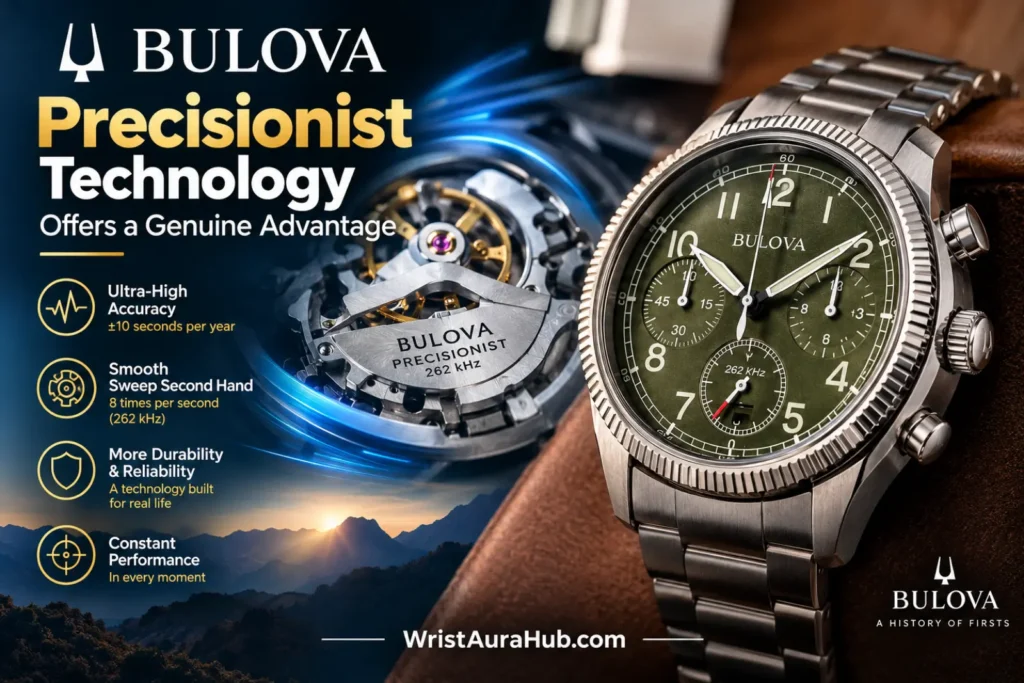
Precisionist is one of the most distinctive reasons to consider Bulova. Its quartz movement operates at 262 kHz and is designed to deliver accuracy measured in seconds per year.
That technology also allows a continuously sweeping seconds hand, unlike the familiar one-step-per-second motion of many standard quartz watches. It gives the watch a different visual character while retaining the convenience of battery-powered timekeeping.
This does not mean every Bulova uses Precisionist technology. Many models use conventional quartz movements, while others use mechanical movements. Check the specifications of the exact watch before paying extra for a particular feature.
Materials and finishing can be appealing
Bulova offers watches with stainless-steel cases, different crystal materials, varied dial finishes, and both bracelet and strap designs. These details influence how substantial a watch feels, how well it handles everyday wear, and how it ages.
Still, a stainless-steel case alone does not guarantee superior construction. Crystal type, bracelet quality, clasp security, dial finishing, crown operation, and the consistency of the hands and markers are better indicators when comparing two watches.
Its history gives certain collections extra interest
The original Accutron used a tuning-fork mechanism instead of the balance wheel found in traditional mechanical watches. Introduced in 1960, it was an important development in electronic timekeeping and helped bridge the gap between mechanical watches and modern quartz technology.
Modern Accutron products should not automatically be treated as identical to vintage tuning-fork watches. The technology varies across generations and products, so historical significance alone is not enough to judge a modern watch’s performance or ownership costs.
Where Bulova’s Reputation Has Limits
A brand can have genuine technical achievements and still produce watches that are not right for every buyer. Bulova’s main weakness is that its collections can appeal to very different customers, making broad quality claims less useful.
Fashion appeal versus horological substance

Some Bulova watches prioritize striking dials, oversized cases, decorative details, and bold chronograph layouts. That is not inherently a problem. A well-made quartz watch can be an excellent everyday timepiece without having a mechanical movement.
The distinction matters if you are paying specifically for traditional watchmaking. A standard quartz model may not satisfy someone who wants visible mechanical finishing, the interaction of gears and springs, or the maintenance experience associated with mechanical ownership.
Precisionist offers a different kind of technical interest, but high accuracy should not be confused with mechanical complexity.
Case size and comfort can disappoint
Some designs have a strong wrist presence. That can work well on larger wrists but may feel bulky on smaller ones, especially when a watch has a thick case, a wide bracelet, or protruding chronograph pushers.
Before choosing, compare case diameter, thickness, and lug-to-lug length. The last measurement matters because it helps indicate whether the watch will extend beyond the edges of your wrist.
Long-term ownership still needs consideration
Quartz watches usually need less routine movement maintenance than mechanical watches, but batteries eventually require replacement. Mechanical Bulova watches need appropriate servicing, and water-resistant watches can require periodic checks of their seals.
Bulova offers a limited warranty, but coverage depends on the applicable terms and conditions. Routine mechanical maintenance and certain types of damage may not be covered. Warranty periods and service options can vary by market, so check the documentation provided by your authorized seller before purchasing.
Which Bulova Collection Offers the Best Value?
The right choice depends on whether you value everyday practicality, distinctive quartz technology, or traditional mechanical construction. These are useful categories to compare, not a claim that every model in a tier has identical specifications or pricing.
| Watch category | What you get | Main trade-off |
|---|---|---|
| Entry-level quartz | Straightforward timekeeping and accessible everyday designs | Less specialized movement technology |
| Mid-range and Precisionist | More distinctive designs, with enhanced quartz precision in Precisionist models | Larger cases and extra features may not suit everyone |
| Mechanical watches | Traditional movement operation and a different ownership experience | More servicing needs and potentially less accuracy than quartz |
| Premium or specialized designs | Unusual case shapes, complex displays, or distinctive finishing | Higher prices do not automatically mean better practical value |
Entry-level quartz: for everyday reliability
An entry-level Bulova quartz watch can make sense if you want a straightforward daily timepiece for work, casual wear, or formal occasions. Quartz movements are convenient because they generally require little routine attention beyond battery replacement when needed.
Focus on the crystal, case finish, bracelet or strap, clasp, and legibility. If two watches provide similar timekeeping, choose the one with better construction and a more comfortable fit rather than paying more simply for the logo.
Precisionist: for accuracy and a distinctive seconds hand
Precisionist is worth considering if accurate timekeeping and a continuously sweeping seconds hand are priorities. Its high-frequency quartz design is a genuine technical distinction, rather than a purely cosmetic feature.
However, not everyone needs that additional precision. If you mainly check the time occasionally, a conventional quartz watch may offer better value for your needs. Compare the actual case dimensions, design, and price before deciding whether the technology justifies the difference.
Mechanical models: for traditional watch enthusiasts
A mechanical Bulova may appeal if you enjoy the engineering behind a watch powered by a spring and gear train. Automatic models wind themselves through wrist movement, while manual-winding models require winding by hand.
Mechanical watches are not automatically more accurate or durable than quartz watches. Their appeal lies in their construction and ownership experience. If low maintenance and accurate timekeeping matter most, quartz is often the more practical choice.
Specialized designs: buy the details, not the label
Some Bulova designs stand out because of their unusual shapes, elaborate chronograph displays, or vintage-inspired styling. These can be worthwhile when the execution justifies the price.
Check the actual movement, crystal material, water-resistance rating, and bracelet construction. A complicated dial is not proof of better engineering, and a sporty appearance does not guarantee suitability for swimming or diving.
How to Judge a Bulova Before Buying
A few practical checks can help you distinguish a genuinely good purchase from a watch that merely looks impressive in photographs.
- Check the movement: Confirm whether the watch uses standard quartz, Precisionist quartz, or a mechanical movement.
- Inspect the crystal: Mineral crystal and sapphire crystal have different scratch-resistance characteristics. Verify which one the model actually uses.
- Assess the fit: Compare diameter, thickness, and lug-to-lug length against a watch you already find comfortable.
- Test the bracelet and clasp: Look for secure fastening, comfortable edges, and links that do not feel poorly finished.
- Read the water-resistance marking: Do not assume every Bulova is suitable for swimming. Follow the specific model’s instructions.
- Check the warranty and service options: Confirm that the seller is authorized and that qualified service is accessible in your country.
For buyers outside the United States, local warranty handling and replacement-part availability deserve particular attention. A watch can be good value at purchase but less convenient to own if routine servicing requires expensive international shipping.
What People Get Wrong About Bulova
Are Bulova watches luxury watches?
Bulova is an established watch brand with a long history, but its products cover a range of price points and levels of technical sophistication. The brand name alone does not place every model in the same category as high-end Swiss luxury watches.
Judge each watch by its movement, construction, finishing, design, and price rather than relying on a single luxury label.
Are Bulova watches good quality for the money?
They can be. Bulova offers practical quartz watches and models with more specialized technology, but value depends on the particular model and its competing alternatives.
Compare watches at the same price level. A cheaper watch with similar materials and features may be the better purchase, while a more expensive Precisionist model may justify its premium for someone who specifically values its movement.
Are Bulova watches any good for daily wear?
Yes, many are suitable for everyday use. Choose a comfortable case size, a durable strap or bracelet, a legible dial, and a water-resistance rating appropriate for your routine.
For office wear, commuting, and general daily activities, a simple quartz model may be all you need. For frequent outdoor use, inspect the particular watch’s construction and specifications instead of assuming all models offer equal toughness.
What do Bulova watch reviews on Reddit tell you?
When reading discussions about Bulova watches on Reddit, look for recurring, model-specific comments about accuracy, bracelet comfort, finishing, battery life, and after-sales service. Separate long-term ownership reports from first impressions and promotional posts.
A complaint about one model’s oversized case does not establish that the entire brand makes uncomfortable watches. Likewise, a positive review of a Precisionist model does not prove that every Bulova offers the same movement or performance.
The Final Talk
Bulova is a good choice if you want an established watch brand with distinctive styling, dependable quartz options, and technology that goes beyond basic timekeeping in selected collections. Its Precisionist range is particularly interesting for buyers who value high quartz accuracy, while its mechanical watches suit people who prefer traditional movement design.
The main reason to hesitate is not the brand’s reputation; it is the specific watch’s price, size, materials, and service requirements. Compare those details before buying, and choose the model that fits your priorities rather than assuming the most expensive option is the best.
Frequently Asked Questions
Generally, yes. Many Bulova watches offer solid everyday construction and reliable timekeeping. Materials, finishing, and movement technology vary by model, so check the individual specifications.
Bulova can compete well on design, quartz technology, and features for the price. The best comparison depends on your budget and whether you prioritize accuracy, mechanical engineering, finishing, or brand prestige.
Yes. A simple quartz model is a practical starting point because it is easy to use and requires relatively little routine maintenance. Choose a comfortable size and a design you can wear regularly.
Do not assume a Bulova will retain its retail price. Resale depends on the model, condition, demand, originality, and purchase price. Buy primarily for enjoyment and use rather than expected investment returns.
Bulova has American historical roots, but its manufacturing origins vary by product and period. Check the markings and official documentation for the particular model instead of assuming every Bulova has the same country of origin.
Neither is universally better. Precisionist quartz prioritizes high accuracy and convenient timekeeping, while automatic movements appeal to people who value traditional mechanical engineering. Choose according to your preferences and willingness to maintain the watch.
Discover More to Learn
Nubeo Watches Review: Prices, Quality, Models & Buying Guide
Pingback: Are Apple Watches Waterproof? The Complete Safety Guide