
Choosing a traditional watch can be confusing when different designs look similar but serve different purposes. Analog watches for men display time through moving hour and minute hands on a numbered or marked dial. However, this describes how a watch shows time, not how it operates. A battery-powered quartz watch, an automatic mechanical watch and a solar-powered timepiece can all use an analog display.
The right choice depends on where you plan to wear it, how much maintenance you accept and which features matter in daily use. Office workers may prefer slim cases and clean dials, while outdoor users often need stronger construction and better water resistance.
Analog Watch Styles at a Glance
- Definition: A wristwatch that displays time through hands moving around a dial.
- Main styles: Dress, field, sports, diver, chronograph and everyday watches.
- Main distinction: Display type and movement type are separate characteristics.
- Common misconception: An analog watch does not necessarily have a mechanical movement.
What Analog Timekeeping Actually Means
An analog display uses hands to represent hours, minutes and sometimes seconds. The hands move across a dial marked with numbers, indices or other indicators. Some designs use Roman numerals, while others have simple lines or dots.
The term describes the display rather than the internal mechanism. A quartz watch uses an electronic circuit and a vibrating quartz crystal to regulate time. An automatic watch relies on a mechanical movement and a wound mainspring. Solar-powered watches convert light into electrical energy.
This distinction matters because two watches can look almost identical while working differently. Their maintenance needs, accuracy and power sources may vary considerably.
Another important difference is the chronograph. It is not a separate movement category or simply another name for a sports watch. A chronograph is an analog watch with an additional stopwatch function.
[readmore url=”https://wristaurahub.com/olivia-burton-watches/”]
The Main Watch Styles Compared
| Watch style | Main design feature | Typical purpose | Main limitation |
|---|---|---|---|
| Dress | Slim case and simple dial | Office and formal wear | Limited extra functions |
| Field | Clear dial and practical markers | Everyday and outdoor use | Less formal appearance |
| Sports | Functional design and stronger construction | Active daily use | Can look bulky |
| Diver | Rotating timing bezel | Water activities and timing | Not every model is suitable for diving |
| Chronograph | Stopwatch subdials and pushers | Measuring elapsed time | More complicated dial |
| Everyday | Balanced and versatile design | Regular daily wear | May lack specialist features |
Dress Watches
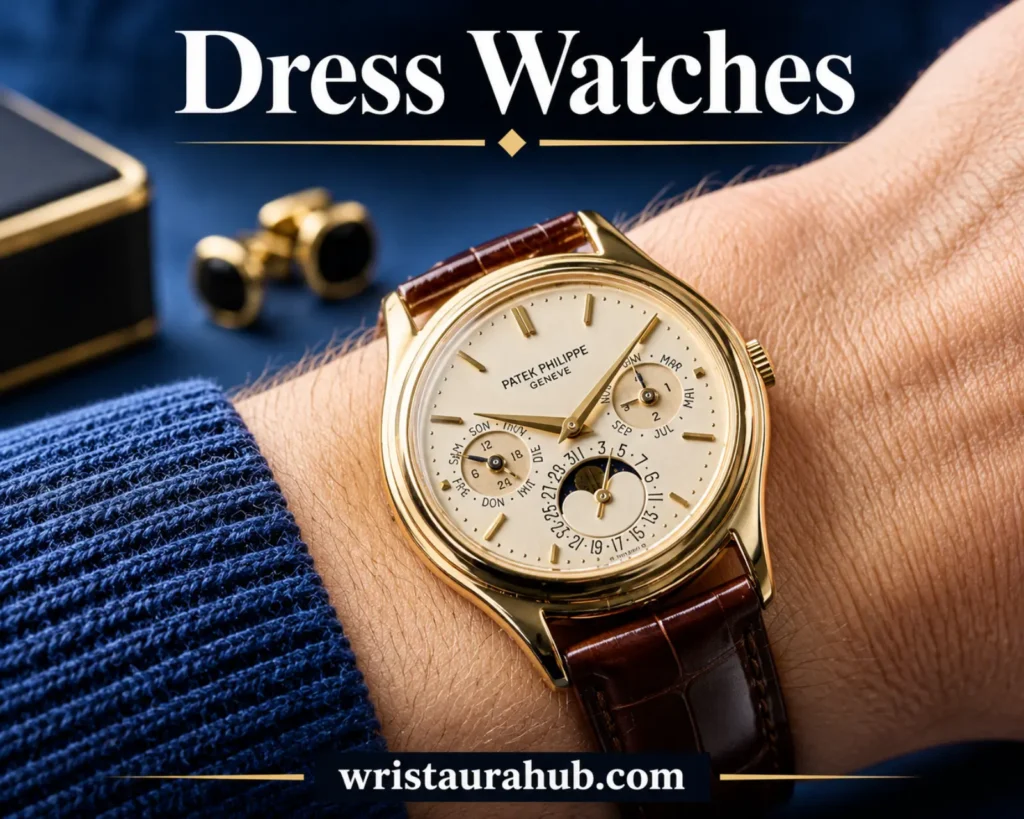
Dress watches prioritise simplicity and proportion. They commonly feature uncluttered dials, slim cases and leather straps or understated metal bracelets. Their design allows them to sit comfortably beneath a shirt cuff.
For office clothing, a black, white, silver or dark blue dial is easy to coordinate. A restrained design also works with suits and formal shirts.
The main limitation is practicality. Some dress watches have minimal water resistance, limited lume and no additional timing functions. They are better suited to professional environments than demanding outdoor activities.
Field Watches
Field watches developed around readability and practical use. Their dials often feature clear Arabic numerals, strong contrast and straightforward hour and minute hands. Many designs also include luminous markers for visibility in low light.
A fabric, leather or durable rubber strap can make this style comfortable for everyday use. It works with casual clothing and can suit relaxed office environments.
However, a traditional field watch may look too casual for formal business clothing. Its simple appearance also means it might not offer complications such as a chronograph or rotating bezel.
Sports Watches
Sports watches focus on functionality and stronger everyday construction. They may include prominent markers, luminous hands, textured bezels and cases designed to handle regular wear.
Some have chronograph functions, while others provide additional timing features or improved water resistance. Stainless steel, resin and reinforced materials are common in this category.
A sports watch is useful when your routine includes commuting, exercise and outdoor activities. Its limitation is size and appearance. Larger cases and busy dials may feel uncomfortable under formal shirt cuffs.
Diver Watches
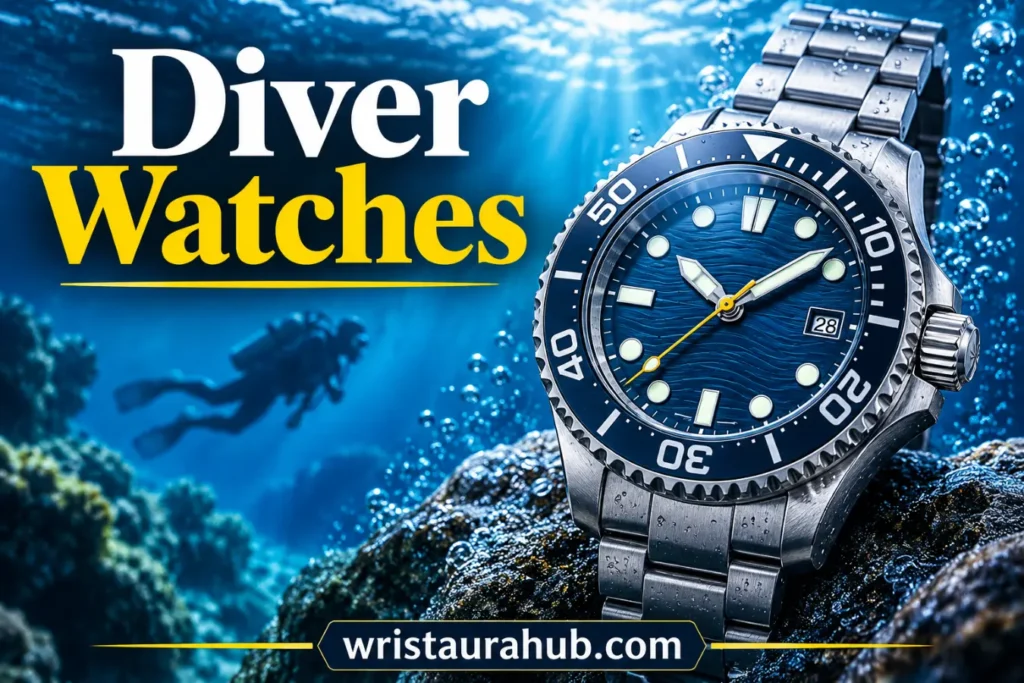
Diver watches are recognisable by their rotating timing bezels, high-contrast dials and luminous hands. A traditional unidirectional bezel allows the wearer to track elapsed time underwater.
Its one-way rotation has an important safety purpose. If the bezel moves accidentally, it can indicate more elapsed time rather than less. This helps reduce the risk of underestimating elapsed time.
Not every watch with a dive-style appearance is a certified diving instrument. Check the actual water-resistance rating, crown construction and any relevant diver certification before using one underwater.
A diver watch can also feel thick and heavy compared with a dress watch. That makes it less convenient for someone who prefers a slim professional design.
Chronograph Watches
Chronographs combine ordinary timekeeping with a stopwatch function. Small subdials and additional pushers help measure elapsed seconds, minutes or, depending on the design, longer intervals.
They can be useful for timing meetings, exercise sessions and everyday activities. Their detailed appearance also appeals to people who enjoy technical watch designs.
The downside is dial complexity. Multiple subdials can make the time harder to read quickly. A chronograph may also require more maintenance than a basic three-hand quartz watch, depending on its movement.
Everyday Watches
Everyday watches sit between formal and sporty designs. They usually have a readable dial, a comfortable case and a versatile strap or bracelet.
This category works well for people who want one watch for commuting, casual outings and regular office use. A balanced design avoids the highly formal appearance of a dress watch and the bulk of some sports models.
The limitation is specialisation. An everyday watch may not provide the water resistance of a dedicated diver or the slim proportions of a traditional dress watch.
[readmore url=”https://wristaurahub.com/retro-watches/”]
How to Choose the Right Design for Your Routine
The easiest way to choose a suitable watch is to start with your daily activities rather than its appearance.
For Office and Business Wear
For office use, prioritise a clean dial, comfortable bracelet and moderate case thickness. A slim stainless steel or leather-strap watch usually works well with formal clothing.
Avoid oversized cases if you regularly wear fitted shirts. A simple three-hand display can be more practical than a crowded chronograph dial.
For Everyday Durability
Look for a well-finished case, secure strap attachment and a crystal that suits your routine. Mineral crystal offers practical everyday protection, while sapphire crystal generally provides better scratch resistance.
Stainless steel is a useful choice for regular wear. Resin cases can also be practical because they are lightweight and often used in rugged designs.
For Outdoor Activities
Choose clear markers, readable hands and useful lume. A comfortable strap matters when wearing a watch for extended periods.
Water resistance deserves particular attention. Do not assume that a watch is suitable for swimming simply because its case looks sporty.
How to Identify a Quality Timepiece
A good watch does not need an expensive movement or complicated dial. Focus on the parts that affect reliability, comfort and long-term use.
- Movement: Quartz offers convenience and generally strong accuracy. Automatic movements appeal to people who enjoy mechanical engineering but need periodic servicing.
- Case material: Stainless steel is a practical everyday option. Check the finishing and inspect the case for rough edges.
- Crystal: Mineral glass is common in affordable watches. Sapphire offers stronger scratch resistance but can still be damaged by a sufficiently hard impact.
- Dial readability: Clear hands, visible markers and suitable contrast make checking the time easier.
- Bracelet and strap: Check the clasp, links, stitching and attachment points. Weak connections can make a watch uncomfortable or insecure.
- Water resistance: Read the actual marking rather than relying on marketing terms.
- Case proportions: Consider diameter, thickness and lug-to-lug length together. A large diameter does not automatically mean a comfortable fit.
Understanding the Movement
| Movement | Power source | Main advantage | Main drawback |
|---|---|---|---|
| Quartz | Battery | Accurate and convenient | Periodic battery replacement |
| Automatic | Wrist movement and mainspring | Traditional mechanical engineering | Requires servicing |
| Manual | Hand-wound mainspring | Direct mechanical interaction | Needs regular winding |
| Solar | Light energy | Reduced battery-maintenance needs | May need light exposure to recharge |
An automatic watch is not automatically better than quartz. Quartz is generally the more practical option for someone who wants reliable timekeeping with minimal attention. Mechanical watches suit people who value traditional watchmaking and accept additional maintenance.
Choosing the Right Fit, Budget and Features
A watch can have excellent construction and still feel wrong on your wrist. Case proportions and comfort should be considered before choosing a particular style.
Wrist size: Smaller wrists often benefit from moderate case diameters and shorter lug-to-lug measurements. Larger wrists can accommodate broader cases, provided the watch remains comfortable.
Budget: Affordable quartz watches can provide reliable everyday timekeeping. Mid-range options may offer better finishing, sapphire crystal or solar technology. More expensive mechanical watches can add movement craftsmanship, but price alone does not guarantee better practical performance.
Dress code: Choose a restrained dial and slim profile for formal offices. Field and sports designs are better suited to casual workplaces.
Maintenance: Quartz and solar watches generally require less routine attention than mechanical watches. Automatic and manual watches need periodic professional servicing.
Strap choice: Leather suits formal settings, stainless steel works across several dress codes, and rubber or fabric is useful for casual and active wear.
Why Casio Is Worth Considering
People researching Casio analog watches for men will find several different design directions. The brand offers simple three-hand watches, business-oriented EDIFICE designs and more rugged analog or analog-digital options.
The important point is to compare individual specifications rather than assume every Casio watch has the same construction. Crystal material, movement, case size and water resistance can differ between models.
What Buyers Often Get Wrong
1. Every analog watch has a mechanical movement.
Incorrect. Analog describes the display. Quartz, solar and mechanical movements can all operate traditional watch hands.
2. A higher price always means better durability.
Not necessarily. Case construction, crystal material, water resistance and strap quality matter more than price alone.
3. Every sports-style watch is suitable for swimming.
Incorrect. A sporty appearance does not establish water resistance. Check the manufacturer’s instructions and the specific model’s rating.
4. Sapphire crystal cannot break.
Sapphire is highly scratch-resistant, but it is not indestructible. A hard impact can still damage it.
5. Larger watches are always easier to read.
Not always. A smaller watch with good contrast and clear markers can be easier to read than an oversized dial with unnecessary details.
6. A chronograph is simply a decorative sports watch.
No. A chronograph includes a stopwatch function. Its subdials and pushers serve a specific purpose, although some designs also use them as visual elements.
[readmore url=”https://wristaurahub.com/moon-phase-watches/”]
Understanding Water Resistance Before Buying
Water resistance is one of the most misunderstood watch specifications. The rating indicates resistance to pressure under defined testing conditions, not a guarantee that every activity is safe.
| Marking | General guidance |
|---|---|
| 30m / 3 ATM | Everyday splashes; not swimming |
| 50m / 5 ATM | Some swimming may be permitted; follow manufacturer guidance |
| 100m / 10 ATM | Greater water exposure; check the manufacturer’s activity guidance |
| 200m / 20 ATM | Suitable for more demanding water activities when the watch is designed for them |
| ISO Diver’s marking | Indicates compliance with a specific diving-watch standard |
Casio’s own guidance distinguishes ordinary water resistance from swimming and diving suitability. Its instructions also warn against operating the crown or buttons underwater on watches that do not permit it.
One important rule: never treat a 30m marking as permission to swim. For scuba diving, look for a properly rated diving watch rather than relying on its appearance or a generic water-resistance number.
The Final Talk
The best watch is not necessarily the most complicated or expensive one. A slim quartz dress watch can be a better daily companion for an office worker than a bulky mechanical sports watch. Someone who spends more time outdoors may benefit from a rugged field design with readable markers and stronger construction.
Start with the display, choose a movement that matches your maintenance preferences, and check the case, crystal and water-resistance specifications. Once these basics are right, appearance becomes a matter of personal preference.
Frequently Asked Questions
Neither is universally better. Analog watches provide a traditional hand-based display and often suit formal clothing. Digital watches can offer easier numerical reading, alarms and additional functions.
The best choice depends on the intended use. Dress watches suit professional environments, field watches offer practical readability, and sports watches provide more functional designs. Compare movement, comfort and construction before choosing.
Casio offers quartz and other watch technologies across different price categories. Its analog collections include simple everyday designs and more feature-rich sports watches. Reliability and durability depend on the individual model and how it is used.
A slim dress watch or understated everyday watch is usually a practical choice. Look for a readable dial, comfortable strap, moderate case thickness and a design that works with formal clothing.
Not automatically. Automatic movements have intricate mechanical components and need periodic servicing. Quartz watches have fewer moving parts and are generally easier to maintain. Both can provide years of use when properly cared for.
Check the case material, crystal, strap attachment, movement, water-resistance rating and manufacturer’s warranty. These details provide a better indication of everyday practicality than appearance alone.
Discover More to Learn
Japan Movement Watch: Meaning, Types & Accuracy
Best Seiko Watches: 7 Top Picks for 2026
[authorbox]
Pingback: Mechanical vs Automatic Watch: Key Differences