
A Japan movement watch contains a timekeeping mechanism developed or manufactured by a Japanese watchmaker or movement supplier. The term commonly refers to quartz movements from companies such as Miyota and Seiko, but Japan also produces automatic and other mechanical movements. These mechanisms power watches sold under Japanese and international brands.
Their appeal comes from practical engineering, dependable timekeeping and broad availability of replacement parts. However, the label does not automatically mean that the entire watch was made in Japan. Understanding the movement type, manufacturer, country-of-origin marking and maintenance requirements helps you judge what you are actually getting.
Japan Movement Watch at a Glance
- Definition: A watch fitted with a movement made or supplied by a Japanese manufacturer.
- Main types: Quartz, automatic, manual-winding, solar-powered and other electronic or hybrid mechanisms.
- Key distinction: Japanese movement describes the mechanism‘s origin, not necessarily the origin of the complete watch.
- Common misconception: Every watch with a Japanese movement is manufactured and assembled entirely in Japan.
What Does a Japanese Movement Actually Mean?
The movement is the mechanism inside a watch that controls timekeeping and operates its hands or digital display. When a specification mentions a Japanese movement, it generally identifies the movement’s manufacturer or Japanese production origin.
For example, Miyota is a Japanese movement manufacturer within the Citizen group. It supplies mechanisms to numerous watch brands, including companies that manufacture their finished watches outside Japan. Seiko also develops and produces movements for its own watches and related watchmaking operations.
The distinction matters because a watch can use a Japanese movement while having its case, dial, hands and final assembly sourced from other countries.
There is also a difference between a Japanese-designed movement and a Japan-made movement. A movement’s design origin does not necessarily establish where it was manufactured or assembled.
Miyota explains that almost all its movements are made in Japan and that Japan-made Miyota movements carry the word “JAPAN.” Its explanation of Japanese country-of-origin rules also highlights the importance of final assembly.
[readmore url=”https://wristaurahub.com/rze-watches/”]
The Main Types of Japanese Watch Movements
Japanese watch movements are available in several categories. Each uses a different power source and offers a different balance of accuracy, convenience and mechanical complexity.
| Movement type | Power source | How it works | Main advantage | Main limitation |
|---|---|---|---|---|
| Quartz | Battery | Quartz crystal regulates electronic timing | Convenient and accurate | Requires battery replacement |
| Automatic | Mainspring | Wrist movement winds the mechanism | No regular battery changes | Requires periodic servicing |
| Manual-winding | Mainspring | Crown winds the mechanism | Traditional mechanical operation | Requires regular winding |
| Solar | Light energy | Light charges a rechargeable cell | Less frequent battery-related maintenance | Needs adequate light exposure |
| Kinetic | Wrist movement | Motion generates electrical energy | Combines movement and electronic timekeeping | More complex energy system |
1. Japanese Quartz Movements
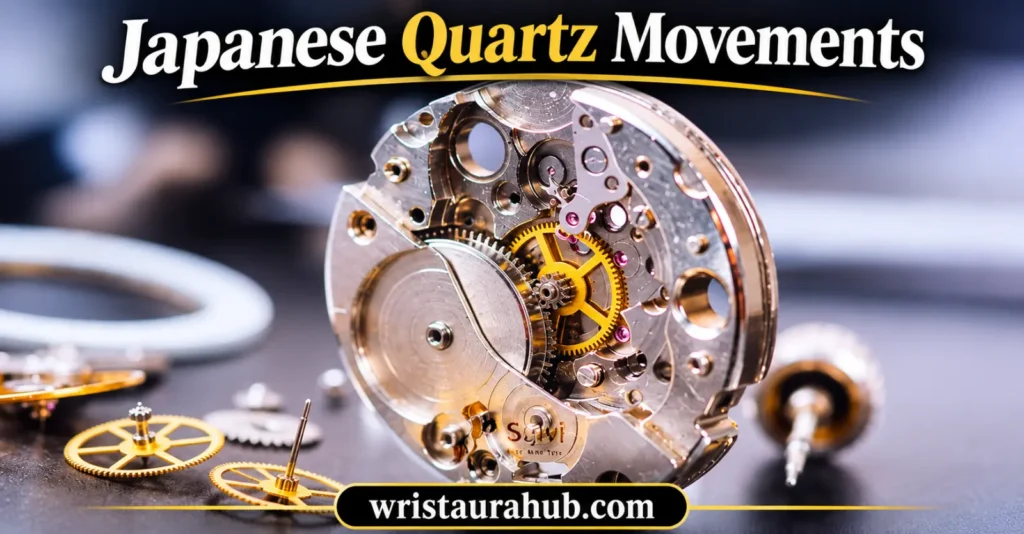
Quartz is one of the most common types of Japanese watch movements. It uses a battery to power an electronic circuit and a quartz crystal to regulate timekeeping.
The crystal vibrates at a consistent frequency when electricity passes through it. The circuit measures those vibrations and sends signals to a small motor that moves the watch hands.
Japanese manufacturers helped make quartz technology widely accessible. Miyota produces several quartz movement families, including standard, slim, multifunction and chronograph mechanisms.
Advantages:
- Generally strong everyday accuracy.
- Affordable maintenance compared with many mechanical watches.
- No daily winding.
- Available in slim and lightweight designs.
Limitation: The battery eventually needs replacement. Some quartz movements also require specialist attention if their electronic components fail.
2. Japanese Automatic Movements
An automatic movement uses a mainspring to store mechanical energy. A rotating weight called a rotor moves as the wearer moves their wrist, winding the spring.
The stored energy travels through a gear train and escapement, regulating the release of power that drives the hands.
Japanese manufacturers such as Miyota and Seiko produce automatic mechanisms used in watches across different price categories.
Advantages:
- Does not require a conventional watch battery.
- Offers visible mechanical craftsmanship in exhibition-back designs.
- Can continue running when regularly worn or properly wound.
Limitation: Automatic movements generally require more maintenance than basic quartz mechanisms. They can also lose or gain more time over a given period.
3. Japanese Manual-Winding Movements
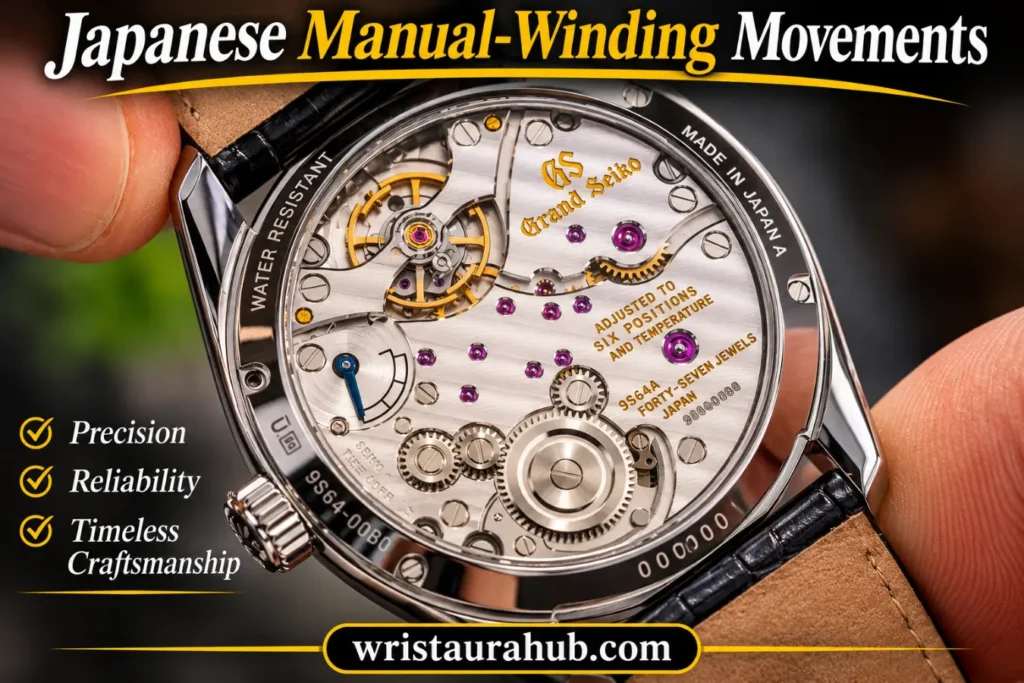
Manual-winding movements use a mainspring but do not rely on a rotor to wind themselves. The wearer turns the crown to store energy in the spring.
This traditional arrangement gives the wearer a direct connection with the mechanism. It also allows watchmakers to create relatively thin mechanical designs because an automatic winding system is not required.
Advantages:
- Traditional mechanical construction.
- No battery required.
- Direct control over winding.
Limitation: The watch needs regular winding. Forgetting to wind it can cause it to stop, depending on its remaining power reserve.
4. Japanese Solar Movements
Solar movements use light to generate electrical energy. A photovoltaic cell, often positioned beneath the dial, converts light into electricity and stores it in a rechargeable energy cell.
Citizen’s Eco-Drive technology is a well-known example of Japanese light-powered watchmaking. Citizen introduced its first solar-powered analogue watch in 1976, demonstrating Japan’s long involvement in this technology.
Advantages:
- Reduces the need for conventional battery replacements.
- Can operate using natural or artificial light, depending on the movement.
- Suitable for everyday use.
Limitation: Long periods without sufficient light can deplete the stored charge. Rechargeable cells also have a finite service life.
5. Japanese Kinetic Movements
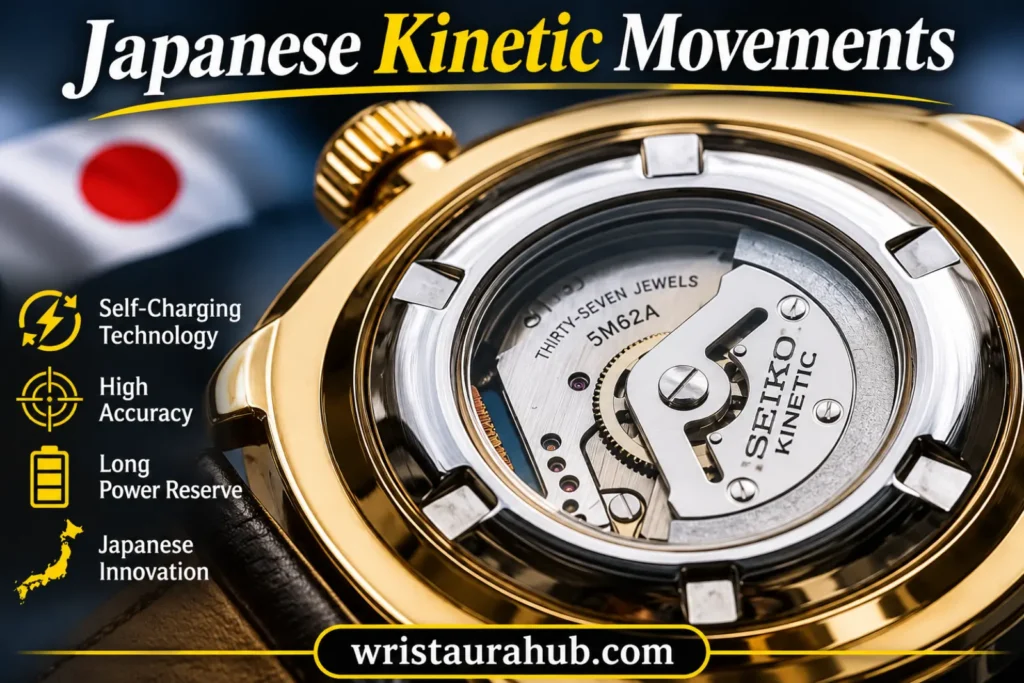
Kinetic movements convert the wearer’s movement into electrical energy. A rotor spins as the wrist moves, driving a small generator that charges an energy-storage component.
The watch then uses electronic timekeeping rather than a conventional mechanical escapement.
This approach combines aspects of automatic winding and quartz technology. It does not need a standard disposable battery, although its rechargeable storage component may eventually need attention.
Advantages:
- Generates energy through wrist movement.
- Offers electronic timekeeping.
- Avoids routine conventional battery changes.
Limitation: The energy-storage system adds complexity, and prolonged inactivity can leave the watch without enough stored power.
[readmore url=”https://wristaurahub.com/movado-watches-for-men/”]
How to Identify a Japanese Movement Inside a Watch
You do not need to open the case to investigate every watch. Start with the manufacturer’s specifications and work through these checks.
- Read the movement specification: Look for terms such as Japanese quartz, Miyota automatic, Seiko movement or Japan-made movement.
- Check the calibre number: A specific calibre number is more useful than a general claim about Japanese technology.
- Identify the manufacturer: Miyota, Seiko and Epson are examples of Japanese companies associated with watch movements and timekeeping technology.
- Check the origin marking: Some movements carry a JAPAN marking. However, the exact marking and its meaning depend on the manufacturer and production origin.
- Confirm the complete watch’s origin: Check whether the manufacturer specifies Japan-made, Japan-assembled or simply Japanese movement.
One useful detail is that Miyota publishes movement specifications, parts information and technical support through its official website. These resources help watchmakers and owners identify the actual mechanism rather than relying on vague marketing descriptions.
Japanese Movement vs Swiss Movement: What Is the Difference?
Japanese and Swiss movements represent two major watchmaking traditions. Neither category is automatically superior. Their differences depend on the individual movement, manufacturing standards and intended use.
| Comparison | Japanese movements | Swiss movements |
|---|---|---|
| Common manufacturers | Miyota, Seiko, Epson | ETA, Sellita |
| Quartz technology | Widely available | Also widely available |
| Mechanical options | Automatic and manual | Automatic and manual |
| Market reputation | Practical engineering and value | Long-established mechanical watchmaking tradition |
| Price range | Broad, from affordable to premium | Broad, from affordable to luxury |
| Main consideration | Exact calibre and specifications | Exact calibre and specifications |
Japanese movements are particularly common in affordable and mid-priced watches. Miyota’s movements, for example, appear in products from established brands and smaller independent manufacturers.
Swiss movements have a long association with traditional mechanical watchmaking, but that does not make every Swiss mechanism more accurate or durable than its Japanese counterpart.
A well-regulated Japanese automatic movement can be a better practical choice than a poorly maintained Swiss movement. The actual calibre matters more than the country label.
Which Japanese Movement Should You Choose?
Your choice should depend on how you use your watch, how much maintenance you accept and what you value most.
- For everyday accuracy: Choose Japanese quartz. It is a straightforward option for someone who wants reliable timekeeping without regular winding.
- For mechanical craftsmanship: Choose an automatic movement. It offers traditional engineering and a mechanical experience.
- For traditional watch enthusiasts: Consider manual winding if you enjoy interacting with the mechanism.
- For lower routine battery maintenance: Consider a solar movement. It is particularly useful for regular everyday wear.
- For electronic timekeeping powered by movement: Kinetic technology offers an alternative to conventional quartz and automatic systems.
Budget also matters. An inexpensive Japanese quartz watch may be a more sensible purchase than a low-cost automatic watch with uncertain servicing support.
If you are considering an automatic model, check its accuracy tolerance, power reserve, warranty and servicing arrangements. These details provide more useful information than the word Japanese alone.
[readmore url=”https://wristaurahub.com/chinese-watch-brands/”]
How to Recognize a Good Japanese Movement Watch
A Japanese movement can be a strong foundation, but the complete watch still needs proper construction.
Look at these quality indicators before making a decision:
1. A clearly identified calibre
A manufacturer should provide an identifiable movement reference rather than relying on a vague Japanese technology label.
2. Reliable timekeeping information
Quartz and mechanical movements have different accuracy expectations. Check the manufacturer’s stated tolerance instead of assuming all Japanese movements perform identically.
3. Serviceable construction
Check whether replacement parts, movement documentation and repair services are available. A widely distributed calibre can make future maintenance easier.
4. Appropriate case protection
The case, crown, seals and crystal all affect everyday durability. A good movement cannot compensate for poor water resistance or weak case construction.
5. A realistic warranty
Read the warranty terms and identify who handles repairs. A manufacturer’s reputation does not automatically guarantee good after-sales support from every retailer.
6. Suitable power management
Battery life, rechargeable storage and mechanical power reserve all matter, depending on the movement category.
Common Misconceptions About Japanese Watch Movements
Every Japanese Movement Is Made in Japan
Not necessarily. A Japanese company can supply movements manufactured in different locations. Check the specific calibre and its origin marking.
Japanese Movement Always Means Quartz
Incorrect. Japanese manufacturers produce quartz, automatic and other mechanical movements. Miyota’s official catalogue includes both quartz and mechanical families.
Japanese Movements Are Always Better Than Swiss Movements
Neither country guarantees superior performance. Accuracy, durability and serviceability depend on the individual mechanism and how well the complete watch is made.
All Japanese Movement Watches Are Affordable
Japanese movements are used across different price categories. The finished watch’s materials, finishing, design and complications also influence its price.
A Japanese Movement Means the Entire Watch Is Japanese
This is another common misunderstanding. The movement may come from Japan while the watch’s case, dial, strap and assembly come from elsewhere.
The Final Talk
A Japanese movement is worth considering because it offers access to several practical timekeeping technologies, from everyday quartz to sophisticated mechanical and light-powered systems. But the country label should be your starting point, not your final buying decision.
Identify the caliber, understand its power source, check its accuracy and consider future servicing. A clearly specified movement from a reputable manufacturer is a much stronger reason to trust a watch than a generic Japanese movement claim.
Frequently Asked Questions
It is a watch powered by a movement manufactured or supplied by a Japanese watchmaking company. It can use quartz, automatic, manual-winding or solar technology.
The phrase means that the watch uses a Japanese-origin timekeeping mechanism. It does not necessarily mean that the complete watch was manufactured in Japan.
Yes. Japanese quartz movements are popular for practical everyday timekeeping. They generally offer good accuracy, convenient operation and relatively straightforward maintenance.
Japanese quartz movements use a battery and electronic timing system. Automatic movements use a mainspring wound by wrist movement. Quartz is generally more accurate and requires less routine maintenance.
It refers to a quartz watch fitted with a Japanese movement. The mechanism uses a quartz crystal and electronic circuit to regulate timekeeping.
It usually identifies the origin or manufacturer of the watch’s movement. Check the caliber number and manufacturer to establish exactly which mechanism the watch uses.
Discover More to Learn
Nordstrom Watches: Best Picks, Women’s Styles & Sales (2026)
All Black Watches: Luxury, Sport & Everyday Styles
[authorbox]