
A chronograph isn’t just a watch with extra dials it is a stopwatch, a piece of history, and one of horology’s most addictive designs.Chronograph watches combine traditional timekeeping with a built-in timing function, making them useful for everything from workouts and cooking to driving and racing. The best choices range from affordable solar quartz models to sophisticated mechanical icons, but the right one depends on your wrist size, budget, movement preference, and how often you’ll actually use the stopwatch.
In this guide, we’ll break down the standout models for 2026, explain what separates a great chronograph from a flashy one, and help you find a watch worth wearing long after the novelty wears off.
What Is a Chronograph Watch?
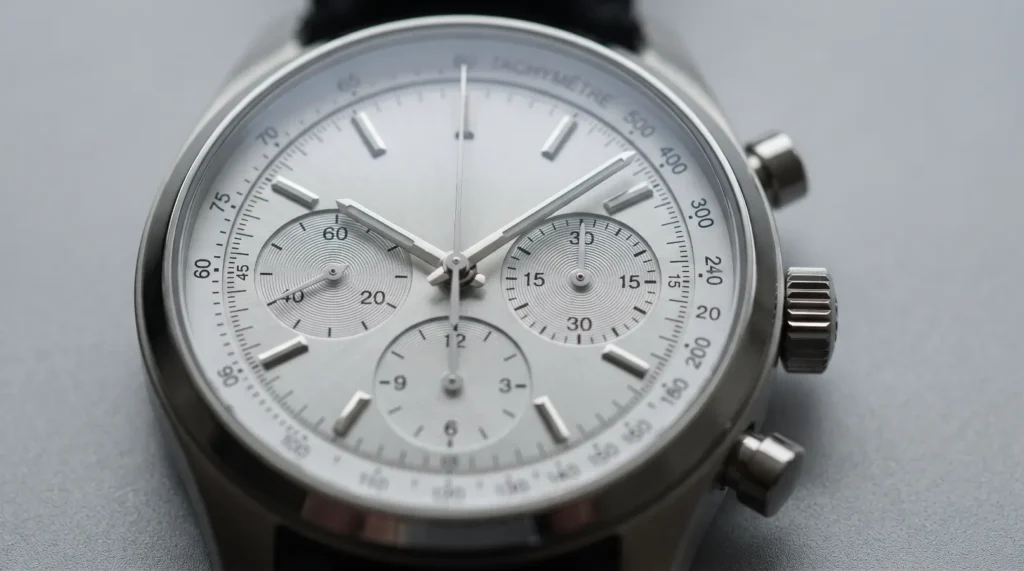
A chronograph is essentially a watch with a built-in stopwatch. Pressing the chronograph pusher starts the timing function, another press stops it, and a reset returns the indication to zero.
The important distinction is simple: a chronograph is a function, not a type of movement. You can have a quartz, solar-quartz, automatic, or manually wound mechanical chronograph.
That matters because buyers sometimes assume a mechanical chronograph is automatically the better choice. It is not. Mechanical versions offer more traditional watchmaking appeal, while quartz and solar versions generally win on convenience, accuracy, and everyday practicality.
What Do the Extra Subdials Do?
The small counters vary by movement, but they commonly record:
- Elapsed seconds: Often shown by a central seconds hand.
- Elapsed minutes: Usually displayed on a subdial.
- Elapsed hours: Found on longer-duration chronographs.
- Small seconds: Shows the normal running seconds separately.
- Date: Common on everyday chronographs, although it is not part of the stopwatch function.
Some models also use a tachymeter, which can estimate speed over a measured distance, while others feature telemeter or pulsometer scales.
A Short History of the Stopwatch Complication
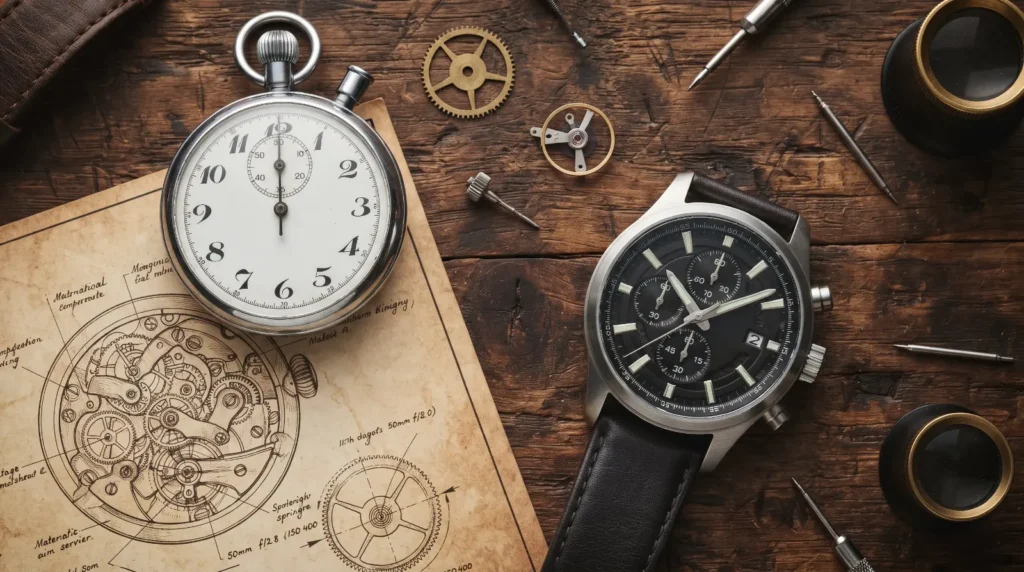
The chronograph has been around for more than two centuries, but its origins are more scientific than sporty. Early chronograph watches grew from precision timing instruments rather than the racing-focused designs we associate with them today. Louis Moinet completed his Compteur de Tierces in 1816 for astronomical observations. The instrument could measure extremely short intervals and included stop, start, and reset functions.
Nicolas Mathieu Rieussec later developed a timing device for horse racing in 1821. His system used ink marks to record elapsed time, and the French Academy of Sciences recognized the device as a chronograph. This early innovation helped establish the foundation for the chronograph watches that would eventually become popular among professionals and enthusiasts.
Modern chronograph watches evolved from these early instruments into tools for pilots, racers, scientists, military personnel, and eventually everyday buyers. Today, much of their appeal comes from the combination of practical timing utility, distinctive design, and mechanical fascination.
The Best Chronographs at a Glance
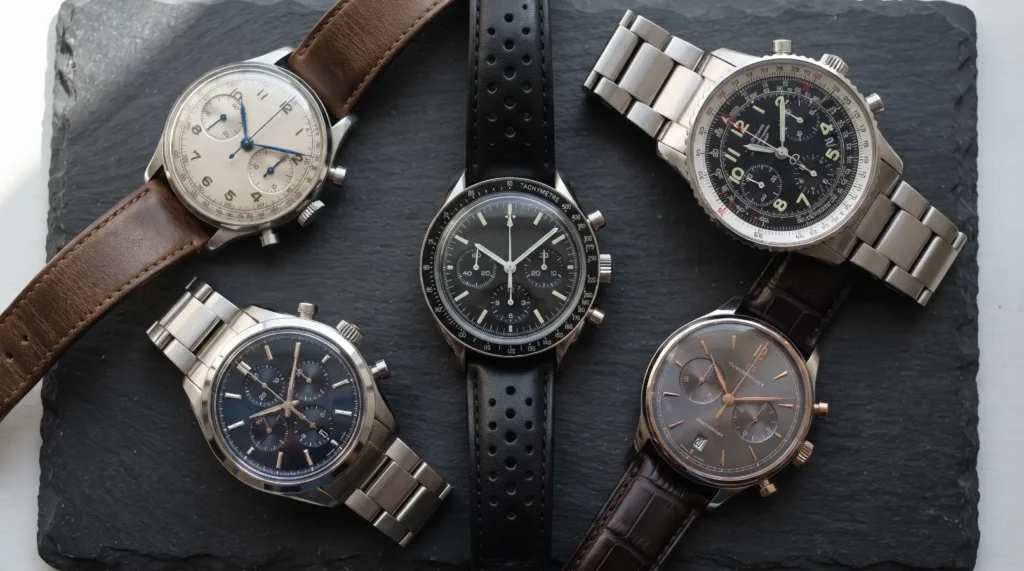
There is no single winner for every wrist. A 39mm solar chronograph makes more sense for someone who wants low-maintenance daily wear, while a mechanical Speedmaster or Navitimer appeals to someone who values history, movement architecture, and mechanical character.
| Watch | Movement | Case | Water Resistance | Best For |
|---|---|---|---|---|
| Seiko Prospex Speedtimer SSC813 | Solar quartz | 39mm | 100m | Best overall value |
| Tissot PR516 / PR-series chronographs | Quartz | Around 40mm+ depending on model | Model-dependent | Affordable Swiss option |
| Hamilton Intra-Matic Auto Chrono | Automatic H-31 | 40mm | 100m | Vintage-inspired mechanical |
| Omega Speedmaster Moonwatch | Manual-wind 3861 | 42mm | 50m | Iconic luxury choice |
| Breitling Navitimer B01 Chronograph 43 | Automatic Breitling 01 | 43mm | 30m | Aviation enthusiasts |
| TAG Heuer Carrera Chronograph | Automatic | Model-dependent | Model-dependent | Motorsport style |
| Rolex Cosmograph Daytona | Automatic | 40mm | 100m | High-end collectors |
Specifications can vary by reference and configuration, so check the exact model before buying.
7 Chronograph Watches Worth Considering
1. Seiko Prospex Speedtimer SSC813
Spec: Solar quartz V192, 39mm stainless steel case, sapphire crystal, 100m water resistance, approximately six months of operation when fully charged.
This is the easy recommendation for someone who wants the chronograph experience without turning ownership into a project. The SSC813 combines a compact 39mm case with a solar movement, sapphire crystal, tachymeter scale, and a 1/5-second chronograph. Seiko lists its U.S. price at $680.
The real advantage is the balance. It looks like a serious racing chronograph without carrying the thickness or maintenance expectations of many mechanical alternatives.
Best for: Everyday wear, smaller-to-medium wrists, and buyers who prioritize practicality.
Skip it if: Your main reason for buying a chronograph is admiring mechanical movement architecture.
2. Tissot PR516 and PR-Series Chronographs
Tissot’s Chronograph Watches range is worth examining if you want Swiss branding without immediately jumping into luxury-watch pricing. The current U.S. collection includes quartz options such as the PR516 around the mid-$500 range, while other Chronograph Watches span different sizes and prices.
This is where Tissot makes sense: you get a traditional Swiss watchmaking brand, plenty of styling choices, and quartz practicality. For buyers exploring Chronograph Watches at an affordable-to-midrange price, Tissot offers a strong balance of brand heritage and everyday usability.
Don’t buy purely because something says “Swiss Made,” though. Compare the exact case size, crystal, movement, bracelet, and water resistance of the reference you’re considering before choosing among Chronograph Watches.
Best for: Buyers wanting a Swiss chronograph around the affordable-to-midrange level.
Skip it if: You specifically want a mechanical chronograph with strong movement-focused appeal.
3. Hamilton Intra-Matic Auto Chrono
Spec: Automatic H-31, 40mm case, 14.45mm thick, sapphire crystal, 100m water resistance, 60-hour power reserve.
The Intra-Matic Auto Chrono gets the vintage-racing formula right without looking like a costume piece. Its 40mm case is considerably easier to wear than many oversized sports chronographs, although the 14.45mm thickness is still noticeable. Hamilton equips it with its H-31 automatic chronograph movement and gives it a useful 60-hour power reserve.
The strongest reason to buy it is character. The dial has enough visual drama to feel special, but the proportions remain restrained.
At $2,595 for the current green-dial configuration listed by Hamilton, it sits firmly above entry-level quartz chronographs.
Best for: Vintage-inspired mechanical chronograph fans.
Skip it if: You dislike thick watches or mainly need accuracy and low maintenance.
4. Omega Speedmaster Moonwatch Professional
Spec: Manual-wind Caliber 3861, 42mm case, 50m water resistance, 50-hour power reserve.
The Speedmaster is difficult to discuss without mentioning its history, but its reputation is not based on history alone. The Moonwatch remains one of the defining mechanical chronographs because the design is functional, recognizable, and unusually coherent.
The current 3861-equipped Moonwatch uses a manually wound movement and includes a tachymeter scale. Omega’s documentation lists a 42mm case, 50m water resistance, and approximately 50 hours of power reserve for the referenced configuration.
There is one catch: 42mm does not tell the entire story. The Speedmaster’s shape and lug-to-lug dimensions determine how it actually wears, so try one on rather than rejecting or choosing it based solely on diameter.
Best for: Someone buying one serious chronograph with decades of cultural and horological significance.
Skip it if: You want high water resistance or a watch you can treat like a rugged sports tool.
5. Breitling Navitimer B01 Chronograph 43
Spec: Automatic Breitling 01, 43mm case, approximately 70-hour power reserve, sapphire crystal, 30m water resistance.
The Navitimer takes the chronograph in a completely different direction. Instead of emphasizing minimalism, it surrounds the dial with information. Its signature circular slide-rule bezel is designed around aviation calculations, making it one of the most distinctive pilot’s watches ever produced.
The current stainless-steel B01 Chronograph 43 uses Breitling’s manufacture Caliber 01, offers approximately 70 hours of power reserve, and has a 43mm case. Breitling lists a U.S. price of $10,200 for one current steel configuration.
This is also a useful reminder that water resistance is not automatically linked to price. At 30m, the Navitimer is better treated as an aviation-oriented chronograph than a swimming watch.
Best for: Aviation history, complicated-looking dials, and buyers who want a statement piece.
Skip it if: You prefer clean dials or need serious water resistance.
6. TAG Heuer Carrera Chronograph
The Carrera is the natural choice for buyers who associate chronographs with motorsport. Its design language is cleaner than the Navitimer’s, and the collection has evolved considerably across generations.
The key attraction is the relationship between the dial, tachymeter elements, and racing heritage. Modern Carrera chronographs also demonstrate how far the category has moved from purely utilitarian timing instruments toward luxury sports watches.
For 2026, TAG Heuer is continuing to lean heavily into its motorsport heritage. Its newly released Monza Flyback Chronograph, for example, combines a flyback function with tachymeter and pulsometer scales, showing how specialist chronograph functions remain relevant to the brand’s identity.
Best for: Motorsport fans who want a sporty luxury chronograph.
Skip it if: You’re looking for maximum value rather than design and brand heritage.
7. Rolex Cosmograph Daytona
The Daytona sits in a different category because buying one is as much about scarcity, collecting, and brand prestige as it is about timing elapsed seconds.
Its 40mm case is relatively wearable compared with some large aviation chronographs, while the three-register layout gives it the classic motorsport look people expect from a high-end chronograph.
But this is not the watch to buy simply because you want a stopwatch. There are vastly cheaper ways to get the same basic function. The Daytona makes sense when the buyer specifically wants the combination of Rolex ownership, collector interest, racing history, and luxury finishing.
Best for: Experienced collectors and buyers who specifically want the Daytona.
Skip it if: You are shopping primarily for functionality or value.
Mechanical vs Quartz Chronographs: Which Is Better?
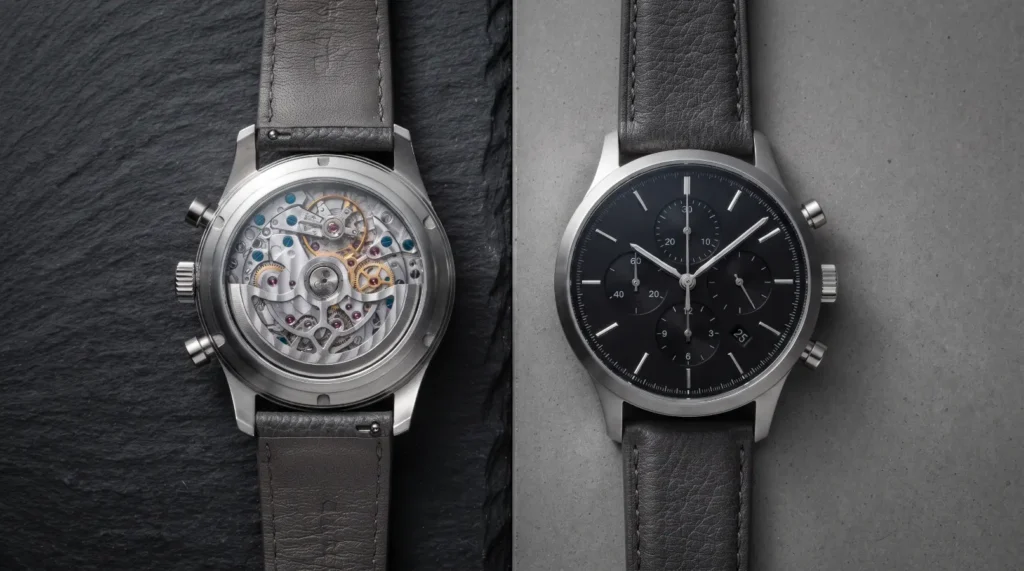
The movement question is one of the biggest decisions you’ll make. Mechanical chronographs are fascinating because the stopwatch function is powered by a network of mechanical components, while quartz versions prioritize precision and convenience.
There is no universal winner.
Choose a Mechanical Chronograph If:
- You enjoy traditional watchmaking.
- You want to see or feel the mechanical movement.
- The ritual of winding or wearing an automatic watch appeals to you.
- Long-term collectability matters.
- You don’t mind higher servicing costs.
Choose Quartz or Solar If:
- You want better everyday accuracy.
- You don’t want to reset a watch after it stops.
- You use the stopwatch regularly.
- You prefer lower maintenance.
- You want more functionality for your money.
This isn’t just theoretical. Watch enthusiasts regularly debate the trade-off between mechanical charm and quartz practicality, with some specifically preferring quartz for chronographs because of reliability and lower maintenance.
For a chronograph you will actually use, quartz or solar can be the smarter purchase.
What Makes a Good Chronograph?
A good chronograph is not simply one with three attractive subdials. Start by asking what the watch does well when you actually use the stopwatch.
1. Legibility
The central chronograph seconds hand should be easy to identify. Subdials shouldn’t be so crowded that you need to stare at the watch to understand them.
2. Pusher Feel
The start, stop, and reset action should feel deliberate. On a mechanical chronograph, smooth and positive pusher operation can make the watch feel significantly more refined.
3. Useful Timing Range
A basic chronograph may measure only minutes, while more capable movements add an hour counter. Decide what you actually need before paying extra for a complicated movement.
4. Case Proportions
Chronographs tend to be thicker than simple three-hand watches because the movement has additional components. Diameter isn’t enough; thickness and lug-to-lug length matter just as much.
5. Crystal and Case Quality
Sapphire crystal is particularly attractive for an everyday chronograph because the busy dial is frustrating to live with once the crystal becomes heavily scratched.
How to Choose the Right Chronograph for Your Wrist
A 43mm chronograph isn’t automatically too large, and a 39mm model isn’t automatically small. Dial opening, bezel width, lug-to-lug distance, thickness, and bracelet taper all change the way a watch wears.
If you have a smaller wrist, start around 38–40mm and pay close attention to lug-to-lug measurements. A larger wrist can comfortably handle bigger cases, but thickness can still make a watch feel cumbersome.
A useful decision process is:
- How often will you use the stopwatch?
If the answer is rarely, don’t overspend for advanced chronograph mechanics. - Do you want mechanical or practical?
Choose automatic/manual for horological appeal and solar/quartz for convenience. - What will you time?
Cooking and workouts need little sophistication. Motorsport or professional timing may justify specialized scales and longer timing ranges. - How large can your wrist comfortably handle?
Consider thickness and lug-to-lug, not diameter alone. - Where will you wear it?
A Navitimer is visually busy and dressy-sporty. A Speedtimer is easier as an everyday option. A racing chronograph naturally leans casual.

Are Chronograph Watches Good for Everyday Wear?
Yes, but not every chronograph is equally practical.
A solar quartz model can be an excellent daily watch because it combines accurate timekeeping with minimal maintenance. An automatic chronograph can also work beautifully as an everyday watch, particularly when it has sapphire crystal, a durable bracelet, and useful water resistance.
The compromise is thickness. Chronographs contain more machinery than simple three-hand watches, so they often sit higher on the wrist.
That is why a slim quartz or solar chronograph can sometimes be a better daily watch than an expensive mechanical model.
Common Mistakes to Avoid
Chronographs attract buyers with their complicated appearance, which can lead to some predictable mistakes.
Buying the Most Complicated Movement
More mechanical complexity does not automatically mean a better watch. If you never use the chronograph, you may be paying for a complication that adds thickness and servicing expense.
Ignoring Thickness
A 40mm case can still feel huge if it is thick and has long, straight lugs. Always check the complete dimensions.
Assuming 100m Water Resistance Makes It a Dive Watch
Water resistance is only one part of dive-watch capability. A chronograph with 100m resistance isn’t automatically designed for serious diving.
Choosing a Busy Dial You Can’t Read
Three subdials, a tachymeter, date window, applied markers, and multiple scales can look impressive in photographs. On the wrist, however, excessive information can hurt legibility.
Buying for the Brand Alone
A famous name does not guarantee the right watch for you. Compare movement, proportions, crystal, water resistance, bracelet quality, service requirements, and price.
Are Chronographs Worth Buying in 2026?
A chronograph is worth buying when you genuinely like the combination of stopwatch functionality and watch design. If you simply want the most accurate, uncomplicated everyday watch, a three-hander or solar watch may make more sense.
But if you enjoy mechanical engineering, racing history, aviation design, or simply want more interaction from your watch, this remains one of the most rewarding complications.
The market also makes the category unusually accessible. Tissot and Seiko offer practical options in the hundreds, Hamilton occupies an attractive mechanical middle ground, while Omega, Breitling, TAG Heuer, and Rolex take the concept deep into luxury territory. Current market coverage likewise shows chronographs stretching from well below $1,000 to highly expensive collector pieces.
The Final Talk
A great chronograph shouldn’t just look impressive on your wrist it should give you a reason to keep wearing it.The Seiko Prospex Speedtimer SSC813 is the standout choice for most buyers thanks to its compact size, solar movement, sapphire crystal, and everyday practicality. Want more mechanical character? The Hamilton Intra-Matic Auto Chrono brings vintage racing charm, while the Omega Speedmaster Moonwatch remains the obvious choice for anyone chasing legendary chronograph history.
At the luxury end, the Breitling Navitimer and Rolex Daytona take completely different approaches, proving that the best chronograph isn’t necessarily the most expensive one. Choose the movement, size, and design that match how you actually wear a watch and you’ll end up with a timepiece that feels exciting long after the first impression fades.
FAQs
A chronograph measures elapsed time independently of the watch’s normal timekeeping function. Pushers typically start, stop, and reset the stopwatch mechanism.
Some are automatic, but chronographs can also use manual-winding, quartz, or solar-quartz movements. The word “chronograph” describes the timing function, not how the watch is powered.
They can be, especially for enthusiasts who value traditional watchmaking and mechanical complexity. However, they generally cost more to maintain than quartz or solar alternatives.
The Seiko Prospex Speedtimer SSC813 is one of the strongest affordable choices because it combines a 39mm case, solar movement, sapphire crystal, tachymeter, and 100m water resistance. Seiko currently lists it at $680 in the U.S.
Chronograph movements contain additional components for the stopwatch mechanism, including controls, gears, and timing components. That extra machinery often requires more vertical space than a simple three-hand movement.
Discover More,
Czapek Watches: 7 Luxury Picks That Deserve More Attention
Solar Watches: 7 Best Picks That Never Need a Battery Change
High End Watches: 7 Must-Buy Luxury Picks for 2026
[author box]