
An 18k gold watch can be a valuable timepiece, but its price depends on much more than its gold color. The difference between solid gold, gold-plated and gold-capped construction can change its actual metal value considerably. An 18-karat alloy contains 75% pure gold, with the remaining 25% made up of other metals that affect its color and durability.
Rolex, vintage Baume & Mercier and other luxury makers have used 18-karat gold in different designs. Understanding the hallmark, gold weight, movement, condition and brand helps explain what a watch is worth and why two similar-looking pieces can have very different prices.
18K Gold Watches at a Glance
- Purity: 18-karat gold contains 75% pure gold.
- Hallmark: The number 750 commonly identifies 18-karat gold.
- Construction: A genuine solid-gold case differs from a plated or gold-capped case.
- Value: Gold content, brand, model, condition and originality all affect resale value.
The biggest distinction is whether the watch actually contains solid 18-karat gold or only has a gold-coloured exterior.
[readmore url=”https://wristaurahub.com/retro-watches/”]
What 18-Karat Gold Means in Watchmaking
Gold purity is measured using a 24-part system. Pure gold is 24 karats, while 18-karat gold contains 18 parts gold and six parts other metals.
That gives it a gold content of 75%, also expressed as 750 parts per thousand. The World Gold Council explains how fineness marks and hallmarks identify precious-metal purity.
The remaining metals are not necessarily a disadvantage. They help make the alloy more practical for everyday objects such as watch cases and bracelets.
Gold alloys also come in different colours:
- Yellow gold: A traditional gold appearance created using gold with suitable alloying metals.
- White gold: A lighter-colored alloy made by combining gold with other metals.
- Rose gold: A warmer pink or reddish alloy that generally uses a higher proportion of copper.
Rolex, for example, produces its own 18-karat yellow, white and Everose gold alloys. Its official explanation confirms the 750-parts-per-thousand gold content.
Different Types of Gold Watch Construction
Not every watch advertised as gold uses the same materials. Understanding the construction is the first step in judging its quality and potential resale value.
| Construction | Material | Gold content | Main consideration |
|---|---|---|---|
| Solid 18K gold | 18K gold alloy | 75% | Has intrinsic precious-metal value |
| Gold-plated | Thin gold surface | Small surface layer | Little recoverable gold |
| Gold-filled | Gold bonded to base metal | Varies by standard | Not solid gold |
| Gold-capped | Gold covering another metal | Depends on construction | Not equivalent to a solid-gold case |
Solid Gold Cases
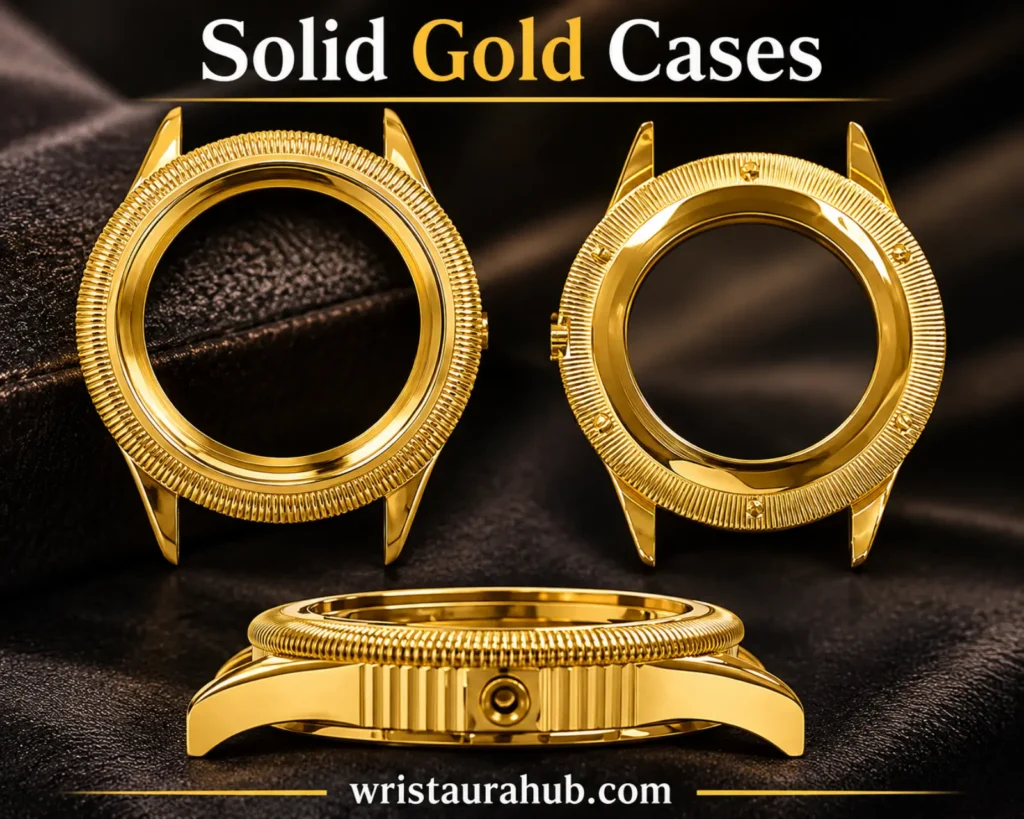
A solid-gold watch uses an 18-karat gold alloy for the components described as solid gold. This may include the case, bezel, bracelet or other exterior parts.
However, solid gold does not mean every component is gold. The crystal, movement, dial, seals and many internal parts use other materials.
A solid 18k gold watch men’s style, for example, may feature a precious-metal case and bracelet while retaining a conventional mechanical movement.
Gold-Plated Watches
Gold-plated watches have a thin layer of gold applied over a base metal. The underlying case is commonly made from another material.
They can provide a similar appearance to solid gold at a lower purchase price. However, the surface layer can wear away, particularly around edges, clasps and frequently contacted areas.
Their scrap-gold value is generally very limited.
Gold-Filled and Gold-Capped Watches
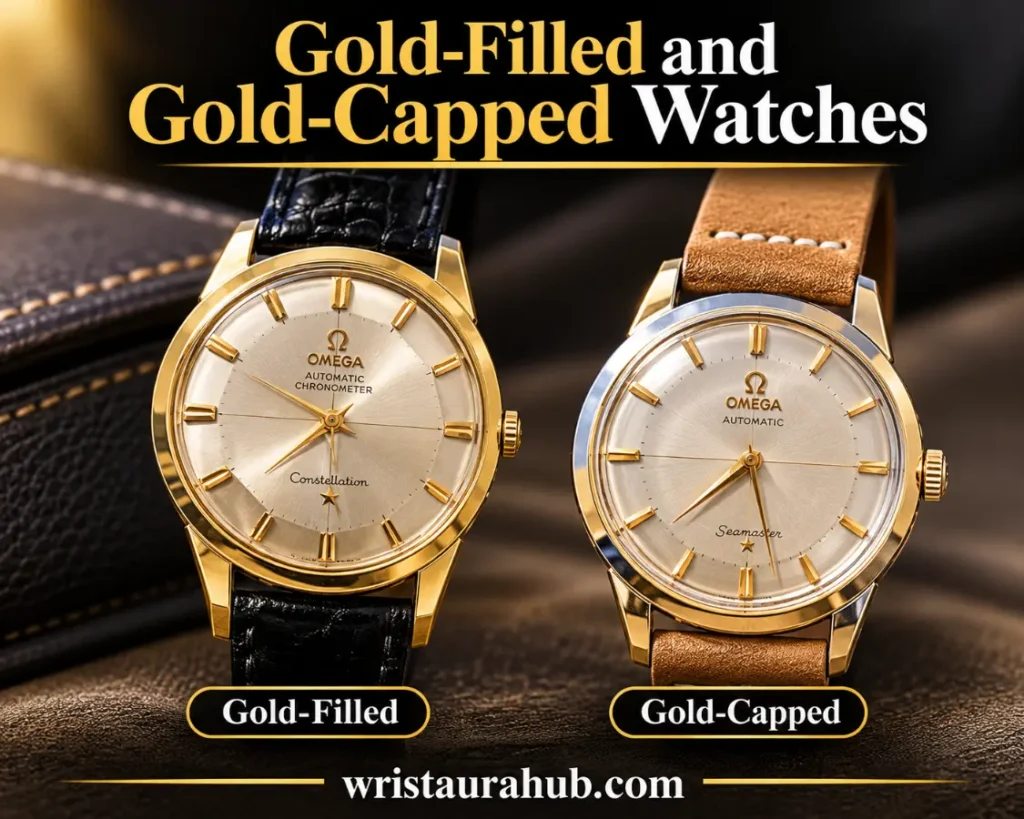
Gold-filled construction uses a mechanically bonded gold layer over a base metal. Gold-capped construction also describes a gold covering rather than a completely solid-gold case.
These terms should not be treated as interchangeable with solid 18-karat gold. Buyers should check the manufacturer’s description and the actual material markings before paying a premium.
How Much Is an 18K Gold Watch Worth?
The value depends on two separate things: the precious metal and the watch itself.
Gold content establishes a starting point, while the maker, reference, originality and condition determine whether a collector or watch buyer might pay more than the metal value.
Calculating the Gold Value
A simple starting formula is:
Gold value = Actual gold weight × Current 18K gold price per gram
For example, if a watch contains 20 grams of verified 18K gold, its theoretical metal value is based on 20 grams multiplied by the current 18K gold rate.
However, the total weight of a watch is not the same as its gold weight. A watch includes a movement, crystal, dial, springs, screws and potentially steel components.
An accurate valuation therefore requires identifying which components are gold and weighing them appropriately.
What Changes the Final Selling Price?
- Gold weight: More verified solid gold generally increases its underlying metal value.
- Brand: Rolex and established luxury manufacturers can command premiums beyond their raw material.
- Model: Certain references attract stronger collector interest.
- Condition: Original components, a clean case and a functioning movement can support a better valuation.
- Originality: Replacement bracelets, aftermarket dials and modified parts can affect desirability.
- Documentation: Original papers, service records and boxes can help establish authenticity and history.
A dealer’s offer may also be below the theoretical gold value because of refining costs, transaction margins and resale considerations.
Why Two Similar Gold Watches Can Have Different Prices
Consider two watches with similar-looking yellow-gold cases. One has a verified solid-gold case, an original bracelet and a desirable reference. The other has a plated case and a replacement bracelet.
Their appearance may be similar, but their material value and collector appeal are very different.
This is why a valuation should never rely on photographs or colour alone.
[readmore url=”https://wristaurahub.com/chronograph-watches/”]
How to Identify a Genuine 18K Gold Timepiece
Before buying a pre-owned gold watch, inspect its markings and construction. A luxury brand name alone does not prove that every exterior component is solid gold.
Check the 750 Hallmark
Look for markings such as:
- 18K
- 18KT
- 750
- 0.750
The 750 mark indicates 75% gold content. The World Gold Council explains that hallmarking systems differ between countries, so a stamp should be considered alongside the manufacturer’s identification and independent testing.
A hallmark is useful evidence, but it is not absolute proof of authenticity. Counterfeit watches can carry misleading markings.
Inspect the Case and Bracelet
Check the case back, inside the lugs, bracelet links and clasp. These areas may carry material markings.
Pay particular attention to the bracelet. Some watches have a solid-gold case but a different-metal bracelet, or a gold bracelet with non-gold internal components.
Get an Independent Assessment
For an expensive vintage watch, ask a qualified watchmaker or precious-metal specialist to inspect it.
A professional can help establish:
- Whether the case is solid gold.
- Whether the bracelet is original.
- Whether the movement matches the reference.
- Whether the watch has replacement components.
- Whether the gold purity matches its markings.
Avoid abrasive home tests or scratching the case. They can damage an otherwise valuable vintage watch.
What Makes Rolex 18K Gold Watches Valuable?
Rolex has a strong position in the luxury-watch market, and its precious-metal models can attract both collectors and buyers interested in gold watches.
The brand’s 18-karat gold construction is particularly relevant because Rolex controls the production of its gold alloys. Its yellow gold, white gold and Everose gold have different appearances but share the same 75% gold purity.
Understanding Rolex Gold Watch Prices
The search for a rolex 18k gold watch price does not have one universal answer. Different collections, references, production periods and bracelet configurations create substantial price differences.
A buyer should consider:
- Whether the watch is a Day-Date, Datejust or another collection.
- Whether it has a solid-gold case and bracelet.
- Its reference and production period.
- Whether the dial and hands are original.
- Its service history and physical condition.
- Whether the watch comes with original documentation.
A vintage model with desirable original components may attract collector interest beyond its gold content. A heavily polished or modified example may be less desirable.
How Much Is a Gold Rolex Worth?
The question of how much is a 18k gold rolex watch worth requires more information than its karat rating.
For instance, a vintage gold Rolex with an original bracelet, desirable dial and documented history should not be valued in the same way as a damaged watch being sold primarily for its precious metal.
Buyers should compare completed sales of the same reference rather than relying on asking prices from online marketplaces.
Vintage Baume & Mercier Gold Watches
Vintage Baume & Mercier watches offer another interesting example of traditional gold watchmaking.
The brand has produced elegant dress watches with different case materials, dial designs and mechanical movements. Some vintage examples feature precious-metal cases, while others use gold-coloured finishes or different materials.
A baume and mercier 18k gold watch vintage search should therefore lead to reference-specific research rather than assumptions based on appearance.
Before buying one, check the following:
- Case markings: Look for 18K or 750 stamps and verify them independently.
- Movement: Confirm that the movement is appropriate for the reference.
- Dial originality: Refinished or replaced dials can affect collector interest.
- Case condition: Excessive polishing can soften the original case shape.
- Service history: Vintage mechanical watches may need professional maintenance.
An older watch is not automatically more valuable. Its condition, originality, rarity and documented history matter more than age alone.
What Determines the Best Choice for Different Buyers?
The right gold construction depends on what the buyer expects from the watch.
| Buyer priority | Suitable construction | Reason |
|---|---|---|
| Precious-metal ownership | Solid 18K gold | Contains substantial actual gold |
| Luxury appearance | Gold-plated | Lower initial cost |
| Vintage collecting | Verified solid-gold vintage watch | Combines history and material value |
| Everyday wear | Gold alloy case | Offers a practical balance of appearance and durability |
| Resale potential | Recognised luxury reference | May attract collector demand |
For Gold Value
Choose a verified solid-gold case and understand the actual gold weight. Do not assume that the bracelet, clasp and every exterior part have identical metal content.
For Luxury Watch Collecting
Look beyond the metal. Movement quality, reference history, originality and condition are essential.
For Everyday Wear
Consider case thickness, bracelet comfort, servicing costs and scratch resistance. Gold is a relatively soft precious metal, so a solid-gold watch can develop scratches and surface marks through regular use.
A gold-plated alternative may make more sense if appearance matters more than precious-metal ownership.
Common Mistakes When Buying a Gold Watch
A gold watch can look impressive in photographs while hiding important problems. These are some of the mistakes worth avoiding.
Assuming Every Gold-Colored Watch Is Solid Gold
Yellow or rose-gold colouring does not establish gold purity. Always check the construction and markings.
Confusing Total Watch Weight With Gold Weight
The movement, crystal and other components contribute to the total weight. Only the verified gold components should be used when estimating metal value.
Paying Too Much for a Brand Name
A luxury logo does not automatically make every watch a good purchase. Compare the reference, condition, originality and actual market demand.
Ignoring Restoration and Replacement Parts
Replacement dials, aftermarket bracelets and heavily polished cases can affect collector value. Ask for photographs and service records before purchasing.
Treating Asking Prices as Actual Market Values
An online listing shows what a seller wants, not necessarily what a buyer has paid. Completed transactions provide stronger evidence when comparing similar watches.
[readmore url=”https://wristaurahub.com/moon-phase-watches/”]
A Better Way to Judge Gold Watch Value
The most reliable approach is to separate precious-metal value from collector value.
Start with the case and bracelet materials. Confirm the 18-karat markings, establish the actual gold weight and calculate the approximate metal value using the current market rate.
Then investigate the watch itself. Its manufacturer, reference, movement, condition and originality help establish whether it deserves a premium above the gold content.
For example, a genuine vintage Rolex may attract collector interest, while an ordinary gold-plated fashion watch may have very little recoverable gold.
Neither category should be judged by appearance alone.
Understanding Gold Content Before Paying a Premium
An 18-karat gold watch combines precious-metal content with traditional watchmaking, but its actual value depends on its construction and history. Start by checking the 750 hallmark and identifying which components are genuinely gold. Then consider the movement, reference, condition and collector demand. A solid-gold Rolex and a vintage Baume & Mercier may both deserve attention, but they require different valuation approaches. The best decision comes from verified materials and realistic market comparisons, not gold color or brand recognition alone.
Frequently Asked Questions
Its value depends on the actual gold weight, current gold rate, brand, model and condition. A solid-gold luxury watch may sell for considerably more than its metal value because of collector demand.
The basic calculation uses verified gold weight multiplied by the current 18K gold price per gram. Remember that the complete watch weight includes non-gold components.
The answer varies between solid-gold, gold-plated and vintage luxury watches. An independent appraisal is the best way to establish a realistic selling value.
Rolex uses 18-karat gold in its designated precious-metal models, but buyers should verify the specific reference and components. Not every gold-colored Rolex is a solid-gold watch.
18K contains 75% pure gold, compared with 58.5% in 14K. It has a higher gold content, while 14K generally offers greater hardness due to its larger proportion of alloying metals.
Some examples attract collector interest, particularly those with verified precious-metal cases, original components and good condition. However, age and brand reputation alone do not guarantee strong resale value.
Discover More to Learn
Movado Watches for Men: Best Collections, Styles & Value
Best Watches Under $300 for Every Style and Budget
[authorbox]