
A great vintage watch does something modern watches often struggle to do: it looks like it has lived a life before it reached your wrist. Patina, smaller proportions, domed crystals, aged lume, and hand-wound movements can give a watch genuine character that a brand-new dial simply cannot reproduce. The best vintage watches for men combine that personality with sensible proportions, dependable mechanics, and a design that still works today.
If you want the real vintage experience, look for well-preserved watches from established makers such as Seiko, Omega, Longines, or King Seiko. If you want the vintage look without the risks of decades-old components, modern heritage reissues from Hamilton, Tissot, Longines, and Timex are often the smarter choice.
vintage watches for men: What Counts as Vintage?
A vintage watch is generally an older timepiece valued for its period design, mechanical character, historical importance, or signs of age. There is no single industry-wide cutoff that makes a watch officially vintage, so collectors usually consider the watch’s production era, originality, condition, and historical context.
That distinction matters because a 1960s Omega and a modern Hamilton designed to resemble a 1960s military watch are not the same thing.
A useful way to divide the market is:
- Authentic vintage: Originally produced decades ago and sold today as a pre-owned or collectible watch.
- Vintage-inspired: A modern watch designed around historical shapes, colors, or military and dress-watch aesthetics.
- Reissue: A modern recreation based closely on a specific historical model or design.
- Neo-vintage: Older modern watches that have become collectible because of their design, movement, or limited production period.
For most first-time buyers, vintage-inspired watches and carefully serviced vintage pieces offer the best balance between character and usability.
vintage watches for men: Why Are They Still Popular?
Vintage watches remain attractive because their appeal goes beyond specifications. A modern watch might offer better accuracy, stronger water resistance, or a more advanced movement, but an older watch can have a dial, case profile, or finishing style that feels genuinely distinctive.
Size is another reason vintage watches have returned to favor. Many older men’s watches were smaller than today’s 41–44mm sports watches, often sitting around the mid-30mm to high-30mm range. That can make them particularly attractive to buyers who find modern oversized watches uncomfortable or visually heavy.
The strongest reasons to consider one are:
- Character: Patina and aging can make each example visually different.
- Classic proportions: Smaller cases and thinner profiles often work well with formal clothing.
- Mechanical appeal: Hand-wound and vintage automatic movements add horological interest.
- Historical connection: Certain watches reflect military, aviation, racing, or mid-century design history.
- Strap versatility: Leather, beads-of-rice, suede, canvas, and NATO straps can completely change the personality.
The downside is equally important: vintage ownership can involve servicing, replacement parts, uncertain water resistance, and originality questions.
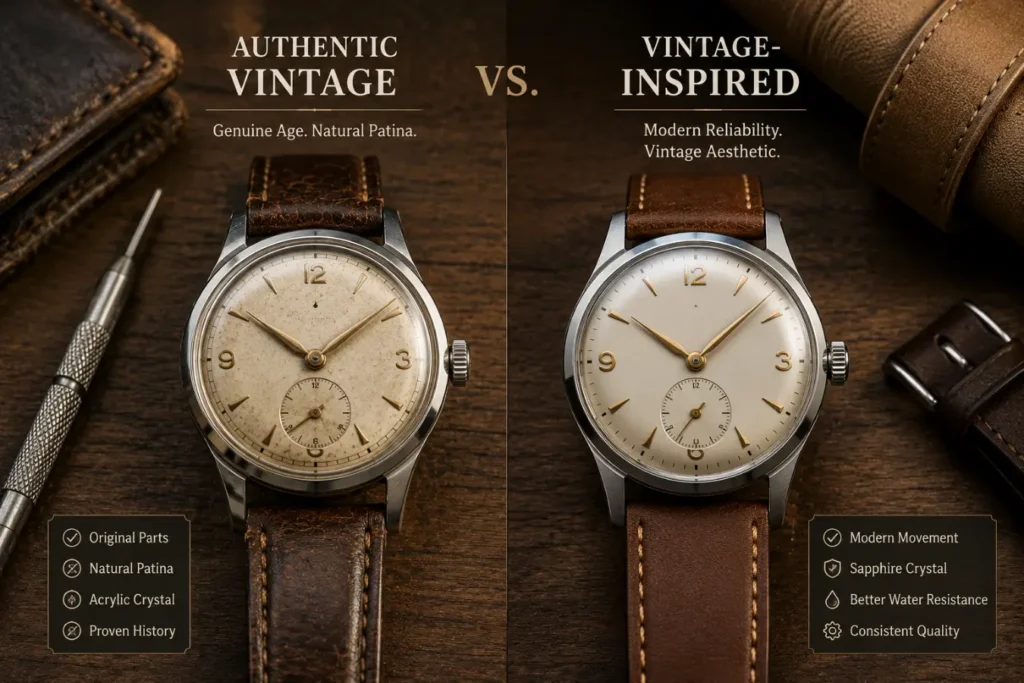
vintage watches for men: Authentic Vintage vs. Vintage-Inspired
The biggest decision is not which brand to buy. It is whether you actually want an old watch.
An authentic vintage piece gives you the real case, dial, movement, and construction of its period. A modern reissue gives you the appearance of that era while usually offering easier servicing, modern seals, improved crystals, and more predictable daily performance.
| Type | Main advantage | Main drawback | Best for |
|---|---|---|---|
| Authentic vintage | Genuine history and character | Condition and servicing risks | Collectors |
| Vintage-inspired | Modern reliability with classic styling | Less historical authenticity | Daily wear |
| Modern reissue | Strong historical connection | Can cost more than basic models | Enthusiasts |
| Neo-vintage | Older character with somewhat newer technology | Condition still matters | Intermediate collectors |
If you want a watch you can wear every day without constantly worrying about its age, start with a modern heritage model. If the attraction is the story, patina, and originality, authentic vintage is more rewarding.
vintage watches for men: 7 Best Watches to Consider
There is no single “best” vintage watch because collectors want different things. The selections below cover genuine vintage collecting as well as modern watches that capture the period accurately.
vintage watches for men: King Seiko Vintage
King Seiko is one of the most interesting choices for buyers who want authentic Japanese vintage watchmaking without immediately entering Swiss luxury pricing.
Vintage King Seiko watches from the 1960s and 1970s are available in a wide variety of references and conditions. Current marketplace listings show well-preserved examples at several hundred dollars, while particularly desirable or restored examples can climb considerably higher.
Best for: Buyers who want authentic vintage character and Japanese watchmaking history.
What to look for: Original dial, clean case lines, correct hands, an intact movement, and evidence of servicing. Over-polished cases can remove much of the crisp geometry that makes vintage King Seiko attractive.
vintage watches for men: Omega Seamaster Vintage
Vintage Omega Seamasters are among the safest places to start if you want a recognizable Swiss name with genuine historical depth.
The Seamaster family covers many decades and configurations, from simple dress watches to sportier models. That variety is useful, but it also means buyers need to research the exact reference rather than simply searching for “vintage Omega.”
Best for: Collectors who want Swiss heritage and a watch with long-term enthusiast interest.
What to look for: Original dial condition, correct hands, movement condition, case reference, and service history. A beautifully photographed vintage Omega can still be a poor purchase if its components have been incorrectly replaced.
vintage watches for men: Longines Heritage Classic Sector Dial
If you want the visual language of a vintage watch without accepting all the mechanical uncertainty of a decades-old piece, the Longines Heritage Classic Sector Dial is a strong option.
The current model measures 38.5mm and uses an automatic movement with a power reserve of up to 72 hours. It also has sapphire crystal and 3-bar water resistance. Longines says the design draws inspiration from models from the 1930s and 1940s.
Best for: Dress-watch buyers who prefer understated vintage styling.
Why it stands out: The sector dial gives it genuine period character without turning the watch into a costume piece.
The limitation is its modest water resistance. Treat it as a dress/everyday watch rather than a swimming companion.
vintage watches for men: Tissot Heritage 1938
The Tissot Heritage 1938 is one of the more convincing modern choices for someone who wants vintage styling with modern mechanical specifications.
The 39mm stainless-steel case houses an automatic COSC-certified movement with a stated 42-hour power reserve. It also uses sapphire crystal and offers 5-bar water resistance.
Best for: Buyers who want vintage dress-watch proportions with modern Swiss mechanics.
Why it made the list: The 39mm size is particularly versatile. It is small enough to retain a vintage feel but not so small that someone accustomed to modern watches will find it difficult to wear.
vintage watches for men: Hamilton Khaki Field Mechanical 38mm
The Hamilton Khaki Field Mechanical is technically a modern watch, but its design is closely tied to Hamilton’s military field-watch heritage.
The current 38mm model uses the hand-wound H-50 movement, sapphire crystal, a 47mm lug-to-lug measurement, and an 80-hour power reserve. Hamilton lists 5-bar/50m water resistance, while the U.S. website currently lists the NATO-strap version at $675.
Best for: Everyday wearers who want military vintage styling without buying an old military watch.
Why it made the list: The manual-wind movement is part of the charm. Winding the watch regularly feels more connected to traditional mechanical watch ownership than simply wearing a modern automatic.
It is also a useful example of why case diameter alone does not determine fit. Its 47mm lug-to-lug measurement gives it a noticeably different wrist presence from a similarly sized round case with shorter lugs.
vintage watches for men: Timex Marlin Hand-Wound
The Timex Marlin is one of the easiest ways to experiment with vintage proportions without spending collector-level money.
The current Marlin Hand-Wound is 34mm and uses a mechanical hand-wound movement. Timex currently lists the model at $269 in the U.S., making it one of the more accessible ways into vintage-inspired mechanical watch design.
Timex also offers a Marlin 1965 Reissue, another 34mm hand-wound model that currently lists at $259.
Best for: Smaller-wristed buyers and anyone interested in genuine mid-century proportions.
The biggest warning is size. At 34mm, this will look deliberately small compared with contemporary sports watches. That is the point, but buyers accustomed to 40mm-plus cases should try the proportions before purchasing.
vintage watches for men: Citizen Tsuyosa
The Citizen Tsuyosa is not a vintage watch, and it should not be marketed as one. It belongs on this list because it demonstrates how modern watches can borrow classic design cues while remaining practical daily wearers.
The current 40mm Tsuyosa uses Citizen’s automatic Caliber 8210, sapphire crystal, integrated stainless-steel bracelet, date display, and 50-meter water resistance. Citizen lists a 42-hour power reserve on the model.
Best for: Buyers who want retro-leaning styling but prefer modern construction.
Its integrated-bracelet design gives it a more contemporary sports-watch personality than the other selections here, so choose it if you want vintage influence rather than a faithful historical appearance.
vintage watches for men: Quick Comparison
The right choice depends heavily on whether you want authenticity, reliability, size, or price.
| Watch | Type | Size | Movement | Water Resistance | Best For |
| King Seiko vintage | Authentic vintage | Varies | Vintage automatic/manual | Varies | Japanese vintage collecting |
| Omega Seamaster vintage | Authentic vintage | Varies | Vintage mechanical/automatic | Varies by reference | Swiss heritage |
| Longines Heritage Classic | Modern heritage | 38.5mm | Automatic | 3 bar | Vintage dress style |
| Tissot Heritage 1938 | Modern heritage | 39mm | Automatic COSC | 5 bar | Dress + everyday |
| Hamilton Khaki Field Mechanical | Vintage-inspired | 38mm | Manual-wind | 5 bar | Military style |
| Timex Marlin | Vintage-inspired/reissue | 34mm | Manual-wind | Model dependent | Affordable vintage look |
| Citizen Tsuyosa | Modern retro | 40mm | Automatic | 50m | Everyday wear |
For authentic vintage watches, specifications can vary substantially between references and production years. Do not assume that two watches carrying the same collection name have identical movements, crystals, or water resistance.
How to Choose the Right vintage watches for men
Start with the watch’s intended role rather than its brand name. A 36mm hand-wound dress watch can be brilliant for an office wardrobe but frustrating if you expect to wear it hiking, swimming, and traveling.
Consider your wrist size
Do not shop by diameter alone. Lug-to-lug length, case thickness, lug shape, dial opening, and strap width all influence how a watch wears.
A 38mm watch with long lugs can feel larger than a compact 40mm case. Vintage watches also tend to have narrower visual proportions, so a smaller diameter does not automatically mean a feminine appearance.
Decide how much maintenance you can tolerate
An authentic vintage mechanical watch is an old machine. Even a beautifully preserved example may need servicing.
Ask whether you are comfortable with:
- Periodic mechanical servicing
- Replacement of aged seals
- Finding specialist parts
- Reduced or uncertain water resistance
- Accuracy that may not match a modern mechanical watch
- Waiting for repairs
If the answer is no, buy vintage-inspired instead.
Prioritize originality over perfection
A completely flawless vintage dial may be attractive, but originality often matters more to serious collectors than cosmetic perfection.
A naturally aged dial with correct hands can be more desirable than a “perfect” watch assembled from replacement parts.
Choose the crystal carefully
Older watches commonly use acrylic or mineral crystals, while modern heritage models often use sapphire.
Acrylic can develop scratches but can also be polished and contributes to authentic vintage character. Sapphire is substantially more scratch resistant and better suited to modern daily wear.
How Much Should You Spend on vintage watches for men?
There is no universal vintage-watch budget because the market spans inexpensive mechanical watches to highly collectible Swiss pieces.
A sensible approach is to divide your budget by risk rather than prestige.
Under $500: Look at accessible vintage Seiko, Timex, and less collectible Swiss dress watches, but leave room for servicing.
$500–$1,500: This is a particularly interesting range for vintage Japanese watches, entry-level Swiss vintage pieces, and strong modern heritage alternatives.
$1,500–$3,000: You can begin looking more seriously at desirable vintage Swiss models and higher-quality modern heritage watches.
$3,000 and above: Reference knowledge becomes increasingly important. Condition, originality, provenance, and service history can have a major impact on value.
Marketplace pricing can vary dramatically. For example, current Chrono24 data shows vintage King Seiko examples starting around the high hundreds in some cases, while specific references and condition can push prices considerably higher. Longines’ broader market also spans from inexpensive older quartz pieces to much more valuable vintage chronographs.
The key lesson: never spend your entire budget on the watch itself. Keep some money available for servicing, a replacement strap, or unexpected repairs.
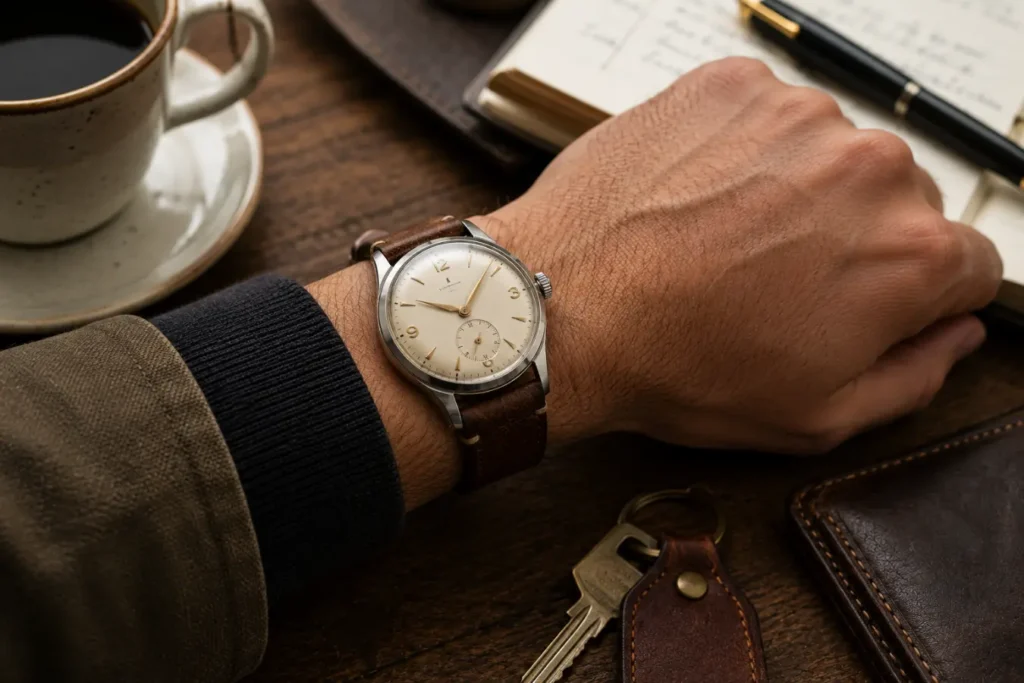
Are vintage watches for men Good for Everyday Wear?
They can be, but not every vintage watch should become a daily beater.
A well-serviced vintage watch with a healthy movement, solid case, and appropriate water resistance can be worn regularly. But an old dress watch with an uncertain service history is better treated as an occasional piece.
Modern vintage-inspired watches are usually the better daily option because their components, seals, crystals, and movements are easier to assess.
For daily wear, prioritize:
- A reliable movement with accessible service support.
- A case size that fits comfortably.
- A crystal appropriate for your lifestyle.
- A strap or bracelet that can tolerate regular use.
- Clearly stated water resistance.
- A seller willing to provide condition and service information.
Never assume that a vintage watch is water resistant simply because the original model was designed for everyday use.
Authenticity and Condition: What to Check Before Buying
Vintage watch shopping requires more caution than buying a current-production model. The biggest mistake is focusing on the dial and ignoring what is underneath it.
A polished case, refinished dial, replacement crown, incorrect hands, aftermarket bracelet, or mismatched movement may significantly affect collectibility.
Before buying, ask for:
- Clear photographs of the dial and case
- Movement photographs where possible
- Reference and serial information
- Service records
- Information about replaced components
- Seller return policy
- Confirmation of whether the dial is original or refinished
- Details about any known water damage
- Whether the watch has been pressure tested, if relevant
For expensive vintage watches, authentication should be handled by a qualified specialist rather than relying solely on seller photographs.
A seller saying “looks original” is not the same as documented provenance.
Common Mistakes to Avoid When Buying vintage watches for men
The vintage market rewards patience. The wrong purchase can turn an attractive bargain into an expensive restoration project.
Buying the cheapest example
The cheapest watch is rarely the cheapest ownership proposition. A low-priced example may need a movement overhaul, crystal replacement, crown replacement, or dial restoration.
Ignoring originality
A shiny case and spotless dial can look appealing, but excessive polishing and refinishing can remove the features that make a vintage watch collectible.
Assuming water resistance is still intact
Gaskets age. Crystals and crowns can wear. A vintage diver that looks perfect may still be unsuitable for water until properly inspected and tested.
Choosing diameter without checking lug-to-lug
A 36mm vintage watch with long lugs can wear completely differently from another 36mm watch with compact lugs.
Treating every old watch as an investment
Some watches become more valuable. Others simply become older. Buy a vintage watch because you appreciate the design and history first; treat potential appreciation as a bonus rather than the main reason for purchase.
Modern Vintage-Inspired vs. Authentic Vintage: Which Should You Buy?
Choose authentic vintage if you care most about historical significance, patina, period-correct construction, and collecting.
Choose vintage-inspired if you want the aesthetic but need dependable everyday performance.
Choose a modern reissue if you want the closest possible visual connection to a historic model while retaining contemporary components.
For most first-time buyers, a Hamilton Khaki Field Mechanical, Tissot Heritage 1938, Longines Heritage Classic, or Timex Marlin provides an easier entry point than jumping directly into an expensive vintage Omega or Rolex.
The best vintage watch is not necessarily the oldest one. It is the one whose character matches your lifestyle without creating maintenance problems you did not expect.
The Final Talk
The appeal of vintage watches for men comes from character rather than specification sheets. Authentic King Seiko and Omega pieces offer real history, while modern options such as the Hamilton Khaki Field Mechanical, Tissot Heritage 1938, and Longines Heritage Classic deliver vintage proportions with fewer ownership headaches. If you are new to vintage collecting, start with condition, originality, service history, and fit before worrying about brand prestige. A modest, honest vintage watch is usually a better purchase than an expensive example with questionable parts.
King Seiko, vintage Omega Seamaster, and vintage Longines models are strong authentic choices, while the Hamilton Khaki Field Mechanical, Tissot Heritage 1938, and Timex Marlin are excellent modern alternatives.
There is no universal size, but many classic men’s watches were smaller than today’s sports watches. Cases in the mid-30mm to high-30mm range can provide an authentic vintage appearance, while lug-to-lug length should also be considered.
A properly serviced vintage watch can be reliable, but its performance depends heavily on age, movement condition, previous repairs, and replacement parts. It should not automatically be expected to perform like a new mechanical watch.
Buy vintage if historical authenticity and patina matter most. Choose a reissue if you want the historical design with modern materials, easier servicing, and more predictable everyday performance.
Check the reference, movement, dial, hands, case, serial information, and seller documentation together. For valuable watches, professional authentication is strongly preferable to relying on photographs or seller claims alone.
Discover More,
Tissot Watches Women: 7 Best Picks for Every Style
Mens Digital Watches: 7 Best Picks for Every Budget
[author]