
Why pay full retail when a pre-owned Omega can give you the same iconic Swiss luxury for significantly less?Buying used Omega watches can be one of the smartest ways to own a Swiss luxury watch without paying the full retail price. Whether you’re looking for used Omega watches for sale, a pre-owned Seamaster, or used Omega watches under $1,000, the right reference can offer strong value.
The key is knowing what you’re buying. Condition, movement, service history, originality, and seller reputation can make a major difference when you buy used Omega watches online or from a local dealer.In this guide, we cover the best used Omega watches, realistic prices, where to buy pre-owned Omega watches, and what to check before purchasing.
[readmore url=”https://wristaurahub.com/swiss-made-watches/ “]
Used Omega Watches: Are They Worth Buying?
Yes, used Omega watches are generally worth buying when the watch has been properly authenticated, is in good condition, and is priced appropriately for its reference and service history. Omega’s extensive pre-owned market gives buyers access to everything from older quartz models to modern Master Chronometer pieces.
The biggest advantage is depreciation. Unlike buying new, you are often avoiding the steepest part of the initial price drop. Current secondary-market guides show that popular pre-owned Omega models can sell thousands below new retail, although prices vary substantially by generation, condition, configuration, and completeness.
For most buyers, the sweet spot is a modern or recent-generation watch from a reputable dealer rather than an extremely old example sold simply because it looks cheap.
Why buy pre-owned?
A good pre-owned Omega can offer:
- Lower entry cost than buying new
- Access to discontinued references
- More choice across older and current generations
- Proven ownership history when documentation is available
- Better value retention because some initial depreciation has already occurred
The trade-off is that condition and authenticity matter much more than they do with a brand-new watch.
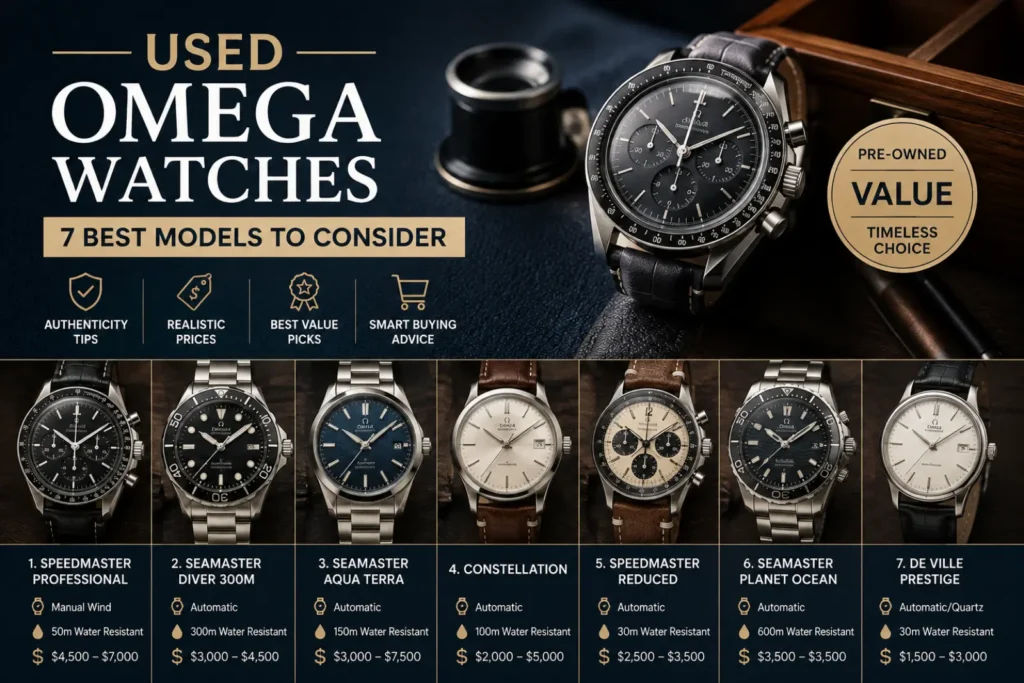
Used Omega Watches: 7 Best Models to Consider
The Omega catalog is broad enough that there is no single “best” pre-owned model. A Speedmaster makes sense for a chronograph enthusiast, while an Aqua Terra is a better one-watch solution for someone who wants something suitable for work, weekends, and travel.
The following selections cover the most useful categories rather than simply ranking the most expensive references.
| Model | Type | Typical Used-Market Range* | Best For |
|---|---|---|---|
| Speedmaster Professional Moonwatch | Chronograph | ~$4,500–$7,000 | Iconic chronograph |
| Speedmaster Reduced | Automatic chronograph | ~$2,500–$3,500 | Smaller wrists/value |
| Seamaster Diver 300M | Dive/sports | ~$3,000–$4,500 | Everyday sports wear |
| Seamaster Aqua Terra | Daily/dress-sport | ~$3,000–$7,500 | One-watch versatility |
| Seamaster Planet Ocean | Dive | ~$3,500–$5,500 | Serious tool-watch buyers |
| Constellation | Dress/sport | ~$2,000–$5,000 | Dressier styling |
| De Ville Prestige | Dress | ~$1,500–$3,000 | Lower-cost Omega entry |
*These are broad 2026 secondary-market snapshots, not fixed valuations. Reference, condition, box and papers, service history, seller reputation, and market demand can move the price considerably.
Used Omega Watches Under $1,000: What Can You Actually Buy?
Finding used Omega watches under $1,000 is possible, but the choices are usually older quartz or mechanical references, smaller cases, or watches showing more wear.
Some vintage Omega models can also fall below this price. However, condition, originality, service history, and collector demand can change the price significantly.
If you are looking for cheap used Omega watches, do not focus only on the lowest asking price. A cheaper watch that needs an expensive service may cost more in the long run.
Used Omega Watches: Speedmaster Professional Moonwatch
The Speedmaster Professional Moonwatch is the obvious starting point if heritage matters. It is the famous manually wound chronograph associated with NASA’s lunar missions, and modern versions retain the traditional hand-wound character that makes the collection distinctive.
A current-generation Moonwatch uses Omega’s manually wound Calibre 3861, while older pre-owned references use different movements and should be evaluated separately. The familiar Hesalite version is particularly attractive to buyers who want the historically minded configuration, while sapphire versions make more sense for owners who prioritize scratch resistance.
Best for: collectors, chronograph enthusiasts, and buyers who want an iconic Omega.
Typical used price: roughly $4,500–$7,000 for many modern/pre-owned examples, with older and special references varying widely.
Watch out for: over-polished cases, damaged bezel details, unclear service history, and replacement parts that compromise originality.
Used Omega Watches: Speedmaster Reduced
If the traditional Moonwatch feels large or expensive, the Speedmaster Reduced deserves attention. Older references such as the 3510.50 combine the Speedmaster’s recognizable chronograph layout with an automatic movement and a smaller case profile.
That makes the Reduced particularly interesting for buyers who want a vintage-feeling Omega chronograph without committing to the larger modern Moonwatch format.
Best for: smaller wrists, first-time Omega buyers, and value-focused collectors.
Typical used price: around $2,500–$3,500 for examples in good condition, although exact pricing depends heavily on reference and condition.
The downside is age. Many examples are now old enough that service history becomes more important than simply finding the lowest asking price.
Used Omega Watches: Seamaster Diver 300M
The Seamaster Diver 300M is the natural choice if you want an Omega that feels more at home around water. Modern examples combine a robust sports-watch design with a 300-meter water-resistance rating and Omega’s Co-Axial Master Chronometer technology.
Why Buy a Pre-Owned Omega Seamaster?
A pre-owned Omega Seamaster can offer much of the collection’s well-known dive-watch character at a lower price than buying new.
Older Omega Seamaster pre-owned references can be especially attractive because previous depreciation has already reduced their entry price.
Before buying, compare the exact reference, movement, water-resistance history, condition, and service records rather than judging every used Seamaster by the collection name alone.
Older generations can be particularly attractive on the pre-owned market because they offer the recognizable Seamaster identity at substantially lower prices than new models.
Best for: everyday sports wear, travel, swimming, and buyers who prefer a dive-watch aesthetic.
Typical used price: roughly $3,000–$4,500 for many mainstream pre-owned examples.
Do not assume every Seamaster Diver 300M has identical specifications. Reference numbers and production generations matter.
Used Omega Watches: Seamaster Aqua Terra
For buyers who want one watch to cover the office, travel, weekends, and casual occasions, the Aqua Terra is arguably the strongest all-rounder in Omega’s lineup.
Modern Aqua Terra models commonly feature 150-meter water resistance and Co-Axial Master Chronometer movements. Older generations can be much cheaper, making them especially interesting for pre-owned shoppers. Recent market guides put older examples around the low-to-mid-$3,000 range, while current-generation watches can command considerably more.
Best for: buyers wanting a versatile everyday luxury watch.
Typical used price: approximately $3,000–$7,500, depending heavily on generation and configuration.
This is one model where buying by reference number pays off. A previous-generation Aqua Terra can deliver much of the same basic wearing experience for considerably less than a newer Master Chronometer example.
Used Omega Watches: Seamaster Planet Ocean
The Planet Ocean sits on the more serious end of Omega’s dive-watch lineup. It is built around a sportier, more technical personality than the Aqua Terra and generally wears larger and more substantial on the wrist.
Older Planet Ocean references can be attractive bargains because depreciation has already done much of the work for the second owner.
Best for: buyers who want a substantial dive watch and don’t mind a larger wrist presence.
Typical used price: around $3,500–$5,500 for many mainstream pre-owned examples, although complications and special materials can push prices substantially higher.
The main caution is size. If you have a smaller wrist, try one on before buying rather than relying only on the stated case diameter.
Used Omega Watches: Constellation
The Constellation is worth considering if your idea of an Omega leans more toward polished and dress-oriented styling than traditional tool-watch design.
The collection covers a wide range of generations and configurations, so the used market is especially varied. Older quartz and mechanical examples can provide a relatively affordable route into the brand.
Best for: dressier everyday wear and buyers who want something less obvious than a Speedmaster or Seamaster.
Typical used price: roughly $2,000–$5,000, depending heavily on reference and materials.
Condition matters here because highly polished cases and damaged bracelets can noticeably change how an older Constellation looks and wears.
Used Omega Watches: De Ville Prestige
The De Ville Prestige is one of the more accessible ways to enter Omega’s pre-owned market. It is considerably dressier than the Seamaster family and has been offered in both quartz and mechanical configurations across different generations.
For someone who wants the Omega name, traditional styling, and a relatively modest used budget, it can make more sense than stretching financially for a newer sports model.
Best for: dress-watch buyers and budget-conscious Omega shoppers.
Typical used price: approximately $1,500–$3,000 for many examples.
The important point is to buy based on the specific reference and condition rather than assuming every De Ville offers the same movement or specifications.
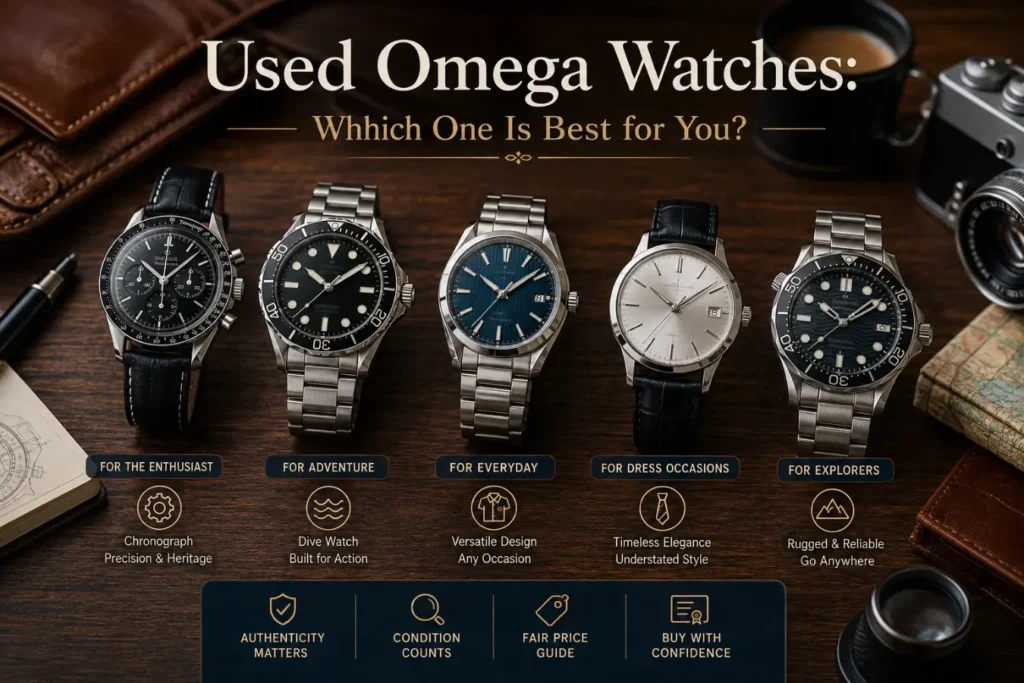
Used Omega Watches: Which One Is Best for You?
Choosing between pre-owned Omega collections becomes much easier when you start with how you will actually wear the watch.
If you want a simple decision framework, use these questions:
- Do you want a chronograph? Choose the Speedmaster.
- Do you want maximum water resistance and a sporty look? Look at the Seamaster Diver 300M or Planet Ocean.
- Do you want one watch for almost everything? Start with the Aqua Terra.
- Do you prefer dressier styling? Consider the Constellation or De Ville.
- Do you have a smaller wrist? Pay close attention to case diameter, thickness, and especially lug-to-lug measurements rather than diameter alone.
The right used Omega is the one whose specifications match your lifestyle. Paying extra for a professional dive watch makes little sense if most of your time is spent at a desk, just as buying a dress-oriented De Ville may disappoint someone who wants a rugged daily sports watch
Find the Best sternglas watches for Your Wrist.
[readmore url=”https://wristaurahub.com/sternglas-watches-7-best-models-youll-want-in-2026/ “]
Men’s Used Omega Watches: Which Models Are Best?
Men’s used Omega watches cover a wide range of styles, from the chronograph-focused Speedmaster to sporty Seamaster models and versatile Aqua Terra references.
For buyers looking for used Omega watches for men, case size and thickness are just as important as the model name. A smaller wrist may suit an older or more compact reference better than a large modern sports watch.
The best choice depends on how you plan to wear the watch. Speedmaster suits chronograph fans, Seamaster works well for sporty use, and Aqua Terra is one of the easiest everyday options.
Used Omega Watches: What Should You Check Before Buying?
The condition of a pre-owned Omega can matter more than the model year. Two watches with the same reference can have very different values depending on polishing, dial condition, bracelet stretch, service history, and originality.
Before paying, inspect the watch as a complete package rather than focusing on the dial alone.
Case and bracelet condition
Look closely at the case edges and transitions between brushed and polished surfaces. Heavy polishing can soften the original geometry, while deep scratches or dents may indicate rough treatment.
Bracelets deserve equal attention. Stretch, missing links, damaged screws, or an incorrect bracelet can affect both usability and resale value.
Movement and service history
A mechanical Omega that has not been serviced for many years may need maintenance soon after purchase. That does not automatically make it a bad buy, but the expected service cost should be part of your budget.
For older watches, documented service history can be more valuable than a box that has simply survived in a closet.
Box, papers, and warranty cards
A complete set can make a pre-owned watch easier to resell and may provide useful provenance. But do not pay an enormous premium simply because a seller has the original box.
A genuine watch with an honest service history is preferable to a questionable watch accompanied by an impressive-looking package.
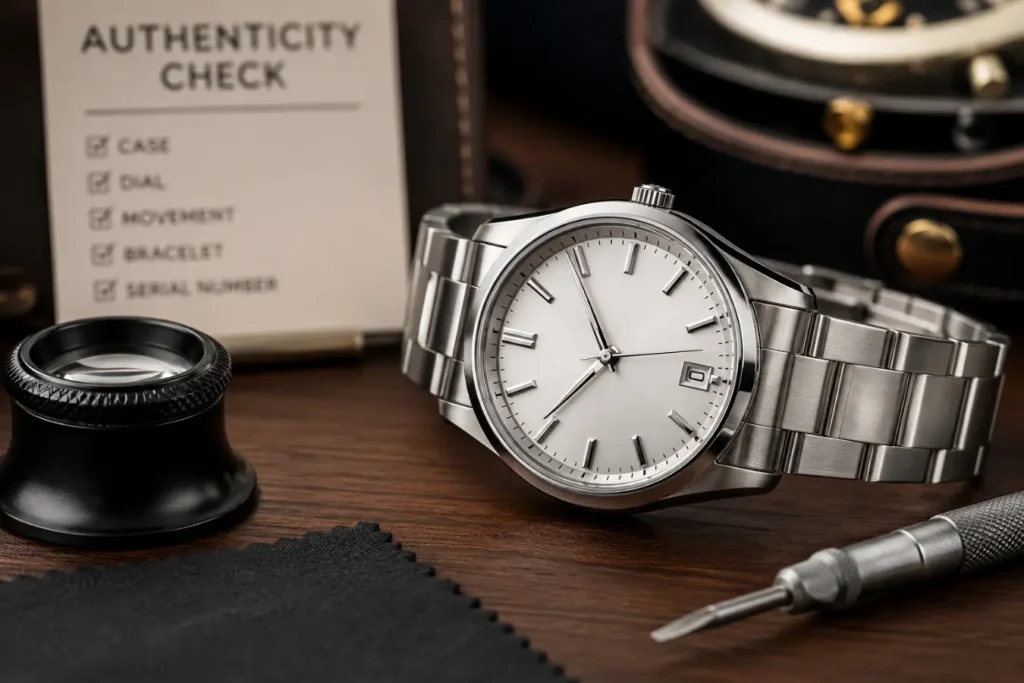
Used Omega Watches: How to Avoid Counterfeits
Popular Omega references are widely copied, so authentication should be treated as a buying requirement rather than an optional extra. Modern fakes can reproduce external details convincingly, which means visual inspection alone is not always enough.
If the price seems dramatically below comparable examples, stop and investigate before sending money.
Look for:
- A seller with a verifiable business history and clear return policy
- Matching reference and serial information
- Correct dial, hands, bezel, case, and movement for the reference
- Clear, high-resolution photographs of the movement when appropriate
- Documentation that makes sense for the watch’s age
- Independent authentication or inspection for expensive purchases
- A payment method offering meaningful buyer protection
A particularly cheap listing is not automatically a bargain. In luxury watches, an unusually low price can be the strongest warning sign.
Find the Best anordain watches for Your Wrist
[readmore url=”https://wristaurahub.com/anordain-watches/ “]
Used Omega Watches Resale Value: What Determines Their Worth?
The resale value of used Omega watches depends on the reference, condition, originality, service history, and current buyer demand.
Box and papers can also help, while aftermarket parts, excessive polishing, or missing bracelet links may reduce resale appeal.
If you are asking, “What is the value for my used Omega watch?”, start by identifying the exact reference and comparing similar pre-owned examples.
The Omega Seamaster Aqua Terra resale value can vary considerably between older references and newer Master Chronometer models, so the exact reference matters.
Used Omega Watches: Common Buying Mistakes to Avoid
The biggest pre-owned Omega mistakes usually come from buying the story instead of the watch. A seller may emphasize rarity, original packaging, or a famous connection while overlooking a heavily polished case or overdue service.
Avoid these mistakes:
- Buying solely on the lowest price: Cheap can become expensive after authentication and servicing.
- Ignoring the reference number: Different generations can have different movements, dimensions, crystals, and water resistance.
- Assuming box and papers guarantee authenticity: Packaging can be separated from the original watch.
- Ignoring service history: An older mechanical movement may need attention even when the watch looks excellent.
- Buying without checking wrist fit: Some Omega sports models are considerably larger and thicker than they appear in photographs.
For online purchases, ask for detailed photographs and documentation before committing. If the seller becomes evasive when you request basic verification, move on.
Used Omega Watches vs New Omega: Which Should You Buy?
For most value-conscious buyers, pre-owned Omega makes more financial sense than buying new. The secondary market offers a much wider selection of discontinued references and can reduce the purchase price substantially, particularly on older Aqua Terra, Seamaster, and Speedmaster models.
| Factor | Used Omega | New Omega |
| Purchase price | Usually lower | Higher |
| Model selection | Current + discontinued | Mostly current |
| Depreciation risk | Usually reduced | Highest early on |
| Condition risk | Requires inspection | Minimal |
| Warranty | Depends on seller/watch | New-watch coverage |
| Service history | Important | Not an issue initially |
| Resale flexibility | Often strong | More depreciation exposure |
New is still the better choice if you want maximum peace of mind, current specifications, and factory-backed ownership from day one.
Used is the smarter route if you care more about value and are comfortable doing the extra research.
Is Omega Better Than Rolex?
Is Omega better than Rolex? Not necessarily. The better choice depends on your priorities, budget, and preferred style.
Omega offers strong movement technology, a broad collection, and attractive opportunities in the pre-owned market. Rolex has exceptional brand recognition and typically stronger secondary-market demand.
For buyers focused on used Omega watches, Omega can be particularly appealing because older Speedmaster, Seamaster, Aqua Terra, and other references can offer substantial value compared with buying new.
Where to Buy Used Omega Watches for Sale
The best place to buy used Omega watches for sale is usually an established pre-owned dealer with authentication, a clear return policy, and warranty support.
Reputable marketplaces can provide more selection, but buyers need to investigate the individual seller. This is especially important when buying expensive second hand Omega watches.
Look for:
- Established seller history
- Clear return policy
- Buyer protection
- Detailed photographs
- Authentication or inspection
- Service information
If a seller offers a used Omega for sale at a price far below comparable watches, investigate carefully before paying.
Where to Buy Used Omega Watches Online
Buying used Omega watches online gives you access to a much larger selection than most local stores.
When deciding where to buy used Omega watches online, check the seller’s reputation, return policy, buyer protection, warranty, and authentication process.
Large marketplaces such as eBay can offer many Omega watches used, but buyers should carefully review seller feedback and listing details before purchasing.
Whether you search for buy used Omega watches online, omega second hand watches, or pre-owned Omega watches for sale, verify the exact reference and condition first.
Certified Used Omega Watches: What Does Certified Mean?
Certified used Omega watches can give buyers additional confidence, but certification does not always mean the watch was certified directly by Omega.
Ask the seller what the certification covers, including authentication, movement inspection, condition checks, and warranty protection.
A properly authenticated pre-owned Omega watch with clear documentation can be a safer purchase than an unusually cheap listing with no return policy.
The Final Talk
The Final Talk
The best used Omega watches are not always the cheapest they are the ones with the right combination of condition, authenticity, service history, and price.Whether you want a used Omega Seamaster, Speedmaster, Aqua Terra, or another classic reference, buying pre-owned can offer excellent value compared with buying new.Before you buy used Omega watches, verify the reference, movement, originality, service records, water resistance, and seller reputation. If you’re shopping online, choose a reputable dealer or marketplace with clear authentication and return policies.
For buyers on a tighter budget, used Omega watches under $1,000 can exist, but older or heavily worn references require extra caution. For most buyers, spending more on a well-documented pre-owned Omega watch is usually the safer long-term choice.
FAQs
Yes. A well-maintained pre-owned Omega can provide excellent value because buyers often avoid part of the depreciation associated with purchasing new. The key is verifying authenticity, condition, reference, and service history.
Prices vary widely, but broad 2026 market ranges run from roughly $1,500 for some older De Ville examples to $7,000 or more for popular modern Speedmaster and Aqua Terra references. Vintage, limited-edition, precious-metal, and complicated models can cost considerably more.
For most buyers, the Speedmaster Professional Moonwatch, Seamaster Diver 300M, and Aqua Terra are the strongest starting points. Your intended use should determine the final choice.
You can find a cheap Omega through older pre-owned references, vintage dealers, and reputable online marketplaces.
A very low price should always be investigated. Check authenticity, condition, service history, and seller reputation before buying.
Some vintage Omegas are relatively cheap because they are older, less collectible references or need servicing and restoration.
However, rare vintage models can be very valuable. Condition, originality, movement, and collector demand all affect the price.
Discover More,
Digital Watches for Men: 7 Best Picks for 2026
Nordstrom Watches: 7 Best Picks Worth Buying
Diamond Watches: 7 Stunning Picks Worth Buying
[author box]