
What if your watch could keep running for months without asking you for a battery change? That is the real appeal of solar powered watches. They convert light into energy, store it in a rechargeable cell, and combine quartz accuracy with remarkably low maintenance.Are solar powered watches any good? Absolutely. Today’s best solar watches include everything from rugged solar powered watches for men and field watches to dive watches, chronographs, digital models, and refined Swiss options from brands such as Citizen, Casio, Seiko, and Tissot.
But which one is actually worth buying? We break down how solar powered watches work, how long they last, their pros and cons, and the 7 best picks for 2026.
Are Solar Powered Watches Any Good?
Yes, solar powered watches are an excellent choice for buyers who want quartz accuracy without the inconvenience of frequent battery replacement. Instead of relying on a conventional disposable battery, a solar watch uses light to generate electricity and stores that energy in a rechargeable cell. This makes the watch particularly convenient for everyday wear because normal exposure to sunlight or indoor lighting can help replenish its power.
The best solar watches also offer much more variety than they once did. You can find compact field watches, rugged sports models, professional dive watches, chronographs, dressier Swiss watches, and multifunction digital watches using solar technology. Brands such as Citizen, Casio, Seiko, and Tissot have each taken different approaches, so choosing the right model depends on whether you value simplicity, durability, outdoor functionality, mechanical-style design, or Swiss refinement.
For most people, the biggest advantage is convenience. A fully charged solar powered watch can often continue running for months in darkness, meaning you do not need to think about replacing a battery every year or two. However, solar does not mean maintenance-free forever. The rechargeable energy-storage component can eventually age, and the watch may still require servicing for seals, crystals, crowns, bracelets, or other components.
Solar Powered Watches: What Are They?
Solar powered watches are quartz watches that use a photovoltaic cell to convert light into electrical energy. That energy is stored in a rechargeable cell and used to keep the quartz movement running when the watch is away from light.
Unlike a traditional quartz watch, which normally relies on a disposable battery, a solar watch is designed around rechargeable energy storage. Citizen calls its system Eco-Drive, while Casio uses Tough Solar across many of its digital and analog models.
The important distinction is that “solar” does not necessarily mean the watch needs direct sunlight every day. Many modern systems can harvest energy from indoor lighting as well, although charging speed depends heavily on the intensity and type of light.
What Types of Solar Watches Are Available?
The term solar watches covers a surprisingly broad range of designs and functions. Along with traditional three-hand models, manufacturers now produce solar powered quartz watches, field watches, dive watches, chronographs, sports watches, and solar powered digital watches. Some models are designed primarily for everyday convenience, while others combine light-powered movements with radio-controlled timekeeping, Bluetooth connectivity, GPS, or outdoor sensors.
This variety means watches with solar power are no longer limited to basic utility pieces. A buyer looking for a refined everyday watch can choose a Swiss solar model, while someone who spends more time outdoors may prefer a rugged Casio or Citizen. There are also lightweight titanium options, solar-powered chronographs for timing events, and highly functional digital watches designed for hiking and adventure.
In other words, solar technology is best understood as a power system rather than a particular watch style. The same basic principle can be used in a dressier analog watch, a professional diver, or a feature-packed outdoor instrument.
Solar Powered Watches: How Do They Work?
Modern implementations can be surprisingly efficient. Casio solar powered watches use the brand’s Tough Solar technology across a wide range of analog, digital, and combination models. The system can draw energy from both natural and artificial light, storing that energy so the watch can continue operating when it is no longer exposed to a light source. On multifunction models, the stored energy can power features such as alarms, illumination, sensors, Bluetooth connectivity, and radio-controlled timekeeping.
This is particularly relevant when shopping for G-Shock. Are all G-Shock watches solar powered? No. G-Shock produces both Tough Solar models and conventional battery-powered watches, so the presence of a G-Shock case does not automatically mean the watch is solar powered. If you specifically want a solar G-Shock, look for a model that lists Tough Solar in its specifications.
The same distinction applies when comparing different solar watches from the same brand. Solar technology can be combined with very different movements, complications, displays, and power reserves. Checking the individual model’s specifications is therefore more reliable than assuming every watch within a collection uses the same charging system.
Why the rechargeable cell matters
The rechargeable cell is one of the most important components in the system. It is not the same thing as an ordinary disposable quartz battery.
That means solar technology reduces the frequency of conventional battery replacement, but it does not make a watch completely maintenance-free forever. Rechargeable components eventually age, and seals, crystals, crowns, bracelets, and other watch components can still require service.
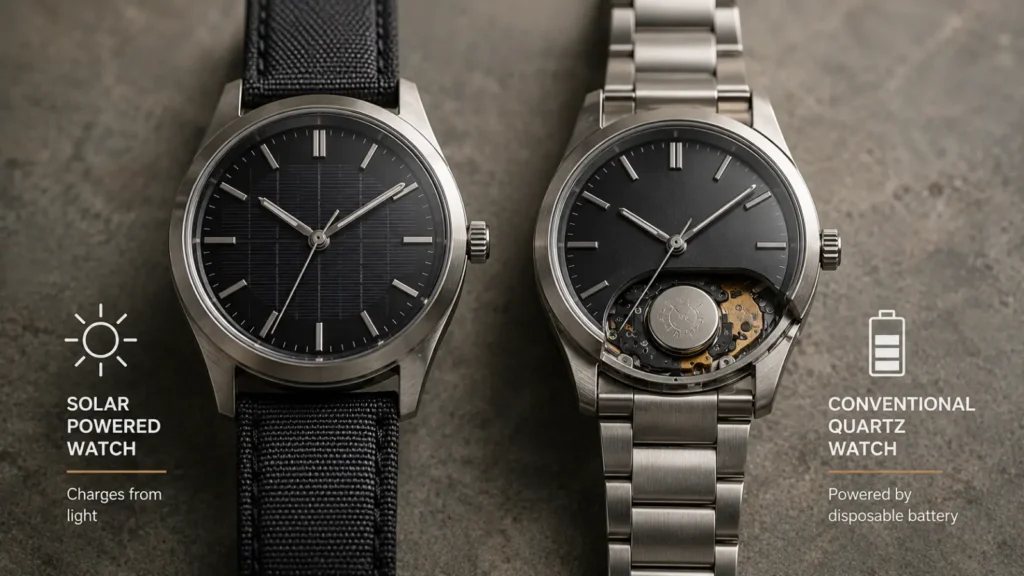
Solar Powered Watches: Are They Better Than Quartz?
For many everyday buyers, yes. A solar quartz watch offers most of the practical advantages of quartz while reducing one of its biggest annoyances: routine battery replacement.
The trade-off is that a solar movement may cost more than a basic quartz movement, and some designs require careful dial engineering so enough light reaches the solar cell.
| Feature | Solar Quartz | Traditional Quartz | Automatic |
|---|---|---|---|
| Power source | Light + rechargeable cell | Disposable battery | Mainspring |
| Accuracy | Generally excellent | Generally excellent | Varies by movement |
| Battery changes | Infrequent/rechargeable system | Periodic | None |
| Stops when unused | Usually only after stored energy is depleted | Eventually when battery dies | Yes, after power reserve runs out |
| Maintenance | Low, but not zero | Low | Generally higher |
| Best for | Low-maintenance daily wear | Budget practicality | Mechanical enthusiasts |
For someone who wants a watch to wear, set, and largely forget, solar quartz is one of the strongest choices available.
What Are the Best Solar Powered Watches for Men?
The best solar powered watches for men are not necessarily the largest or most feature-packed models. Case diameter, thickness, wrist comfort, water resistance, crystal material, and intended use all have a major effect on whether a watch works well as an everyday companion. A compact field watch can be a better daily choice for one wearer, while a larger solar diver or sports watch may make more sense for someone who spends time outdoors.
For solar powered watches for men, the current market offers plenty of choice. Citizen is particularly strong for practical Eco-Drive field and dive watches, Seiko offers compelling solar chronographs, Casio dominates rugged digital and outdoor designs, and Tissot provides a more refined Swiss alternative. The seven watches below are therefore selected for different purposes rather than simply ranking them by price.
If you are shopping specifically for the best solar powered watch, start by deciding how you will use it. An everyday watch should prioritize comfort and legibility, a dive watch needs appropriate water resistance and bezel functionality, while a chronograph should offer useful timing features without becoming unnecessarily bulky.
Solar Powered Watches: 7 Best Models to Consider
The market is broad enough that there is no single “best” solar watch for everyone. A small field watch makes more sense for daily wear than a huge professional diver, while a solar chronograph is useful if you actually need timing functions.
These seven picks cover different use cases and price levels.
Solar Powered Watches: Citizen Garrison BM8180-03E
Citizen Watch’s Garrison is one of the easiest solar watches to recommend for someone who wants simple, practical analog timekeeping.
The BM8180-03E uses Citizen’s E101 Eco-Drive movement and combines a 37mm stainless-steel case with a nylon strap, day-date display, luminous hands and markers, and 100-meter water resistance. Citizen currently lists it at $236 on its U.S. website, although retail pricing and promotions can change.
Spec snapshot:
- Movement: E101 Eco-Drive quartz
- Case: 37mm stainless steel
- Water resistance: 100m
- Crystal: Mineral
- Strap: Nylon
- Best for: Everyday and field-style wear
- Current listed U.S. price: about $236
Its biggest advantage is proportion. At 37mm, it avoids the oversized feel common among rugged watches and works particularly well for smaller to medium wrists.
Solar Powered Watches: Citizen Promaster Diver BN0151-09L
If your idea of a solar watch includes serious water resistance, the Citizen Promaster Diver BN0151-09L deserves attention.
This model combines Eco-Drive technology with a 44mm stainless-steel case, 200-meter water resistance, a unidirectional elapsed-time bezel, luminous hands and markers, and an anti-reflective mineral crystal. Citizen currently lists the model at $296.25 on promotion from a $395 original price.
Spec snapshot:
- Movement: E168 Eco-Drive
- Case: 44mm stainless steel
- Water resistance: 200m
- Crystal: Anti-reflective mineral
- Strap: Polyurethane
- Best for: Diving, swimming, outdoor use
- Listed U.S. promotional price: about $296
The downside is size. At 44mm, this is not the watch I’d choose for a wearer who strongly prefers compact cases.
Solar Powered Watches: Seiko Prospex Speedtimer SSC813
Seiko takes the solar concept in a sportier direction with the Prospex Speedtimer SSC813.
Its V192 solar movement provides approximately six months of operation when fully charged and includes a chronograph measuring up to 60 minutes in 1/5-second increments. The 39mm stainless-steel case is paired with a curved sapphire crystal, 10-bar water resistance, a date display, and power-reserve indicator. Seiko lists the model at $680 on its Middle East site, while regional pricing varies.
Spec snapshot:
- Movement: V192 solar quartz
- Case: 39mm stainless steel
- Water resistance: 10 bar
- Crystal: Curved sapphire
- Power reserve: Approximately 6 months when fully charged
- Best for: Chronograph fans and everyday sports wear
- Listed reference price: $680
This is one of the best choices if you want solar technology without the watch looking like a typical utility quartz model.
Solar Powered Watches: Tissot PRC 100 Solar 39mm
Tissot has pushed solar technology into a more refined everyday-watch category with the PRC 100 Solar.
Its Lightmaster Solar Quartz system places photovoltaic technology within the sapphire crystal rather than simply relying on a conventional panel beneath the dial. Tissot offers the PRC 100 Solar in 39mm and 34mm versions, and the 39mm collection is currently listed on the U.S. site across roughly the $515-$625 range depending on configuration.
A 39mm reference features a 316L stainless-steel case, sapphire crystal, Swiss solar quartz movement, and the distinctive dodecagonal bezel.
Spec snapshot:
- Movement: Swiss solar quartz
- Case: 39mm stainless steel
- Crystal: Sapphire
- Water resistance: Model-dependent; verify the exact reference
- Best for: Dressier everyday wear
- U.S. collection pricing: roughly $515-$625
The PRC 100 Solar is particularly interesting because the solar technology is part of the design solution rather than something the brand tries to hide with a conventional dial construction.
Solar Powered Watches: Casio G-Shock Tough Solar
Casio is the obvious choice when durability and functionality matter more than traditional watchmaking aesthetics.
Tough Solar is used across G-Shock, Pro Trek, and Edifice models. Depending on the watch, the system can power features such as alarms, illumination, stopwatch functions, sensors, radio reception, and Bluetooth connectivity.
Spec snapshot:
- Movement: Tough Solar quartz
- Case: Model-dependent
- Water resistance: Model-dependent
- Display: Analog, digital, or combination
- Best for: Outdoor use, travel, work, sports
- Price: Broad range depending on model
The key advantage is functionality. If you need a watch for hiking, camping, travel, or demanding work, Tough Solar often makes more sense than an elegant three-hand solar watch.
Solar Powered Watches: Casio Pro Trek PRG-340
For outdoor enthusiasts, the Pro Trek PRG-340 demonstrates why solar technology pairs so well with digital watches.
Casio’s specifications include Tough Solar power, 10-bar water resistance, a digital compass, barometer, altimeter, thermometer, world time, sunrise/sunset display, stopwatch, countdown timer, multiple alarms, and a high-brightness LED backlight.
Spec snapshot:
- Power: Tough Solar
- Water resistance: 10 bar
- Functions: Compass, barometer, altimeter, thermometer
- Display: Digital
- Best for: Hiking, trekking, outdoor adventure
- Price: Varies by market and configuration
This is not the right choice if you want understated office wear. It is the right choice if the watch needs to function as a compact outdoor instrument.
Solar Powered Watches: Citizen Promaster Diver BN0200-56E
The Citizen Promaster Diver BN0200-56E takes Eco-Drive into a lighter Super Titanium construction.
Citizen lists a 44mm Super Titanium case and bracelet, E168 Eco-Drive movement, 200-meter water resistance, unidirectional bezel, and mineral crystal. The U.S. listing currently shows a promotional price of $460 versus a $575 original price.
Spec snapshot:
- Movement: E168 Eco-Drive
- Case: 44mm Super Titanium
- Water resistance: 200m
- Crystal: Mineral
- Bracelet: Super Titanium
- Best for: Dive-watch buyers wanting lower weight
- Listed U.S. promotional price: about $460
The Super Titanium construction is the reason to choose this over a conventional stainless-steel Promaster. The size remains substantial, but the material helps make it more comfortable for long wear.
Solar Powered Watches: Which Type Should You Buy?
The best solar powered watch depends on what you need from it. There is no universal winner because a field watch, dive watch, chronograph, dress watch, and outdoor digital model are designed for completely different jobs. Instead of choosing solely by brand or price, consider how often you will wear the watch, how much water resistance you need, whether you prefer analog or digital displays, and how important case size and weight are.
For everyday use, a Citizen Eco-Drive field watch offers a straightforward combination of comfort, accuracy, and low maintenance. If you want a timing function, the Seiko Prospex Speedtimer is one of the more compelling solar powered chronograph watches in this lineup. For diving and swimming, Citizen’s Promaster models offer much stronger water resistance, while Casio Tough Solar watches are better suited to outdoor activities where sensors, alarms, illumination, and digital functionality matter.
If your priority is refined styling, Tissot’s PRC 100 Solar provides a more polished Swiss alternative. The right choice is therefore not simply the watch with the longest power reserve or the highest number of features; it is the model whose specifications fit the way you actually plan to use it.
How Long Do Solar Powered Watches Last?
A quality solar watch can remain useful for many years, but how long will a solar-powered watch last? There is no single lifespan for every model because the answer depends on the movement, rechargeable energy-storage cell, construction, exposure to light, and maintenance. The solar cell itself is designed to repeatedly convert light into electrical energy, while the rechargeable component stores that energy for use when the watch is in darkness.
The important point is that solar technology does not make a watch permanently maintenance-free. Rechargeable cells can gradually lose their ability to hold energy over many years, and other components such as seals, gaskets, crystals, crowns, and bracelets can also require attention. When properly maintained, however, a well-made solar powered watch can provide many years of practical service.
Power reserve is also important. Some watches can operate for several months after reaching a full charge, which is particularly useful for people who rotate between multiple watches. For example, Seiko rates the SSC813 for approximately six months of operation when fully charged, while Tissot states that its PRC 100 Solar can operate for up to 14 months in complete darkness when fully charged.
Do Solar Powered Watches Need Sunlight?
No. Direct sunlight is not required for most modern solar watches.
Many systems can recharge from artificial indoor light as well as natural light. Casio specifically describes Tough Solar as capable of drawing energy from weaker light sources, while Tissot’s Lightmaster technology is designed to harvest both natural and artificial light.
However, stronger light generally charges a watch faster. A watch that spends most of its life in a dark drawer will eventually consume its stored energy.
Which Swiss Brands Make a Solar Powered Watch?
Swiss solar watches are less common than Japanese and digital solar models, but several established Swiss brands have brought light-powered technology into their collections. Tissot is one of the clearest examples, with its PRC 100 Solar collection using the brand’s Lightmaster Solar Quartz technology. This makes it an interesting option for someone who wants Swiss watchmaking, sapphire crystal, contemporary styling, and the convenience of solar power.
If you are wondering which Swiss brands make a solar powered watch and which model should I buy, the Tissot PRC 100 Solar is a strong place to start. It offers a more refined alternative to rugged solar field, sports, and digital watches while retaining the practical advantages of quartz and light-powered charging.
Swiss solar watches are particularly appealing to buyers who care about finishing and everyday versatility but still want to avoid the routine battery replacements associated with conventional quartz watches. However, the smaller selection means Japanese manufacturers such as Citizen, Seiko, and Casio remain the better place to look if maximum variety is the priority.
Advantages of Solar Powered Watches
The appeal of solar is practical rather than gimmicky. It addresses one of the least enjoyable parts of conventional quartz ownership while retaining quartz’s strengths.
The biggest benefits are:
- Low maintenance: Regular disposable battery changes are greatly reduced.
- Excellent accuracy: Solar watches generally use quartz regulation.
- Long stored running time: Many models can continue operating for months after a full charge.
- Wide selection: Solar technology is available in field, dive, chronograph, dress, digital, and travel watches.
- Convenience: Wearing the watch around normal light can continually replenish its energy.
- Useful for rotation: A long power reserve makes solar especially convenient for people who own several watches.
Why Choose Solar Quartz Watches?
Solar quartz watches make sense for buyers who want the accuracy and simplicity of quartz but prefer rechargeable energy over a conventional disposable battery. Because the watch can replenish its stored energy from light, it can reduce the need for routine battery replacement while remaining easy to use. This combination makes solar technology particularly attractive for everyday watches, travel watches, field watches, and sports models.
Another advantage is flexibility. A solar quartz watch can be left unworn for a period of time and still have months of stored energy, depending on the movement. That makes solar especially useful for people who own several watches and do not want to reset or replace batteries every time they return to a particular piece.
Downsides of Solar Powered Watches
The biggest question is not whether solar technology works, but whether its compromises matter to you. What are the downsides of solar-powered watches? The main limitations include dependence on adequate light exposure, eventual aging of the rechargeable energy-storage component, design restrictions caused by the need to capture light, and the fact that solar technology does not automatically guarantee better finishing or durability.
Some solar watches also cost more than comparable conventional quartz watches because the movement requires a solar cell and rechargeable storage system. Others may use mineral crystal, smaller movement choices, or larger cases to keep costs under control. Solar watches can also be less appealing to mechanical-watch enthusiasts because they lack the traditional mechanical movement, finishing, and craftsmanship that make automatic watches interesting to collectors.
None of these limitations makes solar a bad choice. They simply mean that buyers should judge the complete watch rather than treating the word “solar” as a guarantee of quality. Case size, crystal type, water resistance, movement accuracy, power reserve, finishing, and brand reputation still matter.
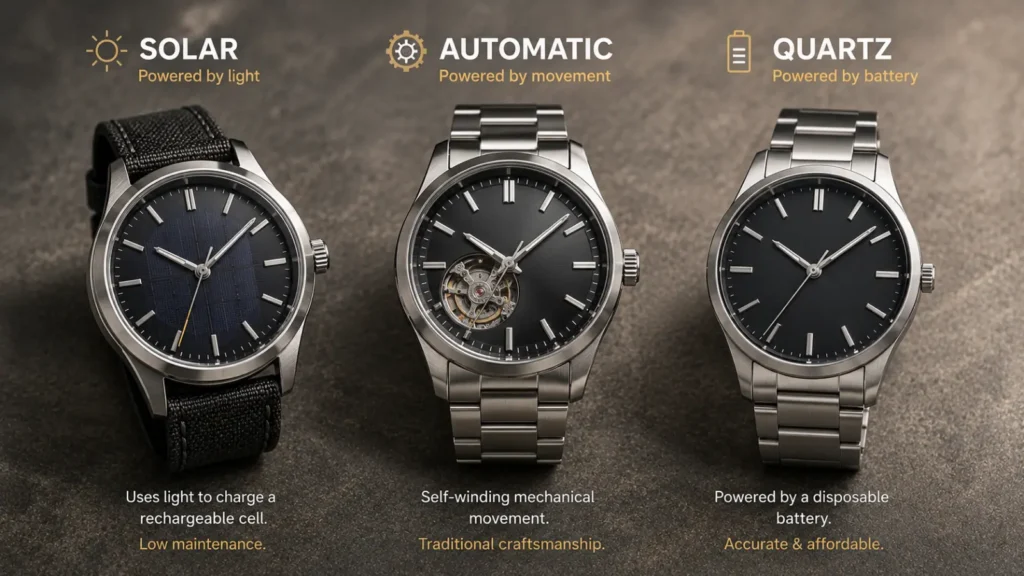
Solar vs Automatic vs Quartz: Which Is Best?
There is no universal winner. Solar quartz is usually the strongest choice for convenience, automatic watches appeal to enthusiasts who value mechanical engineering, and conventional quartz remains attractive for buyers focused on low initial cost.
If your priority is “wear it and forget it,” solar is hard to beat. For those who value movement craftsmanship and horological tradition, an automatic can be more emotionally rewarding. Meanwhile, anyone looking for simple affordability will find conventional quartz perfectly sensible.
How to Choose the Right Solar Powered Watches
Start with the use case rather than the movement. Solar technology is already useful; the rest of the watch determines whether you will actually enjoy wearing it.
Consider these five questions:
- How large is your wrist?
A 44mm dive watch can wear dramatically larger than a 37mm field watch. - Where will you wear it?
Office, hiking, diving, travel, and everyday casual wear call for very different designs. - Do you need a sapphire crystal?
Sapphire is more scratch-resistant than mineral crystal and is especially valuable on a daily-wear watch. - How much water resistance do you actually need?
Do not pay for professional dive specifications if the watch will never leave the office. - How often do you rotate watches?
If a watch may spend months in a drawer, look closely at its stated power reserve.
Common Mistakes to Avoid With Solar Powered Watches
Buying a solar watch is straightforward, but a few mistakes can undermine the whole point of the technology.
Assuming solar means maintenance-free
The watch still contains a movement, seals, rechargeable storage components, and other parts that can eventually require attention.
Leaving it permanently in darkness
A solar watch can run for months without light, but that does not mean it can run indefinitely in a drawer. Store it where it can receive appropriate ambient light when possible.
Choosing size by diameter alone
A 44mm diver and a 39mm sports watch can feel completely different because of lug-to-lug length, thickness, bezel design, and bracelet construction.
Assuming every solar watch is a dive watch
Solar technology says nothing about water resistance. Always check the specific model’s water-resistance rating and intended use.
Buying features you will never use
A GPS, radio-controlled, sensor-equipped, or chronograph solar watch can be impressive, but additional functions often add complexity and bulk. Buy the functions you actually need.
The Final Talk
The best solar powered watch is not simply the one that charges from light it is the one that fits the way you actually wear it. From everyday field watches and rugged G-Shock models to solar dive watches, chronographs, and refined Swiss options, there is now a solar-powered choice for almost every type of wearer.For most buyers, Citizen Eco-Drive is hard to beat for everyday reliability and low maintenance, while Casio Tough Solar is ideal for rugged outdoor use.
Seiko offers excellent solar chronographs, and Tissot brings a more polished Swiss approach.If you want accurate timekeeping, long power reserves, and fewer battery changes, solar powered watches are one of the smartest choices for 2026.
FAQs
Yes. They are especially worthwhile for buyers who want quartz accuracy but dislike regular disposable battery changes. Their low-maintenance design makes them excellent everyday watches.
Yes. Most modern solar watches can harvest energy from artificial light as well as sunlight. However, stronger light generally provides faster charging.
No. G-Shock offers both solar-powered and conventional battery-powered models. Watches equipped with Casio’s Tough Solar technology can recharge from light, while other G-Shock models rely on a standard battery. If solar power is important to you, check the individual model’s specifications for Tough Solar rather than assuming every G-Shock is solar powered.
Yes. Citizen’s Eco-Drive system is based on light-powered technology that converts light into electrical energy and stores that energy in a rechargeable cell. However, individual Eco-Drive watches can have different movements, power reserves, case materials, complications, and charging specifications. Checking the exact model remains important when comparing Citizen solar watches.
No. Solar technology is available in watches designed for both men and women. The main differences are usually case diameter, thickness, lug design, bracelet or strap proportions, and styling rather than the solar technology itself. Buyers looking for best ladies solar powered watches or women solar powered watches should focus on case size and wrist comfort instead of assuming solar watches are primarily a men’s category.
Discover More,
Square Watches: Complete Guide to Styles, Features & Best Picks
Cheap Watches That Look More Expensive
Credor Watches: 5 Stunning Japanese Luxury Picks in 2026
[author box]