
Choosing a watch involves more than selecting a dial, case or bracelet. The movement inside determines how the watch keeps time, how it receives energy and how much maintenance it needs. Quartz vs mechanical watch comparisons usually come down to two different approaches: electronic timekeeping powered by a battery and traditional timekeeping driven by springs and gears.
Quartz watches generally offer better accuracy and convenience, while mechanical watches appeal to people who appreciate traditional engineering and intricate construction. Neither is automatically the better choice. Understanding their movements, accuracy, maintenance requirements and everyday advantages will help you decide which type makes more sense for your needs.
At a Glance
- Quartz: Uses an electrically powered quartz crystal to regulate timekeeping, usually with a battery as its energy source.
- Mechanical: Uses a wound mainspring and a system of gears and an escapement to measure time.
- Main distinction: Quartz prioritizes convenient, accurate timekeeping, while mechanical movements rely on traditional mechanical engineering.
- Common misconception: Automatic watches are not a separate alternative to mechanical watches. They are one type of mechanical movement.
Understanding the Two Movement Technologies
A watch movement is the mechanism responsible for measuring and displaying time. It controls the movement of the hands or, in digital watches, the electronic display.
The main difference between these technologies is how they generate and regulate energy.
A quartz movement uses electrical energy to make a small quartz crystal vibrate at a consistent frequency. An electronic circuit counts those vibrations and sends signals to the motor that moves the hands. Most conventional quartz watches use a battery, although solar-powered versions use light to generate and store electrical energy.
A mechanical movement works without an electronic timing circuit or battery. It stores energy in a tightly wound mainspring and releases that energy through gears, an escapement and a balance wheel. These components work together to regulate the movement of the hands.
Mechanical watches come in two forms: manual-winding and automatic. Both use the same fundamental mechanical principle, but their winding methods differ.
The distinction matters because a watch’s movement affects its daily accuracy, power reserve, maintenance requirements and ownership experience.
[readmore url=”https://wristaurahub.com/movado-watches-for-men/”]
Quartz vs Mechanical Watch: The Main Differences
The following comparison highlights the practical differences between the two movement types.
| Feature | Quartz Watch | Mechanical Watch |
|---|---|---|
| Power source | Usually a battery; some use light | Wound mainspring |
| Time regulation | Vibrating quartz crystal | Balance wheel and escapement |
| Accuracy | Generally very high | Varies with movement and conditions |
| Seconds hand | Often ticks once per second | Usually moves in smaller steps |
| Maintenance | Mainly battery and seal checks, where applicable | Periodic inspection and servicing |
| Power reserve | Depends on battery or stored electrical energy | Usually measured in hours |
| Winding | Usually unnecessary | Manual or automatic |
| Construction | Electronic components and fewer moving parts | Complex arrangement of mechanical parts |
| Everyday convenience | Generally higher | Requires winding or regular wear |
| Traditional appeal | Practical and functional | Strong mechanical and horological appeal |
1. Quartz Movements
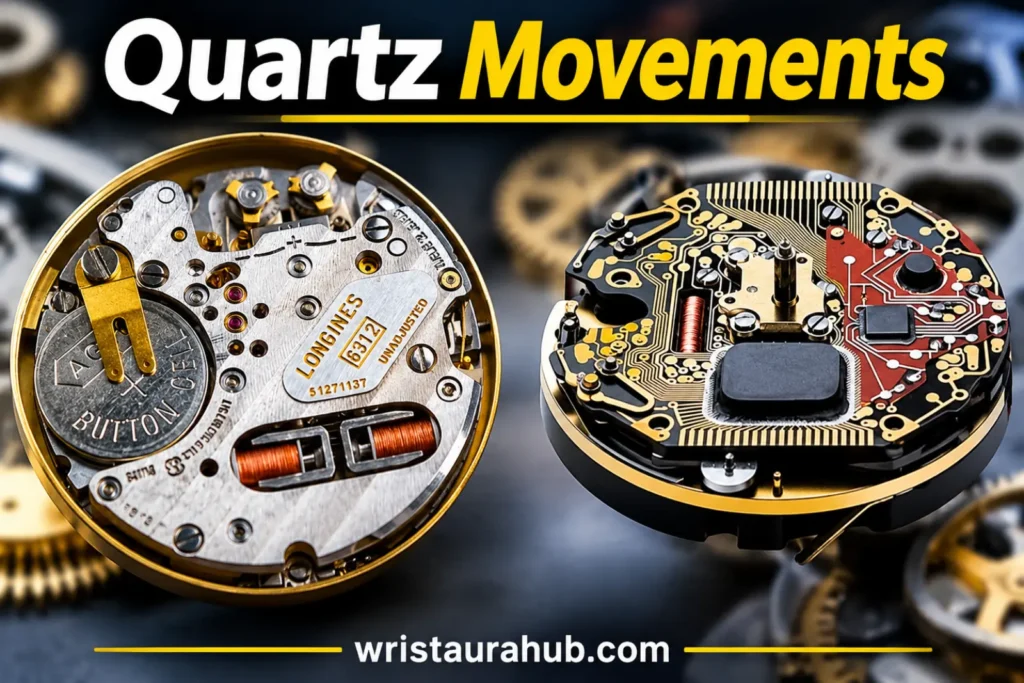
A quartz movement uses the electrical properties of a quartz crystal to maintain consistent timekeeping. When electricity passes through the crystal, it vibrates at a precise frequency. The circuit inside the watch counts these vibrations and controls the movement of the hands.
Most standard quartz watches use a small battery. The battery supplies energy to the circuit and motor, allowing the watch to operate with minimal attention from its owner.
How it works: The crystal typically vibrates at 32,768 times per second. The electronic circuit divides this frequency into regular signals that control the display.
What it is good for: Everyday wear, office use, travel and situations where accurate timekeeping matters more than traditional mechanical construction.
Main limitation: Battery-powered models eventually need battery replacements. Their electronic construction may also be less appealing to collectors who enjoy traditional watchmaking.
Solar quartz watches offer another option. They convert light into electrical energy and store it in a rechargeable cell, reducing the need for conventional battery replacement.
2. Mechanical Movements
Mechanical movements measure time through a coordinated system of springs, gears and regulating components. Instead of using an electronic circuit, they depend on stored mechanical energy.
The mainspring gradually releases its energy. The gear train transfers that energy, while the escapement and balance wheel regulate its release into consistent intervals.
How it works: The mainspring powers the gear train, and the balance wheel oscillates at a controlled rate to regulate timekeeping.
What it is good for: Traditional watchmaking, mechanical craftsmanship, collecting and people who enjoy understanding how a watch operates.
Main limitation: Mechanical movements generally require more attention, can lose or gain more time and need specialist servicing to maintain their performance.
Mechanical watches also come in two winding styles.
Manual-Winding Movements
A manual movement requires the wearer to turn the crown to wind the mainspring. This stores the energy needed to operate the watch.
Some enthusiasts enjoy this daily interaction because it creates a direct connection with the mechanism.
However, the watch stops if the mainspring runs down and is not wound again.
Automatic Movements
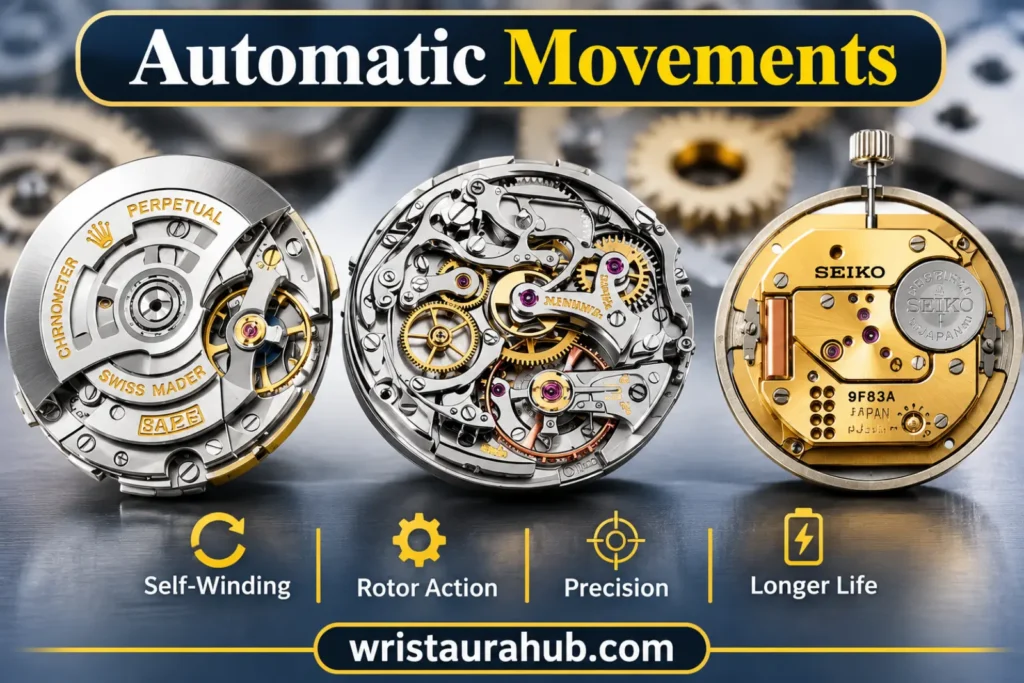
An automatic movement uses a rotating weight called a rotor. As the wearer’s wrist moves, the rotor turns and winds the mainspring.
Most automatic watches can also be wound manually through the crown, although the available winding method depends on the movement.
Automatic movements are convenient for people who wear their watches regularly. However, an unworn watch eventually stops when its stored energy runs out.
[readmore url=”https://wristaurahub.com/bangle-watches-for-women/”]
3. How Automatic, Quartz and Mechanical Watches Relate
The phrase automatic vs quartz vs mechanical watch describes three terms, but they do not represent three completely separate movement categories.
Quartz is one movement technology. Mechanical is another. Automatic describes a winding system within the mechanical category.
A useful classification looks like this:
- Quartz: Electronic timekeeping regulated by a quartz crystal.
- Manual mechanical: Mechanical timekeeping with hand winding through the crown.
- Automatic mechanical: Mechanical timekeeping with a self-winding rotor.
This distinction prevents a common misunderstanding when comparing watches. An automatic watch is always mechanical in the traditional sense, but a mechanical watch is not necessarily automatic.
How to Identify Each Movement Without Opening a Watch
You do not need to dismantle a watch to make an educated guess about its movement. A few visible and practical clues can help.
- Watch the seconds hand: Many standard quartz watches move once per second. Mechanical watches generally show smaller, more frequent movements. However, some high-frequency quartz movements and unusual mechanical displays make this clue imperfect.
- Check the dial or case back: Manufacturers often identify automatic, mechanical, solar or quartz technology on the dial or case back.
- Look for a winding crown: Manual and automatic mechanical watches commonly allow crown winding. A conventional quartz watch generally does not need it.
- Check the power information: Mechanical watches may specify a power reserve, such as 40 or 72 hours. Quartz watches generally provide battery-life information instead.
- Read the specifications: The manufacturer’s movement description is the most reliable way to confirm the technology.
An exhibition case back can also reveal a mechanical movement’s gears, rotor and balance assembly. However, not every mechanical watch has a transparent case back.
Which Movement Suits Your Everyday Needs?
The better choice depends on how you intend to wear your watch and what you expect from it.
Choose Quartz for Accuracy and Convenience
Quartz is a sensible option if you want a watch that keeps time reliably without regular winding.
It suits:
- People who need dependable everyday timekeeping.
- Office workers who prefer minimal maintenance.
- Travellers who do not want to reset their watches frequently.
- Anyone looking for practical timekeeping at an accessible price.
- People who own several watches and rotate between them.
A quartz watch can sit unused for a period without losing time in the same way a mechanical watch does, provided its battery or stored power remains available.
Choose Mechanical for Traditional Craftsmanship
Mechanical movements suit people who appreciate the engineering behind a watch.
They are worth considering if you:
- Enjoy traditional watchmaking and intricate mechanisms.
- Like the interaction of winding a watch.
- Appreciate the movement visible through an exhibition case back.
- Want a traditional mechanical piece for a collection.
- Do not mind occasional accuracy adjustments and servicing.
Mechanical watches can also offer a distinctive ownership experience, but their complexity does not automatically make them more accurate or durable.
Consider Your Budget and Maintenance Tolerance
Quartz watches generally cost less to manufacture and maintain. Mechanical movements require more components, assembly work and specialised servicing.
However, price alone does not determine movement quality. A well-made quartz watch can be more dependable for everyday use than an inexpensive mechanical watch with poor regulation or finishing.
Also consider the case, crystal, water resistance, bracelet and overall construction. These features influence everyday durability independently of the movement.
What Determines Movement Quality?
A movement’s category tells you how it works, but it does not automatically tell you how well it is made. Two watches using the same technology can deliver very different levels of performance.
Here are the main quality indicators worth checking.
Accuracy and Regulation
Accuracy is one of the clearest differences between these technologies. A typical quartz watch may have an accuracy tolerance around ±15–20 seconds per month, although specifications vary.
Mechanical movements are generally measured in seconds gained or lost per day. Their performance depends on regulation, construction, temperature, position and how fully the mainspring is wound.
Quartz watches generally offer better accuracy than conventional mechanical movements. A typical quartz watch may vary by seconds per month, while a mechanical watch can gain or lose several seconds per day.
Movement Construction
For quartz watches, check the quality of the electronic movement, battery arrangement and availability of replacement parts.
For mechanical watches, pay attention to the finishing of the movement, smooth operation of the winding mechanism, regulation and quality of the components.
A transparent case back can help you inspect the construction, but attractive decoration does not necessarily mean better performance.
Power Reserve and Battery Life
Mechanical watches have a power reserve that indicates how long they can run after being fully wound. Many everyday movements offer around 40–72 hours, although the actual figure depends on the calibre.
Quartz watches generally operate for years on a battery, depending on the movement and its functions. Solar models store energy in a rechargeable cell instead.
Maintenance and Servicing
Quartz movements usually need less routine attention. Battery replacement, seal inspection and occasional checks are the main considerations for conventional battery-powered models.
Mechanical movements need periodic inspection and lubrication because their components operate through continuous physical contact. The Federation of the Swiss Watch Industry recommends inspection and cleaning every three to five years as general guidance for mechanical watches. Actual intervals depend on the manufacturer’s recommendations and the movement. fhs.swiss+1
[readmore url=”https://wristaurahub.com/digital-watches/”]
Common Misconceptions About Watch Movements
Several assumptions can make choosing a watch more confusing than necessary.
Mechanical Watches Are Always More Accurate
This is incorrect. Standard quartz movements generally keep time more accurately than conventional mechanical movements. Mechanical watches can achieve impressive precision, but their daily rates are more sensitive to environmental and wearing conditions.
Automatic and Mechanical Mean Different Technologies
Automatic is a type of mechanical movement. The difference is the winding method, not the fundamental timekeeping system.
Quartz Watches Are Cheap and Poorly Made
Quartz describes how a movement operates, not the quality of the entire watch. High-quality quartz watches can feature excellent finishing, durable cases, advanced technology and sophisticated accuracy.
Mechanical Watches Never Need Batteries or Maintenance
Mechanical movements do not require batteries, but they still need servicing. Lubricants age, components wear and accuracy can change over time.
A Sweeping Seconds Hand Always Means Mechanical
Not necessarily. Some quartz movements use more frequent stepping mechanisms that create a smoother-looking seconds hand. The movement specifications are a more reliable way to identify the technology.
The Final Talk
For most people who simply want accurate and dependable timekeeping, quartz is the more practical choice. It is generally easier to maintain, less sensitive to everyday conditions and convenient for occasional wear.
Mechanical watches offer something different: traditional engineering, mechanical complexity and a more involved ownership experience. They are particularly appealing to enthusiasts who value the movement itself rather than timekeeping alone.
Neither technology makes a watch automatically superior. Choose quartz for straightforward reliability or mechanical for the pleasure of traditional watchmaking. The best decision is the one that matches how you actually intend to use your watch.
Frequently Asked Questions
A quartz watch uses an electronic circuit and vibrating quartz crystal to regulate time. A mechanical watch uses a mainspring, gears and an escapement. Quartz usually offers better accuracy, while mechanical movements provide traditional mechanical construction.
The main differences involve their power sources and regulating systems. Quartz watches generally use electrical energy and a crystal oscillator, while mechanical watches store energy in a wound spring and regulate it through moving components.
Quartz is generally more accurate. A typical quartz movement may vary by seconds per month, while a conventional mechanical movement may vary by several seconds per day. Individual movement specifications can differ considerably. JAPAN CLOCK & WATCH ASSOCIATION (JCWA)+1
Mechanical watches need periodic servicing, lubrication and regulation. Conventional quartz watches mainly require battery replacement and appropriate seal checks. Solar quartz watches have different battery-maintenance requirements.
Quartz is usually better for someone who prioritizes accuracy, convenience and lower maintenance. Mechanical is more suitable for someone who appreciates traditional craftsmanship and does not mind winding or servicing a watch.
Both can provide years of use with appropriate care. Mechanical movements can be serviced and repaired, while quartz movements may need electronic components or complete movement replacements when parts become unavailable. Long-term reliability depends on the manufacturer’s support and the watch’s overall construction.
Discover More to Learn
White Dial Watches in 2026: Best Styles and Buying Tips
NORQAIN Watches Review: Quality, Prices & Resale Value
[authorbox]