
What if you could wear the character of a vintage collector’s watch without spending thousands of dollars? That’s the question Dan Henry answers better than most affordable microbrands. Instead of chasing modern, generic designs, the brand looks back at the racing chronographs, military watches, aviation pieces, and dive watches that made twentieth-century horology so memorable, then recreates that visual character for today’s buyer.
Dan Henry watches combine vintage-inspired styling with Japanese movements and globally sourced components, while many current models sit in the roughly $230–$380 range. The designs can look far more expensive than their price suggests, but good looks alone don’t make a watch worth buying. The real question is how the movements, finishing, construction, sizing, and quality control hold up once you look beyond the dial. In this guide, we’ll break down the brand’s history, standout models, manufacturing, prices, owner feedback, strengths, drawbacks, and which watches are actually worth your money.
1. WHAT IS DAN HENRY KNOWN FOR ?
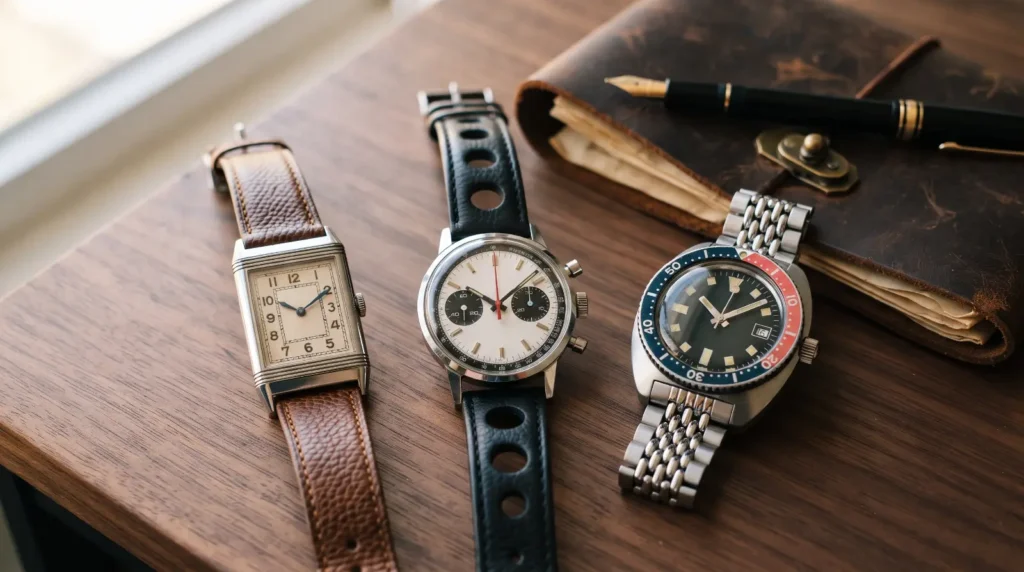
Dan Henry is best known for turning vintage watch collecting into a modern microbrand concept. Rather than creating generic fashion watches, founder Dan Henry builds models around the design language of specific periods, with each watch named after a year associated with its inspiration. The brand says its goal is to create collectible vintage-inspired watches using modern technology at accessible prices.
That philosophy comes directly from Henry’s background as a collector. He has spent decades acquiring vintage watches and built a collection of more than 1,500 pieces before turning that knowledge into a commercial watch brand. His separate Timeline.Watch project was created to document vintage watches and their histories.
The result is a collection that feels more like a visual tour through twentieth-century horology than a conventional modern lineup.
You’ll find:
- Racing chronographs
- Military-inspired chronographs
- Pilot watches
- Dress chronographs
- Automatic divers
- Skin divers
- Seventies-inspired tool watches
- Ladies’ vintage-inspired watches
The brand was launched in 2016, and earlier models that have sold out are preserved in its online “Museum Collection.”
2. BEST MODELS FROM THE COLLECTION
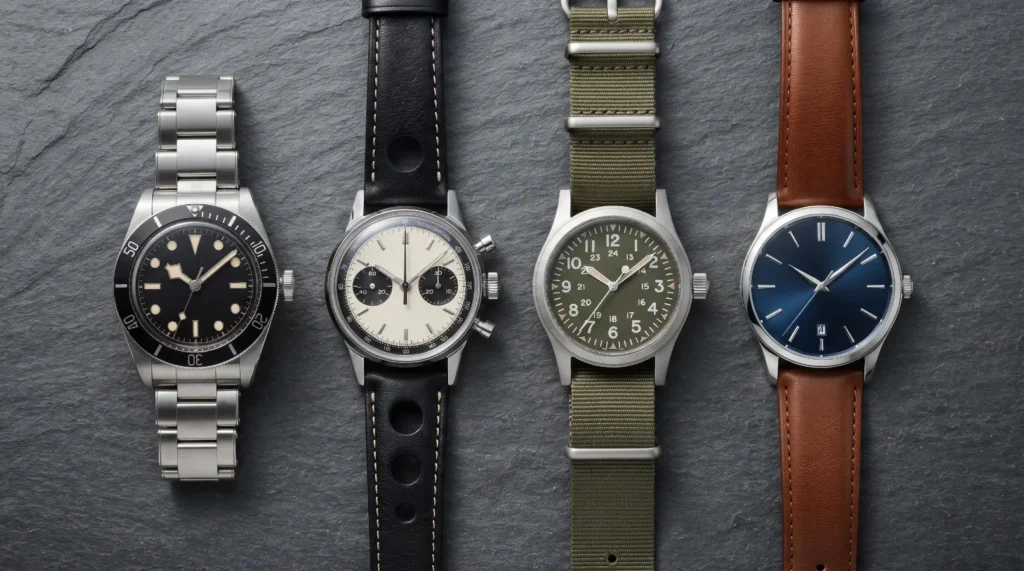
The smartest way to evaluate this brand is model by model. Dan Henry’s watches aren’t equally compelling, and the right choice depends heavily on whether you care most about vintage design, mechanical movements, everyday practicality, or price.
1962 Racing Chronograph: Best Overall for Vintage Style
The 1962 is probably the easiest model to understand. It takes the classic racing-chronograph formula—contrasting sub-dials, tachymeter styling and period-inspired proportions—and packages it at a budget-friendly price.
The current collection lists the 1962 at around $280, with 42.5mm sizing and several dial variations.
Its meca-quartz movement is worth understanding. Instead of being a traditional mechanical chronograph, it combines quartz timekeeping with a mechanical chronograph module. Dan Henry’s own documentation confirms that the 1962 uses a Seiko meca-quartz movement.
Best for: someone who wants the look and feel of a vintage racing chronograph without paying vintage-watch money.
Owner feedback is generally positive about the visual value. One long-time owner described the 1962 as a particularly good-looking first watch and praised its quality at the price, while another criticism centered on its relatively substantial thickness.
If you have a smaller wrist, don’t buy it based on photographs alone. The diameter and overall presence are significant.
1963 Pilot Watch: Best for Aviation-Inspired Design
The 1963 takes the chronograph formula in a different direction. It combines a pilot-watch aesthetic with a rotating GMT bezel and sapphire crystal, giving it more functional visual information than the simpler racing models. The current collection lists it at approximately $380 and in a 38mm case.
The movement is a Seiko VK63 meca-quartz chronograph, according to Dan Henry’s official instructions.
That makes the 1963 particularly interesting for buyers who want a smaller chronograph. At 38mm, it avoids the oversized feel common among affordable chronographs.
Best for: smaller wrists, pilot-watch fans, and buyers who want a vintage military/aviation aesthetic.
1964 Gran Turismo Chronograph: Best Everyday Vintage Chronograph
The 1964 is one of the most versatile designs in the range. Its Gran Turismo inspiration gives it a sporty but relatively refined personality, and the current version comes in a 40mm case with a beads-of-rice stainless-steel bracelet option.
Prices currently begin around $250, making it one of the more accessible options in the lineup.
The big attraction is proportion. A 40mm vintage-style chronograph is easier to wear as an everyday watch than many larger racing chronographs.
The caveat is that owner experiences with quality control aren’t completely consistent. Some owners praise the bracelet and dial, while others have reported issues involving straps, dust under the crystal, or finishing.
Best for: someone who wants one vintage-inspired chronograph for regular casual and smart-casual wear.
1970 Automatic Diver: Best Affordable Mechanical Option
If you care about having an automatic movement rather than simply looking at vintage styling, the 1970 is where the collection becomes much more interesting.
The current model is a 41mm automatic diver listed at around $310, with a separate chronograph version also offered.
This is a better direction for buyers who want the mechanical experience associated with traditional watch collecting.
The design is unmistakably seventies dive-watch inspired, so it works particularly well if your collection already includes dress watches or chronographs and you want something more tool-oriented.
Best for: buyers who specifically want an automatic dive-watch aesthetic at a relatively modest price.
1975 Skin Diver: Best Mechanical Pick
The 1975 is arguably the most technically attractive choice if you’re shopping this brand primarily for the movement.
Its automatic version uses the Miyota 9015, a Japanese automatic movement with a 38-hour power reserve and a 28,800-vph operating frequency, according to Dan Henry’s official instructions.
The model is listed around $280 in the current collection.
The 1975 is also available in a meca-quartz configuration, so make sure you select the correct movement before purchasing.
Best for: someone who wants an affordable mechanical watch rather than simply a vintage-looking quartz chronograph.
3. DAN HENRY MODELS AT A GLANCE
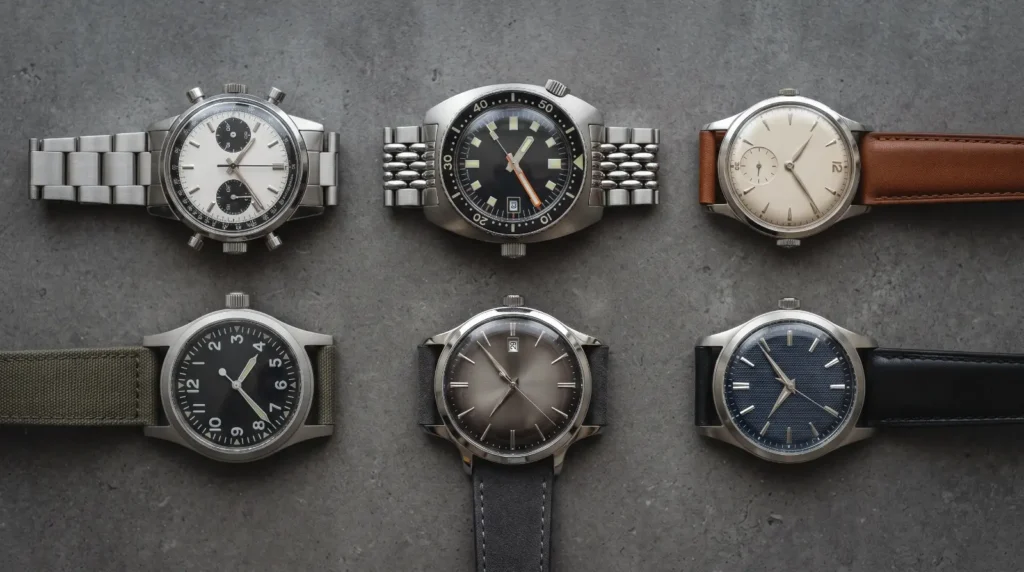
| Model | Style | Movement approach | Current listed price* | Best for |
|---|---|---|---|---|
| 1962 | Racing chronograph | Seiko meca-quartz | ~$280 | Vintage racing style |
| 1963 | Pilot chronograph | Seiko VK63 meca-quartz | ~$380 | Smaller wrists / aviation |
| 1964 | Gran Turismo chronograph | Meca-quartz | ~$250 | Everyday vintage style |
| 1970 | Diver | Automatic / chronograph versions | ~$310 | Dive-watch fans |
| 1975 | Skin diver | Miyota 9015 automatic or meca-quartz | ~$280 | Mechanical-watch buyers |
*Prices are current listed prices observed on the brand’s collection pages and can change.
4. ARE THESE WATCHES ACTUALLY GOOD QUALITY ?
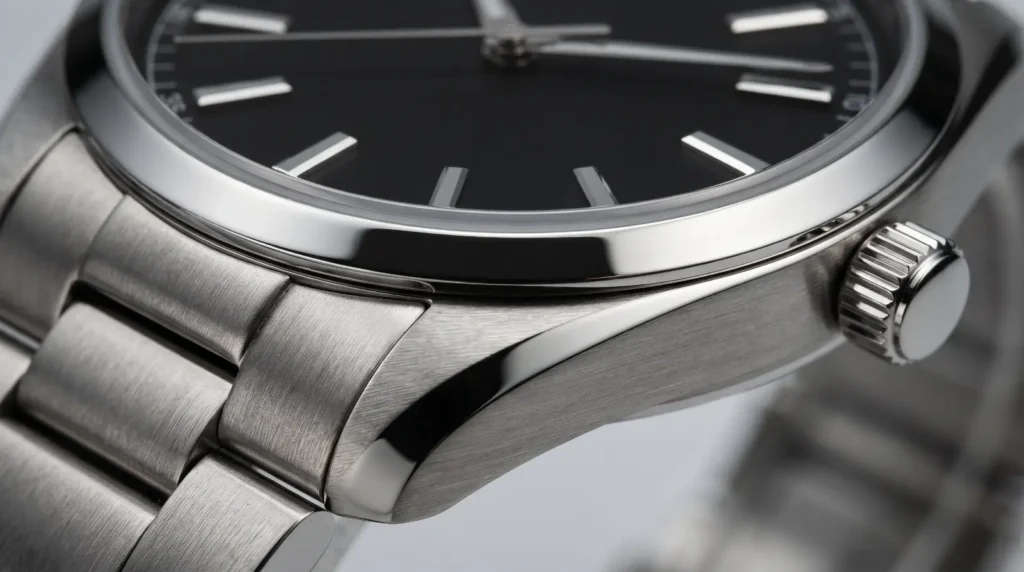
Yes, but with an important qualification: the strongest selling point is design-to-price value, not haute horlogerie-level finishing.
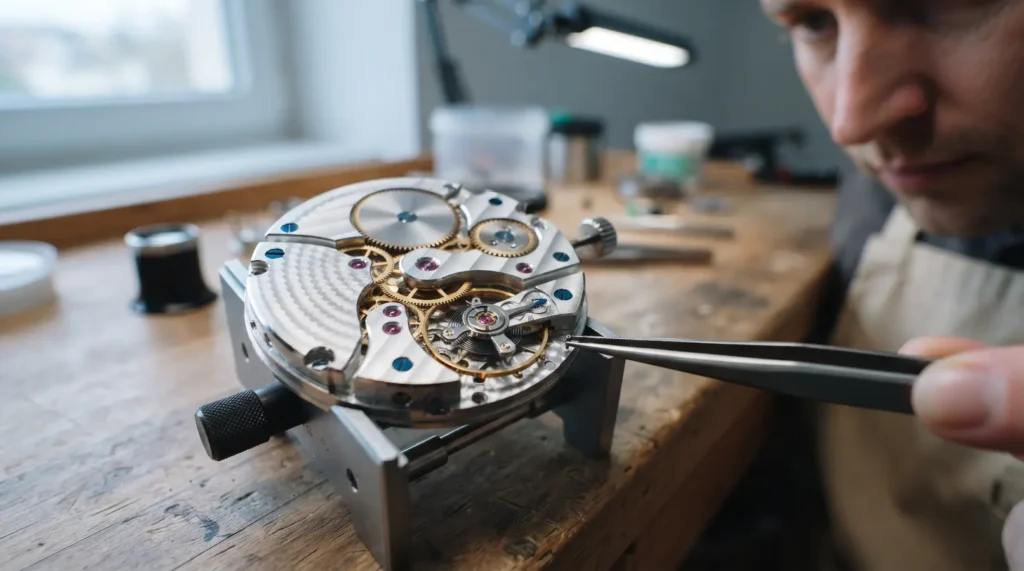
The components and movements are sensible for the price category. Dan Henry has historically used Japanese movements from Seiko and Citizen, while the watches themselves are assembled through external manufacturing partners. In a detailed interview, Henry explained that his designs originate with him in Brazil, movements come from Japan, dials from Korea, cases are machined in China, and final assembly is completed in China.
That manufacturing model isn’t automatically a negative. Worn & Wound reported early on that Henry worked with a Hong Kong-based maker and a Chinese factory, describing the facility as a high-end manufacturing operation.
The more legitimate concern is consistency.
Owner reports range from enthusiastic praise for the dial finishing and value to complaints about straps, dust, quality control and customer-service experiences.
So I’d describe the quality this way:
Excellent design value, respectable components, but not the most reassuring choice if flawless QC is your top priority.
That’s a much more useful assessment than simply calling the brand “good” or “bad.”
5. WHERE ARE DAN HENRY WATCHES MADE ?
Dan Henry watches are globally sourced, with final assembly in China. The founder has explained that the designs are created in Brazil, movements are sourced from Japan, dials from Korea, French leather is used for straps on some models, and cases are machined in China.
This matters because “made in China” shouldn’t automatically be treated as a quality verdict. The manufacturing partner, specifications, quality control and inspection standards matter far more than the country printed on a label.
For buyers who specifically want a Swiss-made watch, however, Dan Henry isn’t the right brand. Its value proposition is different: vintage-inspired design, recognizable Japanese movements and aggressive pricing.
6. HOW MUCH DO DAN WATCHES COST ?
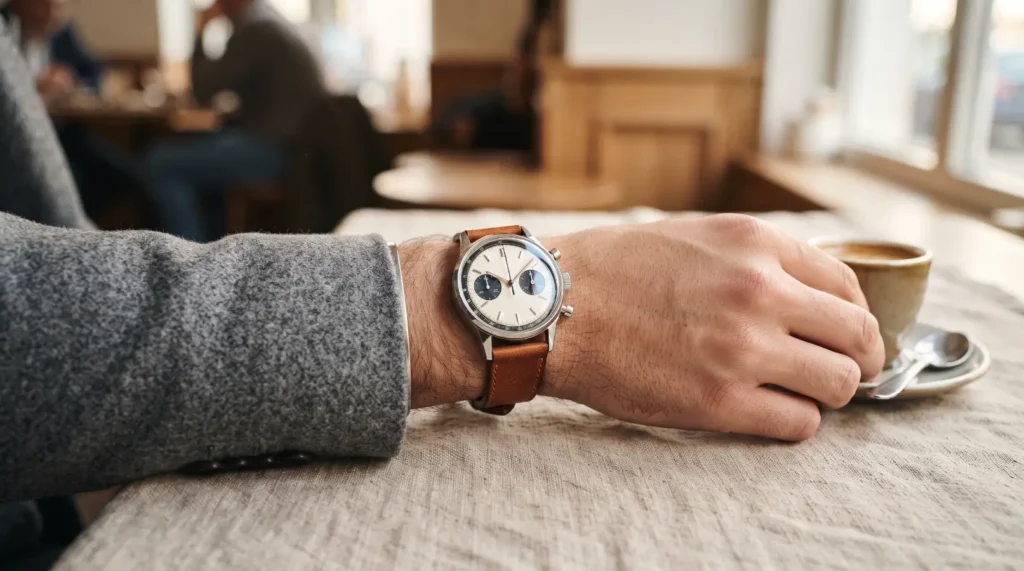
The current collection largely occupies the $230–$380 territory. Examples include the 1900 at about $230, 1937 and 1939 around $290, 1945 around $300, 1962 around $280, 1963 around $380, 1964 around $250, 1970 around $310 and 1975 around $280.
That makes the brand particularly interesting below $500, where buyers often have to choose between generic fashion watches, basic quartz watches and entry-level mechanical options.
The question isn’t whether Dan Henry is cheap. It’s whether the particular model gives you something you can’t get more convincingly elsewhere for similar money.
For the vintage-inspired chronographs, the answer is often yes.
7. DAN HENRY vs. TRADITIONAL WATCH BRANDS
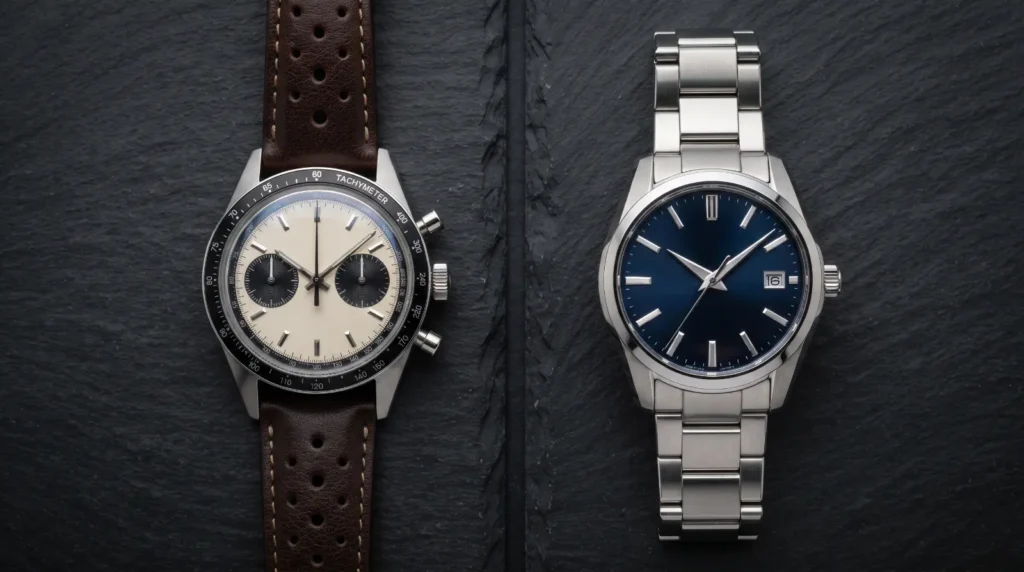
The biggest mistake is comparing these watches directly with Swiss luxury pieces. That’s not the market Dan Henry is trying to serve.
A better comparison is against affordable brands such as Seiko, Citizen, Timex and other microbrands.
| What matters | Dan Henry | Traditional affordable brand |
|---|---|---|
| Vintage styling | Excellent | Depends on model |
| Japanese movements | Common | Common |
| Mechanical options | Available | Widely available |
| Chronograph selection | Strong | Varies |
| Brand heritage | Young microbrand | Often much older |
| Design originality | Vintage-inspired | Model dependent |
| Price accessibility | Strong | Strong |
| Collectibility | Limited-edition dependent | Usually model dependent |
Dan Henry’s advantage is visual storytelling. The watches are designed around historical periods and recognizable vintage aesthetics rather than trying to reinvent the basic three-hand watch.
That’s why the brand can make sense even when another manufacturer offers a technically similar movement for similar money.
8. Are Dan Henry Watches Worth Buying?
Yes, if design is your priority and you understand the compromises.
A $280 Dan Henry isn’t trying to beat a $3,000 Swiss chronograph on movement refinement, finishing or prestige. It is trying to give you the visual experience of owning a vintage-inspired chronograph without the cost, fragility and maintenance headaches of a genuine vintage piece.
That distinction makes the buying decision much easier.
Choose one if you want:
- Strong vintage-inspired design
- An affordable chronograph
- Japanese movement technology
- Interesting limited-edition models
- A watch that looks more expensive than its price suggests
Think twice if you demand:
- Swiss manufacturing
- High-end mechanical finishing
- Perfectly consistent QC
- Strong conventional luxury-brand prestige
- A completely original design language rather than historical inspiration
Owner discussions reflect exactly this split. Some collectors consider Dan Henry exceptional value, while others have criticized QC, straps and customer service.
Common Buying Mistakes to Avoid
The watches are inexpensive enough to make impulse buying tempting, but that’s exactly how you end up with the wrong model.
First, don’t choose solely from the product photographs. Vintage-inspired chronographs can wear considerably larger or thicker than their diameter suggests.
Second, check the movement type before ordering. A meca-quartz chronograph and an automatic diver provide completely different ownership experiences.
Third, don’t assume every Dan Henry model has identical specifications. The collection spans dress watches, chronographs and divers, so crystal, movement, dimensions and water-use suitability vary by model. The manufacturer’s own manuals show substantial differences between individual references.
Finally, check availability and return terms before buying a limited or discontinued model. Once an edition sells out, the brand says production of that model is closed.
THE FINAL TALK
You don’t need a vintage watch budget to get vintage-watch character. That’s the whole appeal of Dan Henry: the brand turns the visual language of racing, military, aviation, and dive watches into affordable pieces that generally stay below the $500 mark.
The trade-off is straightforward. You get distinctive designs and proven Japanese movements, but QC and finishing aren’t going to compete with higher-end Swiss brands. For a first purchase, the 1962 is the standout for vintage chronograph appeal, while the 1975 automatic and 1970 diver make more sense if mechanical ownership is your priority.If you buy Dan Henry for its design rather than its prestige, that’s where the brand makes the most sense.
FAQs
Yes. They offer strong design value, Japanese movements and accessible pricing, although quality-control experiences can vary between owners. They’re best viewed as affordable vintage-inspired microbrand watches rather than luxury timepieces.
Dan Henry uses a global supply chain, with Japanese movements, components sourced from multiple countries, cases machined in China and final assembly in China, according to founder Dan Henry.
The 1962 Racing Chronograph uses a Seiko meca-quartz movement. This combines quartz timekeeping with a mechanical chronograph mechanism, giving the stopwatch hand a more mechanical feel than conventional quartz chronographs.
Some are. The collection includes automatic models, including the 1970 diver and the 1975 Skin Diver automatic, while many of the brand’s chronographs use meca-quartz movements.
Current listed prices generally range from roughly $230 to $380, depending on the model and configuration. Limited editions and sold-out watches can have different prices on the secondary market.
DISCOVER MORE ,
Citizen Automatic Watches: 7 Best Models Worth Buying
Cartier Watches for Men: 7 Icons Worth Buying
Nubeo Watches: Ultimate Review, Prices, Quality & Best Picks
[author box ]