
Most microbrand dive watches look familiar. Wren Watches aim to break that pattern.Wren Watches are Swiss-made automatic dive watches designed in New York, with current models ranging from the 41mm Diver One to the compact 38mm Diver 38.Prices currently start around $1,195 and reach $1,595, depending on the model. But are Wren watches good, and are they worth the price?
This Wren Watches review covers the Wren watches price, best models, where Wren watches are made, and what you should know before buying one.
[readmore url=”https://wristaurahub.com/used-omega-watches/ “]
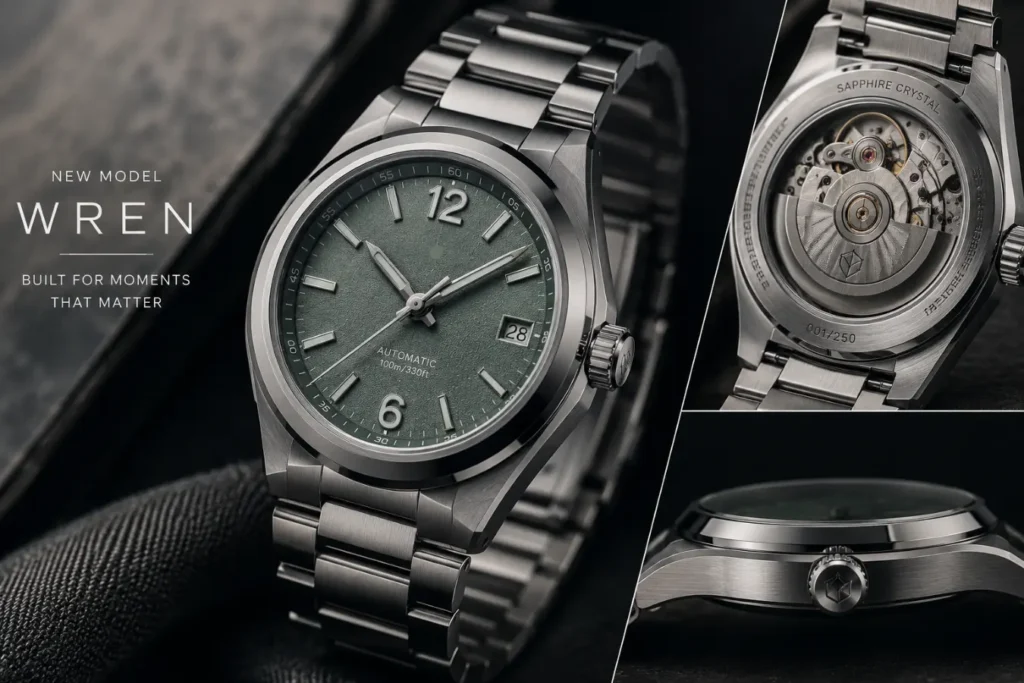
Wren Watches: What Is the Brand?
Wren Watches is an independent New York-based watch brand founded by Craig Karger, the person behind Wrist Enthusiast. The name itself comes from “WRist ENthusiast,” making the company a fairly literal extension of an existing watch-enthusiast platform rather than a conventional fashion label.
Wren describes its watches as designed in New York and Swiss made. Its identity is firmly rooted in mechanical dive watches, with vintage influences balanced by modern materials and brighter color combinations.
That background matters. Wren was created from the perspective of someone already immersed in watch collecting and reviewing, so the brand’s product decisions tend to focus on details enthusiasts actually notice: case proportions, dial construction, lume, bezel execution, bracelet adjustment, and movement choice.
Wren Watches: Who Makes Them?
The brand was founded by Craig Karger, whose watch-industry background began with the Wrist Enthusiast Instagram account in 2015. Wrist Enthusiast later expanded into a blog and other media platforms before Wren was created as a separate watch venture.
Wren’s first production watch was the Diver One Aqua, introduced in 2024 after approximately a year of development. The company says the original model combined vintage and modern aesthetics with a distinctive aqua dial.
This enthusiast-first origin is one of Wren’s strongest selling points. You’re not buying from a company that suddenly discovered mechanical watches because they were fashionable. The brand grew directly out of a watch-media and collecting background.
Where Are Wren Watches Made?
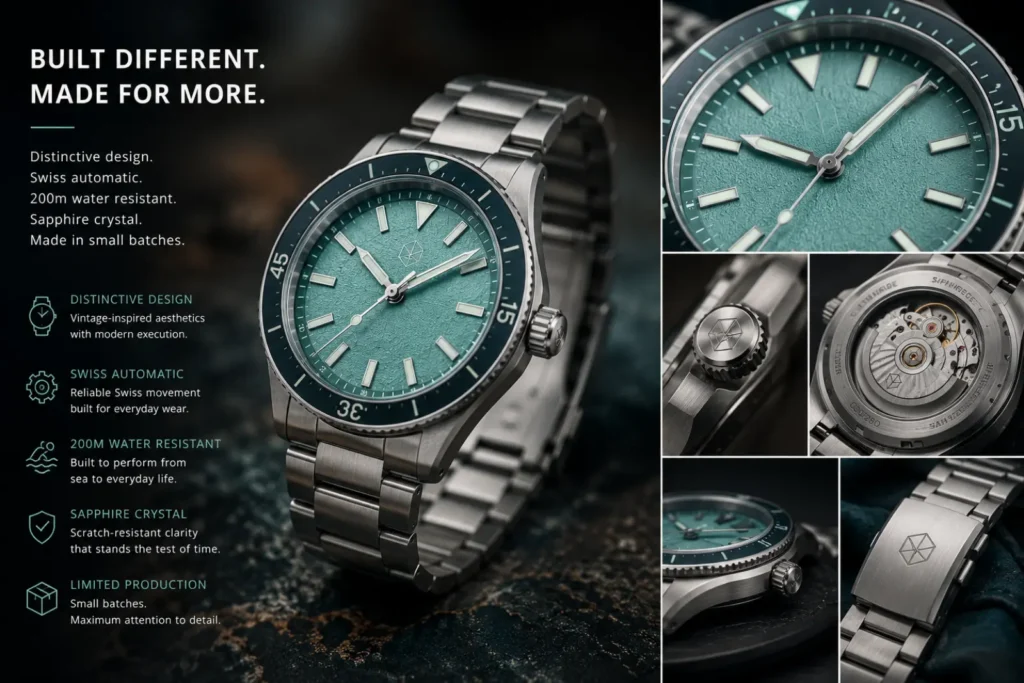
Wren Watches are designed in New York City and assembled in Switzerland. The brand focuses on Swiss automatic movements, quality cases, sapphire crystals, and dive-ready construction. This combination gives Wren a distinct Swiss-made identity while keeping its designs modern and enthusiast-focused.
Most Wren watches are built with 200m water resistance, making them practical for everyday wear and recreational diving. The brand also focuses on compact case sizes, strong lume, and detailed finishing, giving its watches a balance of function, durability, and distinctive design.
Wren Watches: What Are They Known For?
The defining characteristic of Wren Watches is its focus on dive watches that deliberately avoid looking anonymous.
The Diver One established the formula with a larger 41mm case, 200-meter water resistance, a Swiss automatic movement, sapphire crystal, and colorful dial treatments. The later Diver 38 refined that concept into a smaller and thinner package while adding upgraded features such as a ceramic bezel and microadjust bracelet.
Several characteristics define the brand:
- Swiss-made automatic construction
- Dive-watch-focused collections
- Vintage-inspired case and dial design
- Sapphire crystals
- 200-meter water resistance on the documented Diver models
- Limited or small-batch production
- Strong use of color and gradient dials
- Enthusiast-oriented bracelet and clasp details
The result is a brand that feels more characterful than many generic microbrands without moving into traditional luxury-watch pricing.
Wren Watches: Best Models to Consider
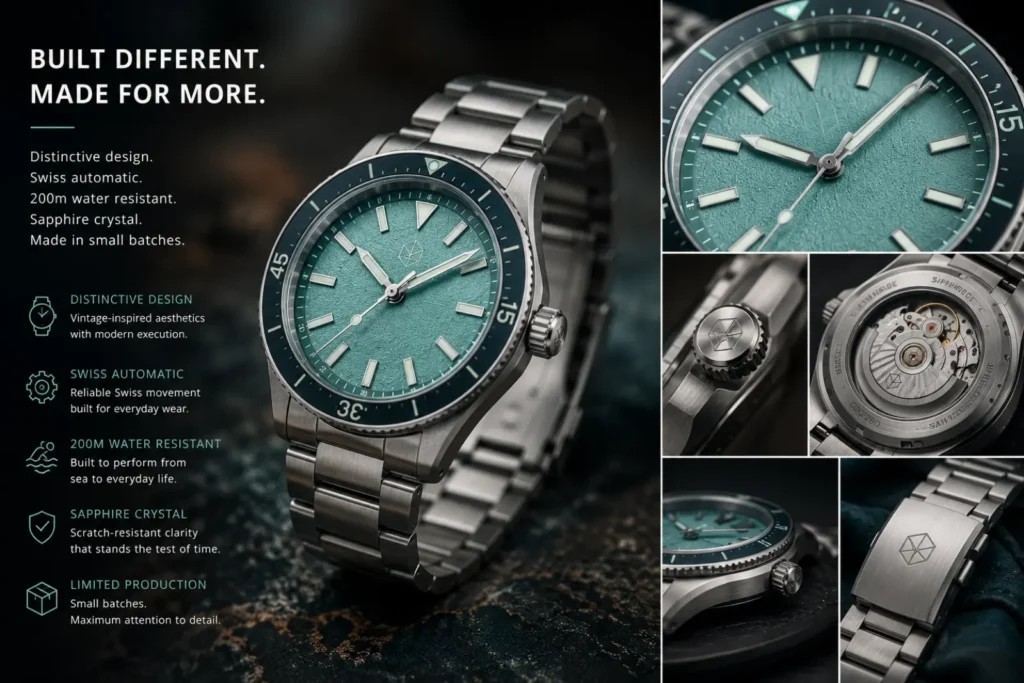
Wren’s current lineup includes the Diver One and Diver 38 families, with multiple colorways and material variations. The official shop currently lists models including the Diver One Obsidian, Diver One Titanium Dusk, Diver 38 Aqua, Diver 38 Crimson, Diver 38 Seafoam, Diver 38 Mad, Diver One Titanium Snow, and Diver One Magma.
Wren Watches Diver 38 Seafoam
The Diver 38 Seafoam is arguably the most complete expression of what Wren is trying to achieve.
Spec snapshot: 38mm case / 45mm lug-to-lug / 10.7mm thick / ETA 2892 automatic / 200m water resistance / sapphire crystal / approximately $1,595.
The compact dimensions are a major advantage. At 38mm with a 45mm lug-to-lug measurement and only 10.7mm of thickness, it is considerably easier to wear than many conventional dive watches. The ETA 2892 automatic movement, ceramic bezel, sapphire crystal, display caseback, and microadjust bracelet make the specification sheet particularly strong for the money.
The Seafoam dial is also one of Wren’s more distinctive designs. Its muted green tone and sandwich construction give it personality without turning it into a novelty watch.
Best for: buyers wanting a compact everyday dive watch with an unusual dial.
Wren Watches Diver 38 Aqua
The Diver 38 Aqua takes essentially the same compact platform and gives it a brighter, more recognizable Wren personality.
Spec snapshot: 38mm case / 45mm lug-to-lug / 10.7mm thick / ETA 2892 automatic / 200m water resistance / sapphire crystal / $1,595.
Wren offers the Aqua in date and no-date configurations, while the package includes a fitted FKM rubber strap. The ceramic bezel is fully lumed, and the bracelet includes on-the-fly microadjustment.
This is the model to choose if you want the Wren aesthetic to be obvious rather than subtle.
Best for: enthusiasts who want a colorful daily-wear diver.
Wren Watches Diver One
The original Diver One is important because it established the brand’s design language.
Spec snapshot: 41mm case / 47mm lug-to-lug / 13.3mm thick / Sellita SW200 automatic / 200m water resistance / sapphire crystal.
Compared with the Diver 38, the Diver One is larger and noticeably thicker. The 41mm case will work particularly well for medium-to-large wrists, while the vintage-inspired styling gives it plenty of wrist presence.
The use of the Sellita SW200 is conventional but sensible. It is a well-known Swiss automatic platform with broad service familiarity, which is reassuring for buyers who plan to keep the watch for years.
Best for: buyers who prefer a traditional-sized, more substantial dive watch.
Wren Watches Diver One Titanium
The titanium Diver One variants are the more interesting choice for someone who wants the original Wren formula but with a lighter-feeling case.
The current Wren collection includes Titanium Dusk and Titanium Snow variants.
The titanium versions make sense for buyers who like larger dive watches but dislike the heft that can come with a steel case and bracelet. They also push Wren slightly further into enthusiast territory rather than simply offering another dial color.
Best for: buyers who want a lighter alternative to the standard Diver One.
Wren Diver One Titanium Dusk
The Wren Diver One Titanium Dusk is one of the brand’s more distinctive lightweight options. It uses a 41mm Grade 5 titanium case and bracelet, measures 47mm lug-to-lug and 12.4mm thick, and carries a 200-meter water-resistance rating.
The movement is an ETA 2824 automatic, while the watch uses a sapphire crystal and fully lumed ceramic bezel. Wren currently lists the Diver One Titanium collection at $1,395.
The main reason to consider the Titanium Dusk is weight. Wren says the titanium version is about 45% lighter than the steel Diver One, while also being 0.9mm thinner.
Best for: buyers who want the wrist presence of a 41mm diver without the weight of a comparable steel case and bracelet.
Wren Watches Diver One Magma
The Diver One Magma demonstrates Wren’s willingness to collaborate and experiment with color.
The Magma was released as a collaboration with Ben’s Watches and sits within the Diver One family. The collaboration is significant because it reinforces Wren’s connection to the online watch-enthusiast community that helped shape the brand.
It is less about radically different engineering and more about giving collectors another distinctive interpretation of the core Wren platform.
Best for: collectors attracted to limited collaborations and unusual colorways.
Wren Watches: Model Comparison
| Model | Case | Movement | Water Resistance | Approx. Price | Best For |
|---|---|---|---|---|---|
| Diver One | 41mm | Sellita SW200 automatic | 200m | Varies by release | Larger wrists |
| Diver 38 Seafoam | 38mm | ETA 2892 automatic | 200m | $1,595 | Best overall |
| Diver 38 Aqua | 38mm | ETA 2892 automatic | 200m | $1,595 | Colorful everyday wear |
| Diver One Titanium | 41mm | Swiss automatic | 200m | Around $1,395 on current listings | Lightweight larger diver |
| Diver One Magma | 41mm class | Swiss automatic | 200m class | Around $1,075 on current listing | Collectors/collaborations |
Current Wren listings show the Diver 38 models at $1,595, Diver One Obsidian at $1,195, and Titanium Dusk/Snow at $1,395, although limited-run availability and pricing can change.
For most buyers, the Diver 38 is the strongest proposition. Its dimensions make it more versatile, while its movement and upgraded bezel, bracelet, and display-back package give it a distinctly premium feel.
Find the Best swis made watches for Your Wrist
[readmore url=”https://wristaurahub.com/swiss-made-watches/ “]
Wren Watches: Are They Good Quality?
Yes. On paper and based on published specifications from watch-industry coverage, Wren offers a serious level of equipment for a young microbrand.
The Diver 38, for example, combines a Swiss automatic ETA 2892 movement, 200-meter water resistance, box-shaped sapphire crystal, ceramic bezel, display caseback, and microadjust bracelet. Those are meaningful functional upgrades rather than decorative marketing claims.
The bigger question is not whether Wren can produce an attractive watch. It clearly can. The question is whether you value Wren’s design and enthusiast identity enough to pay around $1,200–$1,600 when there are many capable alternatives in the same range.
That is where personal preference becomes important.
Wren Watches: Pros and Cons
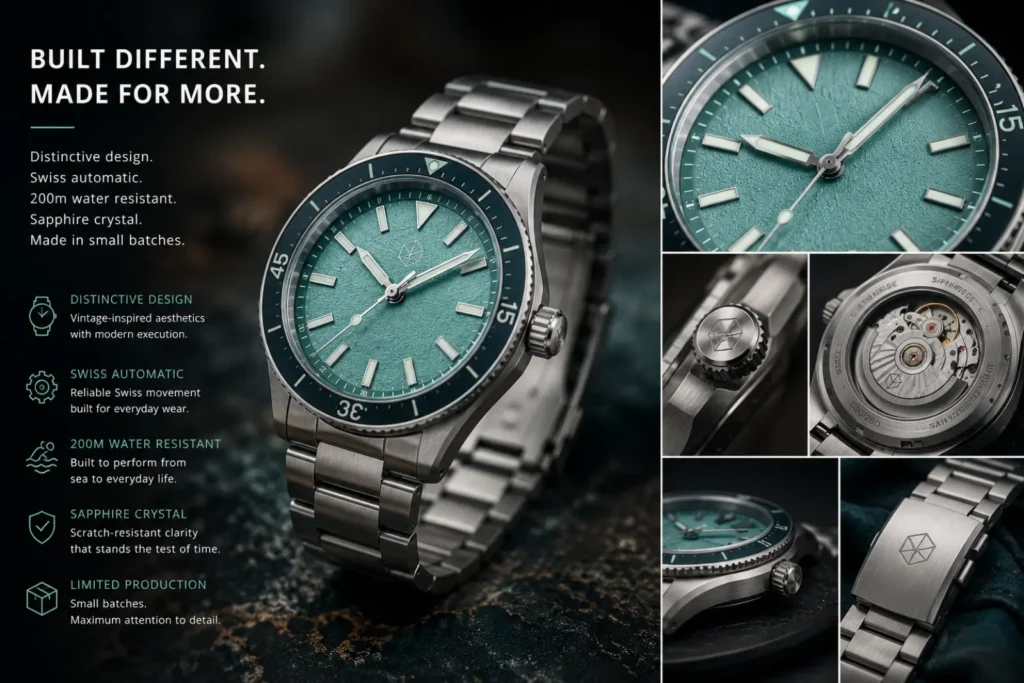
Wren gets many of the fundamentals right, but it isn’t automatically the best choice for every buyer. Its strongest advantages are concentrated in design, proportions, materials, and enthusiast-focused specifications.
Pros
- Distinctive designs without excessive visual clutter
- Swiss-made automatic movements
- Strong 200-meter dive-watch specification
- Sapphire crystals
- Excellent 38mm option
- Interesting dial colors and textures
- Ceramic bezel on the Diver 38
- Useful bracelet microadjustment
- Small-batch independent-brand appeal
Cons
- Relatively young brand with limited long-term track record
- Most of the collection is centered on dive watches
- $1,500 is a competitive price bracket
- Resale liquidity is unlikely to match established Swiss brands
- Limited production can make specific colorways difficult to obtain
The last point deserves attention. Buying a Wren makes the most sense if you actually want the watch. Buying one purely because it might become collectible is much harder to justify.
Wren Watches vs. Christopher Ward
Christopher Ward is one of the most obvious alternatives because it occupies a similar enthusiast-focused territory while having a much longer operating history and a broader product range.
Wren’s advantage is personality. Its colorful, compact divers feel more niche and more closely connected to the independent microbrand scene. Christopher Ward generally offers a broader catalog, greater brand maturity, and a larger ecosystem of models.
| Factor | Wren | Christopher Ward |
| Brand age | Young | More established |
| Design | Vintage-inspired, colorful | Broad modern and heritage range |
| Dive watches | Core specialty | Major part of collection |
| Swiss movements | Yes | Yes |
| Compact options | Strong, especially Diver 38 | Strong |
| Independent character | Very high | High |
| Collection breadth | Relatively narrow | Much broader |
| Best reason to buy | Personality and niche appeal | Breadth and established track record |
If your priority is getting the most mature overall brand proposition, Christopher Ward has the advantage. If you want something less common and more directly tied to the modern microbrand enthusiast scene, Wren is more interesting.
Find the Best boldr watches for Your Wrist
[readmore url=”https://wristaurahub.com/boldr-watches/ “]
Wren Watches: Who Should Buy One?
Wren makes the most sense for a particular type of watch buyer: someone who already understands the difference between buying a specification sheet and buying a design.
The watches are not bargain-basement microbrands. At roughly $1,200 to $1,600 on current listings, you’re paying for Swiss construction, design work, smaller production, and the character of an independent brand.
Choose Wren if you:
- Prefer independent watch brands over mainstream names.
- Want a mechanical dive watch with personality.
- Like smaller cases, particularly around 38mm.
- Appreciate unusual dial colors.
- Want Swiss automatic movements without entering luxury-brand pricing.
- Prefer limited production and enthusiast-community connections.
Skip Wren if your primary goal is maximum resale value, a huge service network, or a brand with decades of history.
Wren Watches: Common Mistakes to Avoid
Buying an independent watch requires slightly different thinking than buying a Seiko, Citizen, Omega, or Rolex. The watch itself is only part of the decision; brand maturity, availability, servicing, and resale should also enter the equation.
The most common mistakes are:
- Choosing case diameter without checking lug-to-lug. A 41mm watch with a 47mm lug-to-lug measurement can wear very differently from a compact 38mm watch.
- Buying purely for limited-edition appeal. Limited production does not guarantee future collectibility.
- Ignoring thickness. The Diver One is substantially thicker than the Diver 38.
- Assuming every colorway will remain available. Wren operates in limited runs, so individual references can disappear.
- Comparing only movements. The difference between Wren and its competitors is as much about case design, bracelet execution, dial work, and proportions as it is about the caliber.
Wren Watches: Final Verdict
A great microbrand watch should offer more than a familiar design and Wren Watches do exactly that.Wren Watches stand out with Swiss-made construction, distinctive designs, and enthusiast-focused details. The Diver 38 suits buyers who prefer a smaller case, while the Diver One and Titanium Dusk offer a larger, sportier feel.
So, are Wren watches good? For buyers who value Swiss automatic movements, 200m water resistance, and unique microbrand designs, Wren is worth considering. Compare the model, price, and availability before buying.
FAQs
Yes. Wren watches use Swiss automatic movements, sapphire crystals, and 200-meter water resistance across the current dive-watch lineup. The main consideration is that Wren is still a young brand compared with established Swiss watchmakers.
Wren watches are designed in New York City and assembled in Switzerland with Swiss automatic movements.
Current Wren prices start at $1,195 for the Diver One, $1,395 for the Diver One Titanium, and $1,595 for the Diver 38. Limited and older models can have different original prices.
The Diver 38 is the strongest all-around choice. Its 38mm case and 10.7mm thickness make it especially versatile, while the ETA 2892 movement, ceramic bezel, sapphire crystal, and bracelet microadjust give it an unusually strong specification package.
Current official listings put the collection broadly around the low-$1,000s to approximately $1,600, with the Diver 38 listed at $1,595 and several Diver One variants between roughly $1,075 and $1,395. Prices and availability vary by reference and production run.
Discover More,
Used Omega Watches: 7 Incredible Deals Worth Buying
Swiss Made Watches: 5 Best Picks for Every Budget
Sternglas Watches: 7 Best Models You’ll Want in 2026
[author box]